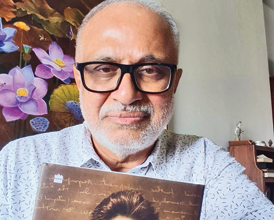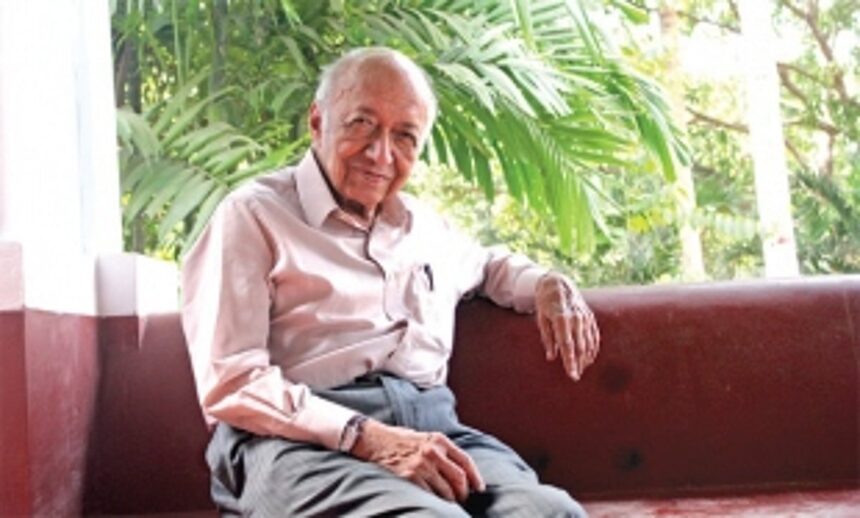
A sharp, intelligent man brimming with
knowledge and warmth… is the first impression
Victor Rangel-Ribeiro makes as he welcomes
you into his home in Porvorim. While delighted
to show us around the palatial Indo-Portuguese
villa, with its sprawling garden, spacious rooms
and even a secret hiding chamber called ‘buniyar’
below a cupboard in one of the bedrooms, Victor
is content living in an outhouse connected to the
villa where he has cupboards full of books and a
faithful computer for company. Victor now lives
in New York, USA with his children, Eva and Eric,
and five grandchildren, but he visits Goa every
year and wants to help his family bond with Goa.
Born in Goa in 1925, Victor started his
working life as a schoolteacher in Bombay before
moving to journalism. He first worked with the
National Standard (now known as the Indian
Express), the Times of India and the Illustrated
Weekly in India. In 1956, he moved to the USA
with his wife, late Lea. There he completed
his masters from Teachers College, Columbia
University. He also conducted classical music
concerts and was the director of the New York
Beethoven Society. He continues writing and his
first book was ‘Tivolem’, which was awarded the
Milkweed National Fiction Prize.
He will be releasing two new books in June
this year. “I just received the copies of my book,
‘The Miscreant, Selected Stories 1949-2016’,
which is a collection of fiction stories. I began
writing in 1945, when my stories started getting
published. Some of the stories in the book are
from 1949 while some, like ‘Dear J.C’, are newer.
The book has short stories, some about Goa,
Goans and Goans who lived overseas. The book
was not planned but I wanted to collect some
parts of my life. So when I turned 91, I thought it
was time to put it all together,” he says.
The second book is ‘F N Souza, The Legend,
The Myths, The Facts’, which will be released
on June 18, 2017. Though Victor and late artist
Francis Newton Souza met in America, they
practically lived next door in Saligao as children.
“There are stories that came up about him even
when people were writing about his death. His
friends who knew him, said the wrong things.
I met Souza in New York and we became close
friends; I got a lot of letters from him. He was a
lovely person but he could flare up at any time.”
The chapters of the book will focus on Souza’s
life in Goa, Bombay, London, New York and his
marriages to Maria Figeuirdo, Liselotte de Kristian,
Barbara Zinkant and his partner Srimati Lal.
With a career in journalism that spanned over
six decades, Victor has witnessed a lot of changes
in the way a publication and its reporters work.
“There are jumps in some ways and I also see
some phrases coming in that seem strange,
like the word ‘upgradation’ instead of ‘upgrade’.
These are tics that come into one’s writing that
really shouldn’t be there,” explains Victor.
Going back to the days when he was a music
critic for the New York Times, Victor reminisces,
“In the New York Times building has multiple
floors. Every day, on the main floor, there was a
raised section and there would be a man sitting
with the paper and a red pen. He would be
marking missing commas, wrong spellings and
mistakes in red ink. It was very rare to pick up the
Times and see blunders. Now, there are blunders
everywhere because that tradition has gone.”
His advice for young writers is: “When you are
beginning, the first thing that you write is good.
But it is only when you are writing for a long time
that you realise how to change, and improve. A
single word can make a difference and ten words
can make a bigger difference. So what appears
finally is very different from the first copy.”
Speaking with Victor, we realise that there are
no limitations for a writer. He says, “I can keep on
writing till even 2am. In fact, an idea that could
change the story could come to me in the middle
of the night, while I’m asleep. Hence I always
keep a pen and paper at hand. With practice, you
learn to write in the dark.”
‘Kala Vichaar: Dialogues on Contemporary
Art’ will have a comprehensive dialogue between
Victor Rangel-Ribeiro and Jugneeta Sudan, who
will explore the artistic practices of the Bombay
Progressive Artists Group, at 6pm on April 21,
2017 at Museum of Goa, Pilerne