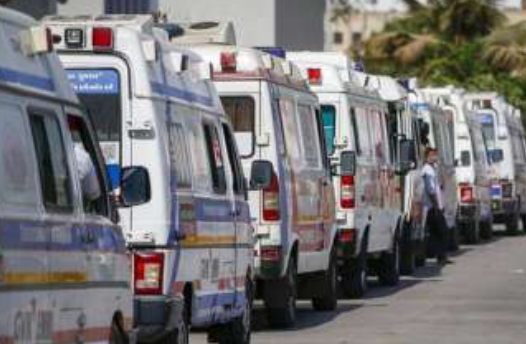
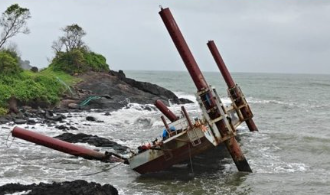
With deterio rating road conditions and rising emergency response challenges, the critical role of ambulance drivers has come under the spotlight. Emergency medicine ex pert Dr. Jorson Fernandes has raised serious concerns over the lack of specialized training for ambulance driv ers in Goa, stressing that un qualified drivers are putting patient lives at risk — even before reaching the hospital. Citing a recent incident at Socorro-Porvorim, Dr. Jorson recounted how an ambulance transporting a patient from Mapusa District Hospital to Goa Medical Col lege (GMC), Bambolim, over turned while attempting to navigate a road riddled with potholes and loose gravel. The vehicle hit a divider and toppled on its side. Fortu nately, only minor injuries were reported, and heavy traffic was absent at the time — what Dr. Jorson described as “sheer luck.” “This was a close call. The ambulance driver was un able to control the vehicle due to poor road conditions and lack of proper naviga tion skills. It’s time we stop treating ambulance drivers like ordinary heavy vehicle operators. They are an es sential part of the emergen cy response team and must be trained accordingly,” said Dr. Jorson. He emphasized that am bulance drivers need far more than a standard driv ing license. “In other coun tries, they undergo rigorous training and are assessed for decision-making, interper sonal skills, and emergency preparedness. Here, there is no focus on aptitude, emer gency procedures, or soft skills,” he noted. Dr. Jorson called for the mandatory implementation of the Emergency Vehicle Operator Course (EVOC) — a globally recognized train ing that equips drivers with skills in safe emergency navigation, understanding siren protocols, handling stretchers and spine boards, basic life support (BLS), car diopulmonary resuscitation (CPR), and assisting EMTs. He stressed the importance of knowing how to position the ambulance at accident scenes, navigate GPS sys tems, use proper lifting tech niques, and remain calm un der pressure. He also raised concerns about the common miscon ception that ambulances are allowed to violate traffic rules. “Ambulances have the right of way, not the right to violate,” he stated. “Red signals can only be crossed when a traffic officer is present and has cleared the route. Hospitals have the au thority to alert traffic police in advance, much like VVIP convoys or fire brigades, to ensure smooth passage.” Dr. Jorson further high lighted how the road from Panjim to GMC Hospital, particularly during peak hours, can become a “death trap” for critical patients. Congested traffic, crumbling infrastructure, reckless driv ers, and lack of dedicated emergency lanes often delay life-saving care. He stressed the need for better traffic engineering, improved road discipline, and dedicated trauma lanes. He also reminded author ities of the “Golden Hour” protocol — the interna tionally accepted standard that demands emergency help reach a critical patient within 10 minutes. “The first hour after trauma is vital. Quick intervention can dra matically improve survival and recovery,” he said. In addition, he empha sized the importance of proper sanitization of ambu lances after each use, along with replenishing emergen cy equipment and dispos ables to prevent cross-infec tion between patients and staff. “Ambulance drivers must be skilled, not just licensed. They are the first link in the chain of survival. Without proper training and infra structure, we’re compromis ing lives that could be saved,” Dr. Jorson concluded, calling for urgent reforms in the re cruitment, training, and op eration of emergency trans port services in Goa.
Dr. Jorson Fernandes Highlights Risks of Untrained Ambulance Drivers in Goa