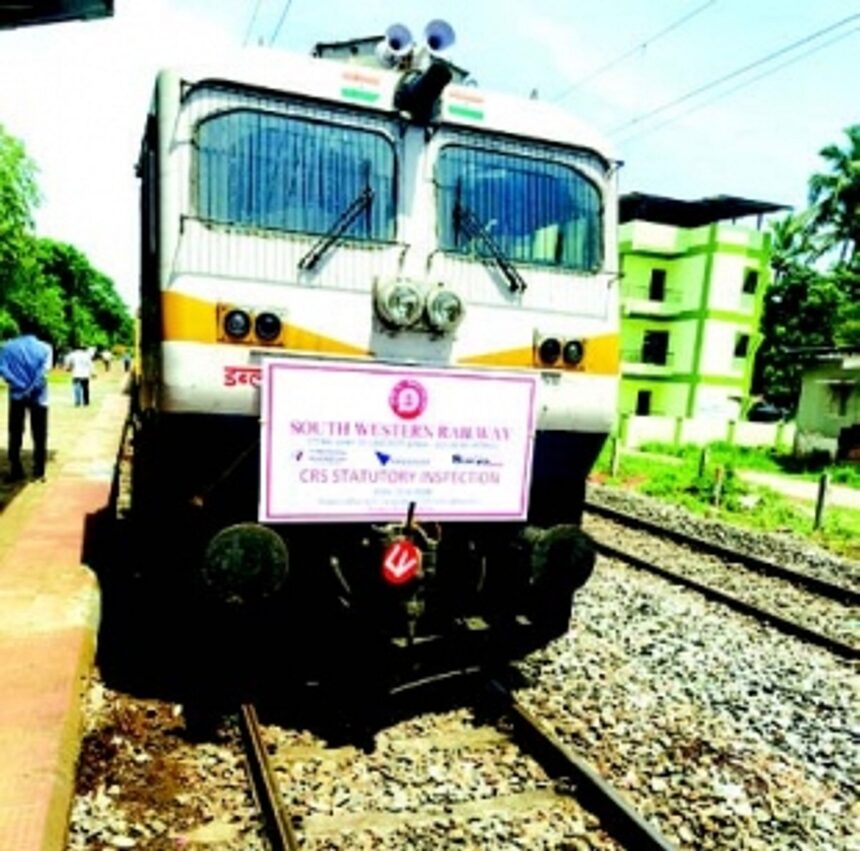
MARGAO: After conducting a successful speed trial run on the newly laid second track of the Majorda-Cansaulim segment of the South Western Railway (SWR) by the Commissioner of Railway Safety (CRS), this new 4.5 km-long double-tracked Majorda-Cansaulim section became operational immediately.
This section forms part of the Hospet-Hubballi-Tinaighat-Vasco double-tracking project.

According to a senior railway official, the train achieved a speed of 108 kmph during the trial.
Following the inspection, CRS approved the standard sectional speed on the new Majorda-Cansaulim section.
With this, this track has been commissioned and thrown open for both passenger and cargo goods traffic, said senior railway officials.
“Amravati Express was the first train to pass along the new double track,” the official added.
It is pertinent to note that this development marks the third partial double line stretch to be commissioned in Goa.
The statutory inspection of the new double line and trial was conducted in the presence of CRS Southern Circle A M Chowdhary; SWR Chief Administrative Officer (CAO) Construction Ram Gopal; Rail Vikas Nigam Limited (RVNL Principal Executive Director (PED) Saroj Patra; SWR Additional Divisional Railway Manager (ADRM) S K Verma; RVNL Chief Project Manager (CPM) A K Patil; and RVNL General Manager (GM) S B Sahoo.
The SWR had earlier inaugurated the 15.2 km double-tracked Margao-Chandor-Sanvordem section on October 10, 2021, marking it as the first functional stretch along the Hospet-Hubli-Tinaighat-Vasco doubling-tracking project in Goa. During the speed trial of Margao-Chandor-Sanvordem conducted in September 2021, the train reached a speed of 124 kmph.
Thereafter, on March 11, 2024, SWR had commissioned Kalay-Curchorem (Sanvordem) segment after a successful speed run was conducted on this stretch where the test train achieved a speed of 100kmph during the trial.
The commissioning of the third partial double line is expected to enhance train mobility, according to railway officials. Additionally, recent infrastructure developments that were sanctioned by the Centre further contributed to the project’s progress.