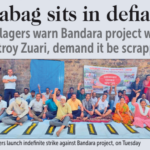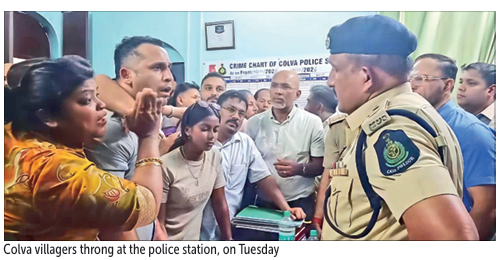
Tension gripped Colva on Tuesday as hun dreds of villagers gathered outside the Colva Police Station, protesting against the local Police Inspec tor (PI) over allegations of intimidation, abuse of authority and assault of a local fisherman and his family. The flashpoint was the PI’s alleged visit to the Colva Church, accompanied by a heavy police contin gent, in connection with a controversial land dispute — a move residents say was neither communicated nor justified. The incident is linked to a long-running dispute over alleged illegal construc tion on land belonging to traditional fisherman An tonio Rodrigues. Villagers warned that they would launch a massive agitation if illegal construction was not stopped and officials held accountable. According to residents, the police visit to the Church deeply hurt reli gious sentiments and trig gered widespread anger within the local Catholic community. News of the visit spread rapidly across Colva and neighbouring areas, prompting villagers to assemble in large numbers at the police station de manding accountability, a public apology and the im mediate transfer of the PI. It was also brought to no tice that the PI had visited the Church earlier over the same land issue.
Under mounting pressure, the inspector later tendered an apology. Protesters alleged that the manner of the police visit was intimidating and disrespectful. “The Church is a place of worship and peace. When po lice enter with force, it creates fear and sends the wrong message,” said a villager present at the protest. Another resident said the action had shaken trust be tween the police and the local community. “We respect the law, but the law must also respect our institutions and sen timents,” he added. Anger intensified further after villagers alleged that Rod rigues and his family had been threatened and assaulted by the police in connection with the land dispute. Protesters demanded immediate action, including registration of an FIR against the concerned police personnel. The large-scale protest drew the attention of senior po lice officials, with South Goa Superintendent of Police San tosh Desai personally arriving at the Colva Police Station, accompanied by Deputy Superintendent of Police Siddhant Shirodkar. A heavy police presence was maintained in and around the area as a precautionary measure. Despite the tension, the protest remained largely peaceful, though traf fic in the vicinity was temporarily disrupted. Local MLA Venzy Viegas and local leader Warren Alemao joined the protest, extending support to the villagers. Ad dressing the gathering, Viegas alleged that the PI had be haved rudely with citizens and demanded that an FIR be registered against him for abusing a resident. Viegas also raised serious concerns over land allegedly belonging to local fishermen, claiming it had been illegally converted and allotted to a private party by the Town and Country Planning (TCP) department. “Construction is being carried out on converted land, which is wrong. We want peace in the constituency, but il legalities cannot be ignored,” he said. Following prolonged discussions, SP Desai assured the villagers that Colva PI Vikram Naik would be transferred and replaced, and that an inquiry would be conducted into the allegations. The assurance brought temporary calm, though residents warned that the agitation would intensify if promised action was not implemented. The unrest is rooted in a formal complaint lodged by Antonio Rodrigues, who alleged that he was violently at tacked and threatened by a developer and his associate over access to his property. According to Rodrigues, the incident occurred on January 30 at around 8.40 pm when he attempted to enter his land bearing Survey No 76/3 in Colva. He alleged that developer Subhrangshu Gupta and his associate Ajay blocked his entry and assaulted him, adding that he was rescued by women residents of the locality who witnessed the incident. Police Inspector Vikram Naik was reportedly present at the site. Rodrigues stated that he had been unwell in recent months and alleged that the developer took advantage of his condition by fencing the property in a manner that landlocked his land. As a traditional fisherman, he uses the land to store essential fishing equipment. “I was entering my property peacefully, as I do every day with my family, when suddenly they blocked me and attacked me,” he said in his complaint. He also cited a history of disputes over access, stating that the Village Panchayat of Colva had issued a Stop No tice against the developer after he raised complaints of obstruction. Rodrigues has sought registration of an FIR for assault, intimidation and obstruction of lawful access, along with police protection for his family. Police confirmed receipt of the complaint but declined to clarify whether an FIR had been registered. The Colva unrest has also brought renewed focus on re sistance in Ward 3, where residents have mobilised against a proposed project by a Delhi-based builder planning to con struct 10 villas. Villagers argue that the ward falls under the Coastal Regulation Zone (CRZ) and is officially designated as a fishing village, making such development impermissible. “We do not want such projects in our village. This is a traditional fishing community, and any large-scale devel opment will disrupt our livelihoods and the local environ ment,” residents told the media. Villagers further alleged that despite a Stop Work Order issued by the Village Panchayat, construction activity con tinues, claiming police support for the builder. “Villagers are deeply concerned that the project could set a precedent for further encroachments in the CRZ and threaten the community’s traditional way of life,” said a resident. Another added, “We are ready to approach the courts if necessary to protect our land and ensure that the law is upheld.” Residents have vowed to continue their agitation until construction is halted and CRZ regulations strictly en forced, calling for accountability from authorities and greater sensitivity in policing matters involving tradition al communities, religious institutions and environmental safeguards.