Dolcy D’Cruz
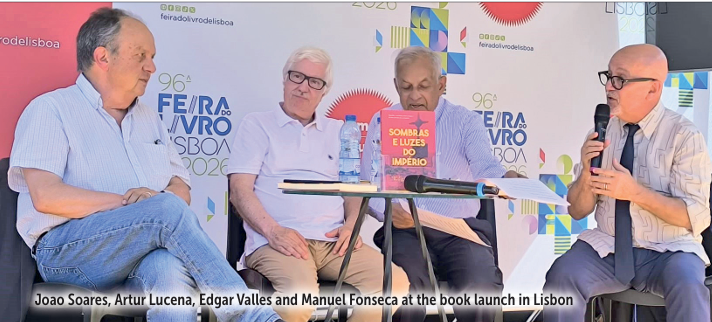
What was life like in Angola during the 1950s and 1960s, and in Portugal during the 1970s? Were Goans able to live without experiencing racism or discrimination? Could people openly use nicknames? And how much importance was placed on education during this period? Of Goan origin, Edgar Valles’ life has taken him across three continents. He was born in Angola in 1953 and has lived in Portugal since 1970, where he took part in the anti-fascist struggle against the dictatorship. Besides being a lawyer by profession, he has worked as a journalist and is the author of 19 books. His new book in Portuguese, ‘Sombras e Luzes do Imperio’ was recently released in Lisbon in June and now its English translation by Aren Noronha, ‘Shadows and Lights of the Portuguese Empire’, published by Edicoes de Goa, 1556, an imprint of Goa 1556, will be released today, August 27 at Fundacao Oriente, Fontainhas at 6 pm.

The writing in ‘Shadows and Lights of the Portuguese Empire’ is presented in a witty, humorous, and anecdotal style, blending historical recollection with personal storytelling. Rather than placing himself at the centre, Edgar acts as a chronicle, recounting real experiences from Goa, Angola, and Portugal during the final years of the Portuguese Empire. The short stories spanning just 3-4 pages each are engaging, using irony and humour to reveal the contradictions of colonial society, political repression and everyday life under the Portuguese dictatorship. ‘Shadows and Lights of the Portuguese Empire’ brings together 34 short essays set against the backdrop of Goa, Angola and Portugal in the years leading up to the Carnation Revolution of April 25, 1974. Edgar deliberately keeps himself away from the centre of the narrative. “I had the privilege of being in three continents and of having seen and participated in many different situations. The 34 stories are a kind of life, where I am just a person who is not the central actor. I just tell what I saw,” says Edgar, who was the president of the Board of Casa de Goa (Portugal) from 2014 and 2017. The stories move between the Portuguese colonies and Portugal and are told with a mixture of history, observation, wit and humour.
Alongside lighter episodes are accounts of political activism, colonialism and the struggles surrounding the Estado Novo dictatorship in Portugal. He says, “The moves from one continent to another gave me the sense that we must fight against chauvinism and conservative nationalism. We are citizens of the world and we need to have a broad mind, to tolerate the others. Being a Goan, I am also a Portuguese and so I realize there are good and bad things in each country and in Africa also.” The central idea of the book is that change, however difficult, is unavoidable. “The central message is that changes are essential for the life of people, even if they harm a section of the people. It is not possible to please everybody. We have resistance to changes, but changes are essential,” he says. Among the essays closest to him are two episodes that reflect different aspects of his experiences. He recalls, “I especially like the short story of Jawaharlal Nehru on a beach of Angola, because it shows how people who are not politically educated can believe in all nonsense and also be manipulated. An also our trip from Angola to Goa, in 1956, when we were prevented in South Africa, in the apartheid regime, from staying in a hotel for whites.” Edgar has also beautifully inserted wise letters from his family archives that are worth reflecting upon especially as they were written in the 1950s and still have the same value today.
Speaking about his first reaction on discovering them, he says, “My first reaction was the surprise to see how well written the letters were and also emotional because it was as if those who wrote the letters were still alive, as the letters give good advices. I selected the letters which gave advices that are still valid, like the one that says that a daughter, who was a doctor should work, instead of asking money from her parents,” he informs. The book also reflects on Edgar’s experiences as a young student and political activist in Portugal before the 1974 revolution. “The book ends on the day of the revolution, April 25, 1974, because this day is the end of the oldest fascist regime in Europe, the day of democracy, decolonization and development in Portugal. I am preparing a new book with short stories beginning with the new regime and covering also the three continents,” he explains. The preface of the book is written by Joao Barroso Soares, the son of Mário Soares, ex President of Portugal, who signed the treaty with India recognising Indian sovereignty over Goa.
Through the book, he also distinguishes between the Portugal of the dictatorship and the democratic country it became after 1974. “I would like readers to realize that Portugal of today has nothing to do with the Portugal their ancestors knew. People are still friendly and different from British and other Europeans. Goans liked the Portuguese because they considered Goans as equals. But the regime was a colonialist regime and also a fascist regime. Now it is a democracy. I would like to believe that there is no sense in being against the improvement of relations between Goa (India) and Portugal,” he explains. Looking back, he believes that generation’s experience carries an important lesson for young people today, democracy cannot be taken for granted. “The new generation must realize that the freedom and democracy they now enjoy is the consequence of a hard fight and so they must also fight to preserve and improve democracy. By nature, young people are generous and they must keep generosity and change the world for better,” he advises. As the Portuguese edition of the book was released earlier, Edgar says that it is very important for an English edition for a wider readership. The English edition allows the book to be read by many people who cannot speak Portuguese. “I hope the publisher will do an e-book, so that people in Diaspora may buy the book and read it.
Aren Noronha, who has translated the book, has done excellent work. He is a young man with a bright future. His father must be proud of him. It was not easy to translate the book,” he adds. Though living in Portugal, his relationship with Goa also deepened over the years. As the former president of Casa de Goa in Portugal, where he worked to strengthen links between the Goan community in Portugal and Goa. “We organised in 2017 a conference in Lisboa about ‘Goa Sustainable Development’ and I personally gave the conclusions of the Conference to Chief Minister Parrikar, in Goa.
When I was young, I didn’t feel as a Goan, but mainly as an Angolan. Then as Portuguese. Now I feel myself Goan, Portuguese and in a certain way Angolan, by this order.” After decades in Portugal, Edgar’s idea of home remains divided between the two places that have become central to his life. “When I am in Portugal, home is Portugal, home when I am in Goa, home is Goa. It is a strange sensation. I feel at home in both lands. Portugal is a nice country. Goa is also a nice land. I feel sorry because many Goans are always criticising the changes in Goa and are not able to see that the whole world is changing,” concludes Edgar, who will be at the book launch today.