BLAISE COSTABIR
“The question is no longer whether our youth are frustrated. The question is wheth er they are willing to step forward and be counted.” I wrote these words in the closing para graph of my June 2026 OpEd in O Heraldo. They have answered my question. I salute the youth, or Gen Z, as they are now famously called. They did not just step up; they stepped up and forced the es tablishment to take no tice. It was not easy. There was a lot of pain, hard ship and ridicule. They braved it all, including lathis — not any lathis, but ones with nails. Pellet guns were used, causing severe injuries. Questions remain over who authorised the use of force. This grassroots mobi lisation, based on a call given by Abhijit Dipke, founder of the satirical Cockroach Janta Par ty (CJP), who returned from the US where he was studying, repre sented a seismic shift in political engagement. It was driven by a raw, unscripted conviction that defied the tradi tional mechanics of In dian political protests.

The CJP’s emergence and rapid growth are well documented. It be gan as a satirical online response to the contro versy surrounding the Chief Justice’s remarks about unemployed youth and subsequent ly became a national youth protest move ment. These young protest ers were not motivat ed by the promise of ABC, alcohol, biryani and cash. Rather, they were fuelled by a sense of existential urgency and armed with digital connectivity. They de manded the resignation of Education Minister Dharmendra Pradhan following the NEET fi asco. While their parents watched the news with a mixture of anxie ty and bewilderment, this generation used encrypted messaging groups and social me dia threads to coordi nate logistics, share legal-aid resources and livestream the ground reality to a global au dience, bypassing the now-famous godi me dia.
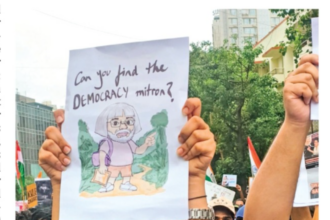
The air at these gath erings was filled with the creative energy of handmade placards, impromptu slam poetry and a brand of patriotic dissent not seen before. Those who could not reach Jantar Mantar started protest sites across the country, and every site was well at tended. The problem was real, and so was the anger at the apathy being displayed openly. Beyond the physical bruises, a psychological war erupted in the dig ital trenches. A section of the media sought to portray these protest ers as misguided pup pets or, worse, profes sional agitators. They dissected every social media post, looking for a slip-up, a single stray word that could be twisted to fit a narra tive of foreign interfer ence or funding. The students coun tered the media nar rative simply by being present, transparent and peaceful. The es tablishment had tried to treat the protest against a system — in this case, education — like a minor riot, fail ing to understand that these young men and women were demand ing better policies, not just lip service. The minister re signed, saying he was doing so to protect youth from anti-nation al forces. The irony of this defensive posture was not lost on the pub lic.
A minister tasked with the stewardship of the nation’s educational system chose rhetoric over accountability. By framing his departure as a heroic sacrifice against a shadowy ene my, Pradhan attempted to pivot from questions of administrative ac countability to those of a beleaguered patriot. The narrative of “pro tecting Gen Z” rings particularly hollow when one considers the psychological and financial toll inflicted on students who spent years preparing for a fair competition, only to find the playing field tilted by corruption. This diversionary strat egy seeks to polarise the discourse, suggest ing that any criticism of the government’s com petence is somehow an alignment with subver sive forces. In reality, the most significant threat to national progress is not external but inter nal: corruption, both moral and financial. As the dust settles on this resignation, the focus must shift from politi cal posturing to a diag nosis of the leadership that failed its stake holders. Can a generation that has discovered its polit ical voice turn that en ergy into sustained civic engagement without be coming just another po litical party? They have shown that they do not need power to influence power. Dipke made a reel asking the PM to ad dress Gen Z and outline his plans for them.
In his Independence Day address, Prime Min ister Narendra Modi placed India’s youth firmly at the centre of the country’s ambition to become a developed nation by 2047. He promised greater access to resources for their ideas, innovation and entrepreneurship. He also promised AI skill ing for young people and free online coaching to prepare youth for a rapidly changing econ omy. His message to the young was therefore both an invitation to participate and a re minder of the bounda ries within which that participation is expect ed to operate. Does Gen Z have the ear of the government? Because, in the same breath, he also said, “Hathiyaarband Naxal to chale gaye, lekin ye dimaagi Naxal mauke ki talaash mein hain,” and that such elements have to be identified and iso lated. If young people are en couraged to think inde pendently, innovate and challenge established systems, where does le gitimate dissent end and “anti-national” thinking begin? Time will tell. For now, Gen Z has made us proud and given us hope. (The author prefers to write rather than chat in a balcao.)