BY INVITATION Vivek Menezes
Manohar Parrikar ushered Narendra Modi to power with his famous 2009 comments about L K Advani, the main other contender for BJP leadership at the time: “It is like a pickle which takes a year to mature. But if it is kept for two years or so, it gets rancid. Advani’s period is more or less over … another couple of years … and after that he should act as a guardian or mentor for the party. [We] should give prominence to leaders who are between 40 and 60 years.” The master politician, whose oversized shadow still looms over Goa in 2024, seven years after his 2019 death, would have surely had an equally choice analysis to offer his party and avowed brother-in-arms today (notice how Modi is now 73) as they continue to struggle and fail, again and again, in comprehending the obvious winds of change in Indian politics.

Parrikar was highly skilled at reading the electorate, and keeping people with him by telling them exactly what they wanted to hear, but those he left behind have no such abilities. Instead, emboldened by impunity, they have bullied and blundered, exposing their incessant crimes and utterly alienating their constituencies, so that states like Goa (where the BJP has ruled since 2014) are mired in an extraordinary collapse of confidence in democracy itself. Voters no longer believe their elected officials work for their interests, and those suspicions are confirmed every day with additional news of diabolical atrocities, more shamefully wasted funds, with an array of crooks getting away with unspeakable crimes. But while the people have kept scanning anxiously the horizons for someone, anyone, to come in strong to help clean up the system, it turns out hope was dawning in their own homes instead. With terrific inspirational power, the youngest generation of Indian voters has suddenly made its presence felt, and showed its mettle on the streets and on social media, while amply demonstrating it will not accept the same old degraded status quo their elders survived in abject silence. History has already turned decisively in their direction.
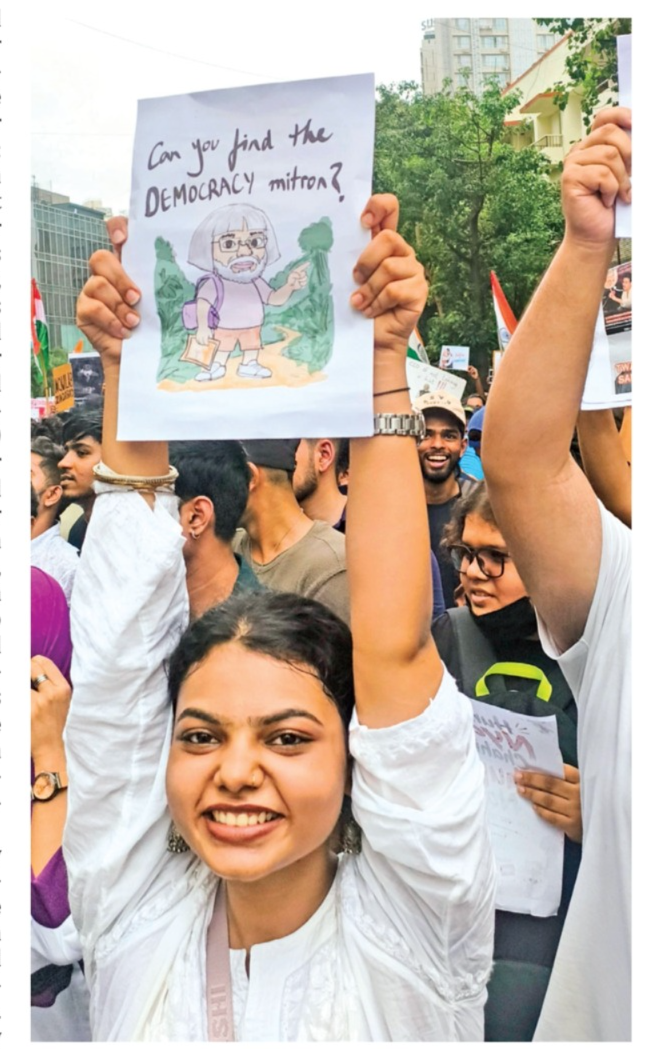
Just look at what happened in a single evening earlier this week after the chronically high-handed chairman of the Bar Council of India (BCI) Manan Kumar Mishra issued an official order barring all 2026 National Academy of Legal Studies and Research (NALSAR) graduates from enrolling as advocates in any state bar council, as a kind of collective group punishment (pending investigation, and individual retributions) for protesting the Chief Justice of India Surya Kant Yadav’s selection as the chief guest for their graduation ceremony. The students objected because of the CJI’s dismissive comments that had provoked, and later further stirred, the sweeping Cockroach Janta Party (CJP) protests last month, which resulted in the stunning resignation of Education Minister Dharmendra Pradhan, an unheard-of reckoning and admission of failure that has never happened before from the current dispensation.
Just an hour after this news hit the internet, the CJP founder Abhijeet Dipke took notice on Twitter (it was 6.26pm), and another hour later at 7.34 pm the CJP co-convener Saurav Das tweeted his own statement saying that Mishra’s actions were “grossly disproportionate, deeply troubling, and prima facie indefensible. Students cannot be collectively penalized for expressing dissent over a ceremonial invitation. If the BCI does not withdraw this order immediately, then all law students, advocates, senior lawyers, and well-meaning young cockroaches will protest outside Bar Council’s office and Mishra’s official residence, and their respective states. [His] accountability will be fixed.” Astoundingly, just ten minutes after he pressed send, Mishra himself responded directly to Das that his order was cancelled, and the BCI’s statement to that effect came out at midnight.
All this is completely unprecedented, but even more amazing was how Dipke, Das and their CJP cohorts refused to be mollified, did not back off even an iota, and have proceeded to parade Mishra’s shockingly abysmal record of sycophancy, pliancy, and nonstop dubious dealings to an appalled public. Previously effectively unassailable – he has been chairman of the BCI since 2012 and after (quite outrageously) invoking Modi as “Mahatma Gandhi reborn” in 2016 has won seven consecutive terms – but now Mishra became obsolete. Literally overnight, amidst an overwhelming chorus of calls for his resignation. Prashant Bhushan went one further (and it would be foolhardy to bet against his prediction) saying “apart from the absurdity of this fellow Mishra’s initial order (that no students of Nalsar of 2026 will be enrolled by the BCI) or the absurdity of the modified order of seeking disciplinary action against protestors [since when BCI has no jurisdiction], I can bet that there was no proper meeting of BCI before his first or second order. This fellow feels that he can act like a dictator, because he has the system under his control. This fellow’s place is in jail.”
Mishra will go, and if he has not done so by the time you read this, it will happen soon. But what about the man he addressed in an excruciatingly fawning 2016 public letter as “my lord” (8 times), “our guardian, our guide” and “the most efficient and able leader of the world” while promising “Bar Council of India is your institution”? Does the prime minister realise just how comprehensively young Indians have turned against him, and there is no longer any possibility of respectable recovery from this degree of ridicule? We all know the BJP controls the crucial levers of the state, and can win elections almost anywhere, but even that is not enough to turn back the clock, or dismay the gallant cockroaches. Make no mistake, change has already come, and the future is now. Either the BJP leadership and its legions of supporters around the country will prove intelligent enough to understand how and why India’s political mood has irrevocably shifted against the status quo, and switch up what they have to offer at the top (which goes beyond the PMO) or their time is up. One thing for sure, Parrikar would have recognised it.
(Vivek Menezes is a writer and co-founder of the Goa Arts and Literature Festival)