Dolcy D’Cruz
St Lawrence, one of the early Christian Church’s most revered martyrs, served as one of the seven deacons of Rome under Pope Sixtus II. He was among the Christians put to death during the persecution ordered by Roman Emperor Valerian in 258 AD. In Goa, the feast of St Lawrence is observed every year on August 10, with centuries-old traditions and religious celebrations marking the occasion. As every year, two prominent churches in Bardez and Tiswadi will come alive with festivities as the faithful gather to honour the martyr and seek his intercession.

St Lawrence Church, Sinquerim
The Feast of St Lawrence will be celebrated at St Lawrence Church, Sinquerim with Masses at 6 am, 7.30 am, 9 am and 10.30 am, with the solemn Mass at 10.30 am to be followed by the traditional procession and blessing of the sea. An evening Mass will be celebrated at 4 pm. Parish priest Fr Milchester Furtado says that this year’s pastoral theme for the feast is ‘Abide in Me.’ “The celebrations will focus on seeking the intercession of St Lawrence and following in his footsteps to become better Catholics and Christians and to live more closely according to the teachings of Jesus,” says Fr Milchester, who will celebrate the 6 am Mass.
“Fr Agnel Fernandes, the former parish priest, will celebrate the 7.30 am Mass. The 9 am Mass will be celebrated by Fr Gabriel Fernandes, Provincial of the Capuchins. The 10.30 am solemn Mass will be celebrated by Fr Leenoy Dias, Secretary at the Secretariat for Confraternities/Fabricas/ Cofres (Seccao das Confrarias) at Archbishops House. The 4 pm Mass will be led by Fr Valerian Ferrao,” informs Fr Milchester.
Dom Miguel de Noronha, the 4th Count of Linhares and Viceroy of Portuguese India, ordered and financed the original chapel of St Lawrence at Sinquerim in 1630. It was handed over to the Franciscans in 1636 and elevated to the status of a parish in 1688. Before that, residents of Sinquerim had to attend church in Candolim.
Adolfina Thamma, a great-granddaughter of one of Sinquerim’s village families and a traditionalist, is committed to preserving the rich history and heritage of the church and passing it on to future generations. She informs, “The church has a rare architectural feature known in Portuguese as an ‘alpendre’, a balcony above the main façade. In the case of St Lawrence Church, its location was also significant as it was a strategic and vigilant point from where the Viceroy could look out towards the Arabian Sea, particularly as it was situated at the mouth of the Mandovi River. Another distinctive feature of the church is the presence of angels surrounding the front compound, beneath which are niches known as ossuaries, where the remains of deceased parishioners were placed. No other church in the entire state has angels surrounding the front compound in this manner. Each niche has an angel with joined hands, symbolising protection and the safeguarding of the soul in a prayerful manner.”
The statue of St Lawrence is depicted holding a boat in one hand. He is also traditionally invoked by cooks and childless couples. “Many people come with special intentions connected to these professions and circumstances. Cruise-line workers, those employed on ships, fishermen and childless couples are among those who particularly observe the feast,” she says.
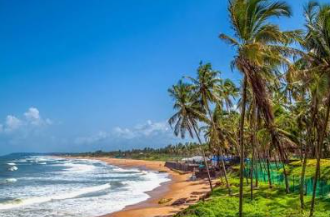
Today, the blessing is conducted from the bandstand, but the tradition was once carried out from a boat. She explains, “Until around the mid-20th century, according to what our elders have told us, whoever was the official present, whether the Viceroy, Governor or another dignitary, would accompany the priest in a boat. A rope was stretched across from Aguada towards Dona Paula. Prayers were offered and, after the ceremony, the official would cut the rope with a knife or sword. This was followed by a gun salute, with cannons being fired to announce the opening of the Aguada sandbar.”
The opening of the sandbar traditionally marked the beginning of the fishing season. Fishermen would still not venture out until the following day. A Mass would be offered on August 11, a tradition that continues even today.
St Lawrence Church, Agassaim
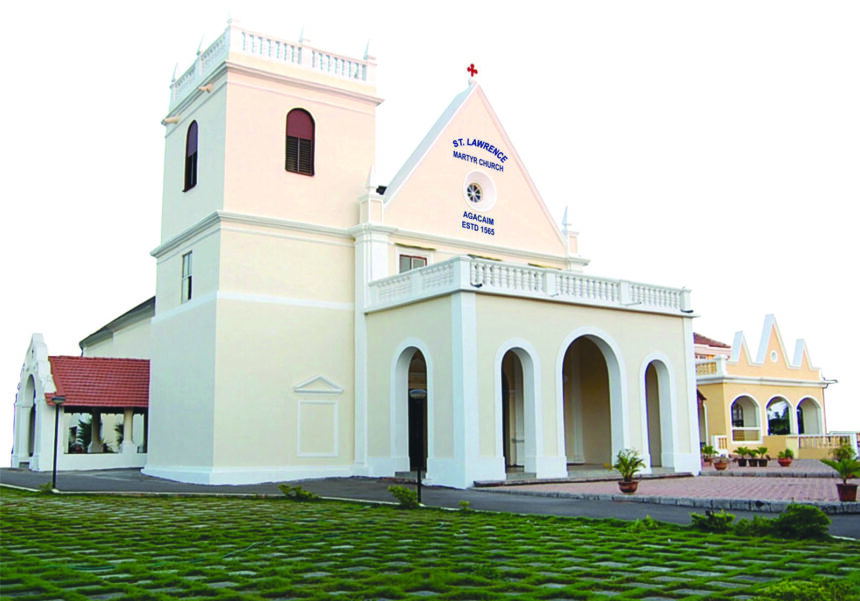
Agassaim was once a significant crossing point, with boats carrying people and goods between Tiswadi and Salcete travelling through the Agassaim–Cortalim route. The church’s elevated location therefore offered a commanding view of the surrounding area and the river. Perched on a hillock overlooking the Zuari estuary, St Lawrence the Martyr Church, Agassaim, was originally a small chapel built before 1541. The Agassaim Chapel was replaced by a new church built by Jesuits in 1565 and enlarged within the next eighty years. Vestiges of the primitive Agassaim chapel can be seen on the northern side of the present church. The bell of the Agassaim church was acquired from the Chorao seminary in 1871.
The Feast will be celebrated at St Lawrence Church which was built in 1565 by the Jesuits on the hillock overlooking the village. Two Masses will be held today, 6.30 am and 8.30 am. “The High Mass will be celebrated at 8.30 am with Bishop Alwyn Barretto, Bishop Emeritus of Sindhudurg, as the main celebrant. The theme for this year’s feast is ‘Bhag Lawrensachem Jivit Gheun, Jezunt Jieum-ia’ (‘Taking the life of St Lawrence as our example, let us live in Jesus’),” informs Fr Ronaldo Fernandes, assistant parish priest of St Lawrence the Martyr Church, Agassaim.
In the evening, the celebrations in the village will shift to Dugrem, Agassaim where the Young Stars of Dugrem will be celebrating their 53rd All Goa Coconut Breaking Contest and Cultural Festival, which is known for the famous All Goa Coconut Breaking contest. The evening will continue with a Konkani tiatr, ‘Hi Avoi Kosli?’ directed by Sammy Tavares at 7.30 pm in the church hall.