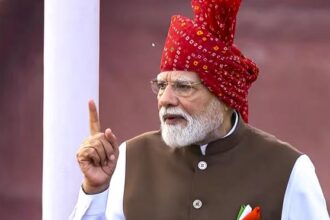
Vande Mataram is in the news as India marks 150 years of the iconic patriotic song. For the first time, the song was sung from the Red Fort during the country’s 80th Independence Day celebrations on August 15, 2026.
Parliament recently held a special discussion to mark 150 years of Vande Mataram, with Prime Minister Narendra Modi opening the Lok Sabha debate. The song has played a significant role in India’s freedom movement and has also been the subject of political and religious debates because of imagery in some of its later stanzas.

Origins of Vande Mataram
According to historical accounts cited by the Press Information Bureau, Bankimchandra Chattopadhyay composed Vande Mataram around 1875. The song later appeared in his celebrated novel Anandamath, which was serialised in the magazine Bangadarshan in 1881.
The song presented the motherland as a figure worthy of devotion and gradually became associated with the idea of India as Bharat Mata. Its powerful imagery and emotional appeal helped transform it from a literary composition into a symbol of patriotism.
Vande Mataram and the Freedom Movement
Vande Mataram became particularly influential during the Swadeshi Movement that followed the 1905 partition of Bengal by the British government under Lord Curzon.
The slogan was used during protest marches, boycott campaigns and political meetings. Newspapers and organisations also adopted the phrase as part of the nationalist movement. Its popularity made it a powerful expression of opposition to colonial rule.
In 1906, more than 10,000 Hindus and Muslims reportedly marched together at Barisal while shouting Vande Mataram, reflecting the song’s early role in mobilising people across communities.
Several prominent nationalists, including Rabindranath Tagore, Bipin Chandra Pal and Sri Aurobindo, helped popularise the song.
British Attempts to Suppress It
The colonial government viewed Vande Mataram as a powerful tool of political mobilisation. Authorities attempted to restrict its public use, with students facing punishment and protestors facing police action.
Chanting the slogan increasingly became an expression of resistance against British rule. Its influence also spread beyond India. In 1907, revolutionary Madam Bhikaji Cama unfurled an early Indian national flag at Stuttgart, Germany, with the words Vande Mataram displayed on it.
Role of the Congress
Vande Mataram was closely associated with the Indian National Congress. In 1896, Rabindranath Tagore sang the song at the Congress session in Calcutta, giving it greater national prominence.
The Congress later formally adopted it for use at national events during the Swadeshi era. However, debates over its religious imagery grew in the 1930s.
In 1937, the Congress Working Committee decided that only the first two stanzas should be used for national occasions. Muslim leaders had objected to the later stanzas because of their references to Hindu religious imagery.
Vande Mataram and Jana Gana Mana
At the time of Independence, India had to decide how its national symbols would be represented. On January 24, 1950, Constituent Assembly President Dr Rajendra Prasad announced that Jana Gana Mana would be the National Anthem, while Vande Mataram would receive equal honour and status because of its historic role in the freedom struggle.
| Year | Key Development |
|---|---|
| 1875 | Bankimchandra Chattopadhyay is believed to have composed Vande Mataram |
| 1881 | Featured in Anandamath |
| 1896 | Rabindranath Tagore sang it at the Congress session |
| 1905 | Became a major symbol of the Swadeshi Movement |
| 1907 | Vande Mataram appeared on the flag associated with Madam Bhikaji Cama |
| 1937 | Congress decided to use only the first two stanzas |
| 1950 | Given equal honour and status alongside the National Anthem |
| 2026 | 150 years marked with special events and a Red Fort rendition |
Today, Vande Mataram remains deeply connected with India’s freedom struggle. Its 150th anniversary has renewed discussion about its history, cultural significance and place among the country’s national symbol