As the gala night in Paris draws near, world football finds itself in an unfamiliar yet exhilarating position: there is no undisputed coronation in sight. For well over a decade, the gilded sphere was treated almost as a private affair passed between Lionel Messi and Cristiano Ronaldo. Today, following a breathless 2025–26 campaign defined by Paris Saint-Germain’s second European triumph, fierce domestic title races, and an unforgettable summer World Cup, the debate over who deserves the game’s ultimate individual prize has reached fever pitch.
Before assessing the leading contenders, it is essential to understand the mechanics of how the Ballon d’Or is decided. Organised by France Football, the accolade is voted on by an elite jury comprising one specialist journalist from each of the top one hundred nations in FIFA’s official men’s rankings. Unlike the calendar-year evaluations of old, the award strictly assesses performances across the traditional European season from August to July, encompassing major summer international tournaments. Voters are instructed to weigh three core criteria: individual performance and decisive, spectacular impact on the pitch; team achievements and silverware accumulated across club and country; and finally, class and fair play on the field.

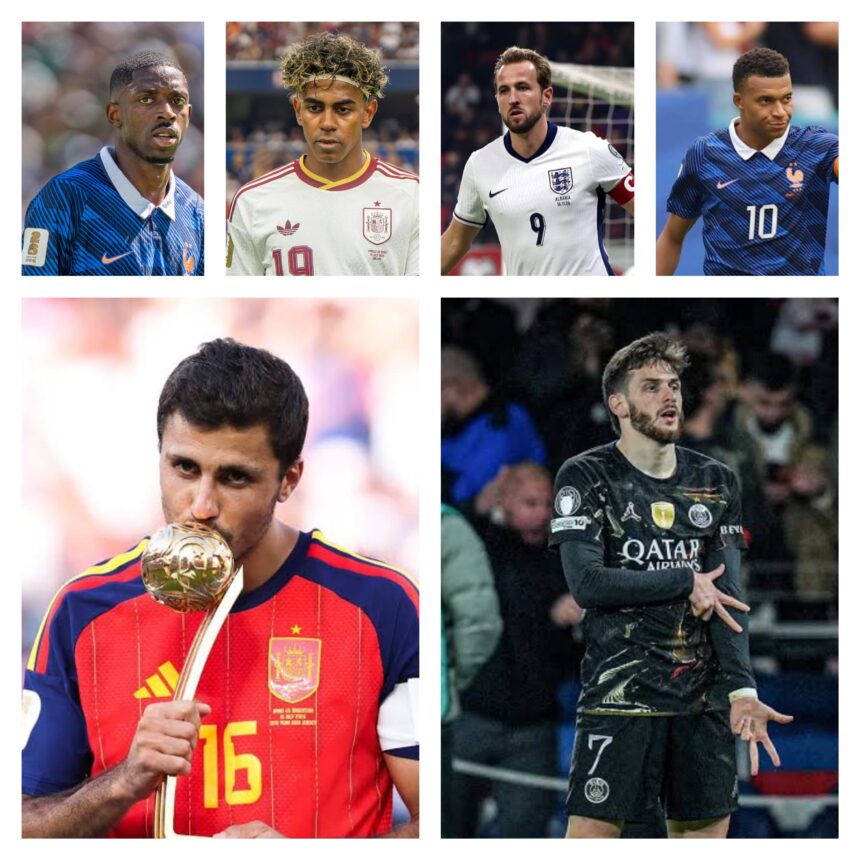
The resulting race presents an extraordinary clash of footballing philosophies. On sheer silverware and continental mastery, Khvicha Kvaratskhelia stands at the forefront. The Georgian winger was the primary catalyst behind Paris Saint-Germain’s second Champions League title, collecting the official UEFA Champions League Player of the Season award alongside a twenty-goal, double-figure assist tally across all competitions. His club teammate, Ousmane Dembélé, also produced arguably the finest and most productive campaign of his career, contributing thirty-one direct goal involvements across PSG’s pursuit of domestic and European honours.
Yet international legacy invariably casts a massive shadow during a tournament year. Rodri once again proved why he remains the planet’s premier midfield general, anchoring Spain to World Cup glory while scooping the tournament’s Golden Ball and maintaining a passing accuracy exceeding ninety-three per cent across the season. Beside him on the international stage, teenage sensation Lamine Yamal tore defences apart, pairing sixteen goals and eleven assists in La Liga for Barcelona with a string of fearless performances throughout the World Cup knockout stages.
At the same time, the sheer weight of raw scoring numbers cannot be overlooked. Kylian Mbappé delivered an astronomical forty-two goals for Real Madrid before plundering ten goals for France on the world stage. In Germany, Harry Kane enjoyed another monstrous campaign for Bayern Munich, netting thirty-six goals in thirty-one Bundesliga outings, while Erling Haaland claimed yet another Premier League Golden Boot with twenty-seven league strikes and thirty-five direct goal involvements for Manchester City.
When the golden envelope is finally unsealed beneath the Parisian chandeliers, the hundred voting journalists will have to settle the sport’s ultimate conundrum: whether to reward the unyielding statistical output of a pure goalscorer, the tactical perfection of a World Cup-winning midfield anchor, or the dazzling brilliance of a European champion.