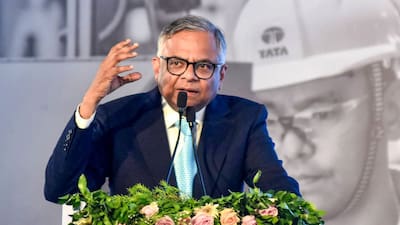
N Chandrasekaran has decided not to seek another term as chairman of Tata Sons, bringing his nearly decade-long tenure at the top of the Tata Group towards an end.
Chandrasekaran informed the Tata Sons board of his decision on Wednesday, August 12, and said he would continue as chairman until his existing term expires in February 2027.

He took charge as executive chairman of Tata Sons on February 21, 2017, after spending nearly three decades at Tata Consultancy Services (TCS). He became TCS chief executive and managing director in 2009 and was reappointed as Tata Sons chairman for a second five-year term in 2022.
His tenure has included several major strategic moves by the Tata Group, including the acquisition of Air India and expansion into semiconductors, electronics, electric vehicles, batteries and digital businesses.
Why Did Chandrasekaran Decide Not to Seek Another Term?
Chandrasekaran said the decision followed a lack of unanimous support for extending his tenure by another five years.
According to his statement, the Sir Dorabji Tata Trust and Sir Ratan Tata Trust had unanimously resolved to recommend a five-year extension. The recommendation was also recorded by the Tata Sons Nomination and Remuneration Committee and the board.
The proposal was placed before the Tata Sons board on February 24, 2026. However, Chandrasekaran said it did not receive unanimous support because one board member opposed the extension.
He subsequently chose to defer the decision. With six months passing without a resolution, Chandrasekaran said the uncertainty could not continue indefinitely, particularly as Tata Sons has several major strategic projects at critical stages.
Chandrasekaran Will Continue Until February 2027
Chandrasekaran’s decision does not amount to an immediate departure from Tata Sons.
He will remain chairman until his current term officially ends in February 2027. This gives the company several months to identify his successor and ensure an orderly leadership transition.
His decision also removes uncertainty over whether he would continue beyond February next year and allows the board to formally begin succession planning.
How Much Did Chandrasekaran Earn?
Chandrasekaran’s remuneration has also drawn attention following his decision.
According to Tata Sons’ FY26 annual report, he received ₹158.66 crore in total remuneration during FY26, compared with ₹155.81 crore in FY25. It was his highest annual remuneration since Tata Sons began disclosing executive compensation in FY22.
His FY26 package included ₹17.97 crore in salary and other benefits and ₹140.69 crore in profit-linked commission. The commission accounted for nearly 89 per cent of his total remuneration.
Across FY22 to FY26, his total remuneration from Tata Sons amounted to approximately ₹671.4 crore, based on the company’s disclosed figures.
How Will Tata Sons Choose His Successor?
Tata Sons has a formal mechanism for selecting its chairman under its Articles of Association.
The succession process involves a five-member selection committee. Three members are nominated jointly by the Sir Dorabji Tata Trust and Sir Ratan Tata Trust, while one member is nominated from the Tata Sons board. The fifth member is an independent outside member selected by Tata Sons.
With Chandrasekaran’s decision now clear, the succession process is expected to become a key priority for Tata Sons ahead of the end of his term.
His departure will mark the end of an important phase for the conglomerate, which underwent significant expansion and diversification during his leadership.