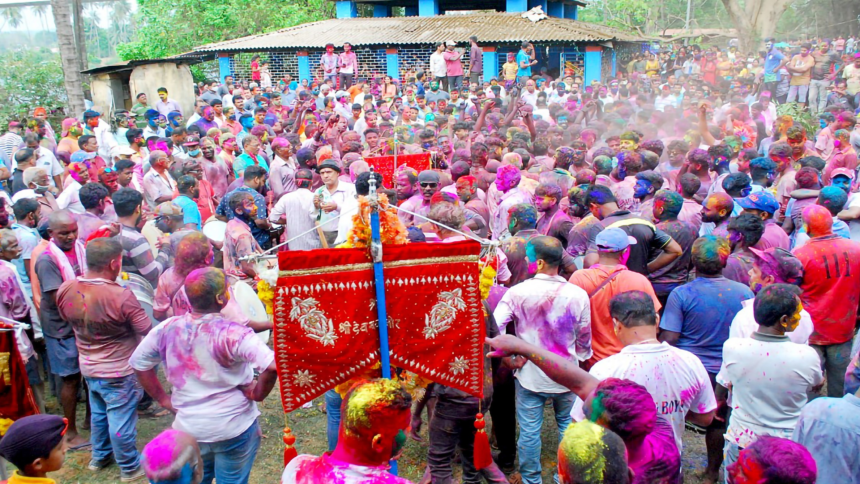
Shigmo is the most appropriate time of the year to explore the diversity of festivals and the ritual attached to it, which very few places can compete with Goa. Goa has unique tradition of celebrating Dhakto Shigmo before the full moon for five days and Vhodlo Shigmo mostly in the vicinity of village temples. In the villages, a tall tree trunk decorated with mango leaves, flowers and coconut (naal) is erected as Holi at a sacred place, Maand. The festival begins with invocation of local deity and Naman accompanied by music and Shigmo songs with chants of ‘Shabai Shabai…. While sprinkling of Gulal is universal during Shigmo, some festivals in the villages stand out for its uniqueness.
Gade Utsav

Famous amongst the festivities is the Gade Utsav at Sal, Kudne and Pilgao in Bicholim taluka. In all, 64 dhoti clad Gade take part in the ritual in the past who follow some strict norms of purification before the festival. Gada who takes part in the ritual is thought to develop unnatural power who perform acts beyond their normal self. Gade gathers near Gadyacho Maand and the moment singing and Dhol starts beating, they get possessed by spirit (Devchar), the Protector of village and in their trance state, they disappear in the forest, all bare feet and in the safe hands of Protector.
Strict vigil is kept in the villages where Gade festivals are organised. All illumination are mandatorily cut-off as only flashes of light that is visible throughout the festival is the burning torch shown by Devchar emanating from different direction that guide the Gade running in all direction in the forest.
Though Gade at Saal and Kudne has its own suspense and thrill, festival at Pilgao happens in broad day light. Pilgao resident Mahesh Falkar says, “After two days of dark night vigil in the village as the Gade roam in the village, Rakhandar is thought to hide them during that period.” Next morning, they come running in their trance condition carrying dead bodies, bones, skulls or any other organ collected from village crematorium as the onlookers in thousands are left aghast to observe the act. In that condition, they crash lifeless on the ground near Shree Shantadurga Devasthan, where Devi appears to take them into her care and bring them back to their senses.
After the ritual, Gades visit a well near Shree Mahadeo temple and the bones and body parts are burnt. They seek blessings and safety of the villagers through the year. All this is carried with singing of Shigmo songs as beats of Romat never stops. Another uniqueness of this village is that they organise Bhurgyache Gade, (children’s Gade), a day before in the evening, which is a joy to observe.
Playing with Fire
Running over hot burning amber is quite a sensational ritual which not everyone can dare to perform, but such event is part and parcel of Shigmo as it is considered as an act of purity of soul. While the practice of running over fire during Homkhand is quite well-known at Britona, the one at Chorao Island has gained great publicity in recent times as thousands of people attend the ritual.
Resident of Saude, Rohan Volvoikar shared, “Homkhand is an occasion where the faith and science meet hand in hand. People walk on the fire to prove the holiness of Rakhandar as beautiful rhythm (Naman) sang by villagers with Dhol and Taso energizes the atmosphere. It is exciting to see as devotees run over a bed of fire, chanting the name of lord Vishnu, Bhumika Devi and Rakhandar. For many, it is a lifetime experience.”
Playing with Colours
Dhulvat or Dhoolvad in many villages is held mostly on the seventh day of Shigmo. Coming back to their roots and getting smeared with colours is considered as a blessing. Shigmo. At Satiya Devi Devasthan, Romta Mhel from seven villages gather at this rock shrine dedicated to Shree Satiya Devi located along the bank of River Tiracol. The villagers seek blessings from Devi, who is the mother of Lord Shree Mulvir, an incarnation of lord Mahadeo.
Mistaken Thieves and Warriors
Sattari is known for Chor, Karavlyo, Chorotsav and Ghodde Modni traditions that draws huge crowd. During Shigmo, there is a practice of petty stealing by Chors (robbers) which is loved by everyone without anyone questioning them. Young boys acting like thieves, wearing mango leaves garland roam the village streets and rob only the seasonal fruits. However, the biggest attractions of the Shigmo in these areas are the Chorotsav festivals near Sateri Kelbai Devasthan at Zarme and Shantadurga Devasthan at Caranzol. According to some legends, the festival is in remembrance of mistaken identity, mark of respect and repentance by the villagers.
Karvalyo in these villages is remembering the sacrifice of women who underwent Sati ritual. The ancient cruel Hindu practice of woman jumping in funeral pyre after husband’s death was quite a norm then and the mistaken robbers are thought to be their husbands. Two boys dressed as woman in typical Nav Vari saree worn by Hindu married woman are taken from house to house on shoulder. Pooja is performed and they are offered Vhuti comprising Shriphal, Saree, bangles, Haldi-Kumkum.
Romtamel
Haldoni ritual at Agarwada-Chopdem, Pernem is very special as a Shigmo fest at Bhumika Panchayatan Devasthan. Holi (tree trunk) is erected in the precinct of Shree Ravalnath temple. After the invocation (gharane) to god, the Romat takes round of the main temples. During Haldoni, sacred Haldi water is sprinkled on the deity and all devotees take it home, which is considered to purify everything.
A resident, Nitin Parsekar says, “The Romat Mhel visits as far as Kaisuva and Siolim villages on 4th to 6th day. On the 7th day, it’s the day of Dhulvat, splashing of colours in the village in the village when Shree Phal (coconut) is taken down after Gharane for the wellbeing of the villagers.”
Devotees from these villages are the Mhajans of Shree Vetal. The deity has a great significance for fishing community who considers Shree Vetal as their protector. Even people from Karwar and Ratnagiri take part in the festivity and also some noted industrialists pay their obeisance.