Herald: You were into advertising before. How was this transition from advertising to wine and what brought you to McLaren Vale in South Australia?
Tony Parkinson: The transition from advertising to wine was gradual as these pursuits overlapped for several years. I had been raised in the McLaren Vale region from a young age and my great-great grandfather had actually lived there in the 1850s before my father took us back in 1952 to grow almonds. When I decided to move family from the city of Adelaide, I decided to look for an established vineyard to provide a cash crop and to take part in the wine industry. It took until 1988 to abandon the pursuit of a planted vineyard and instead, we purchased bare land to develop our own vineyard from scratch. The land was bought ironically on 8.8.88.
Herald: Mclaren Vale has the distinction of having the world’s first soil mapping of wineries. How important has such soil mapping been for McLaren Vale?
TP: The making of McLaren Vale’s geology map is considered a world first in that it maps geological variations, but within a designated geographical area. Geological mapping for McLaren Vale shows seven different terrains. And within those terrains are sub-terrains making the whole geological structure complex to say the least. What is important for the region is that we can now begin to compare flavours and soil profiles and understand better which areas work best for specific varieties.
Into the future, our soil mapping will lead to more informed viticulture and more single site wines being produced, their stories enhanced by a knowledge now more clearly enunciated in geological terminology that was not necessarily available to our forefathers.
Herald: Your award-winning wines have had interesting names and the stories behind them are equally fascinating. What the story behind some of your wines? Besides, each of your wine bottles has a distinct Red dot.
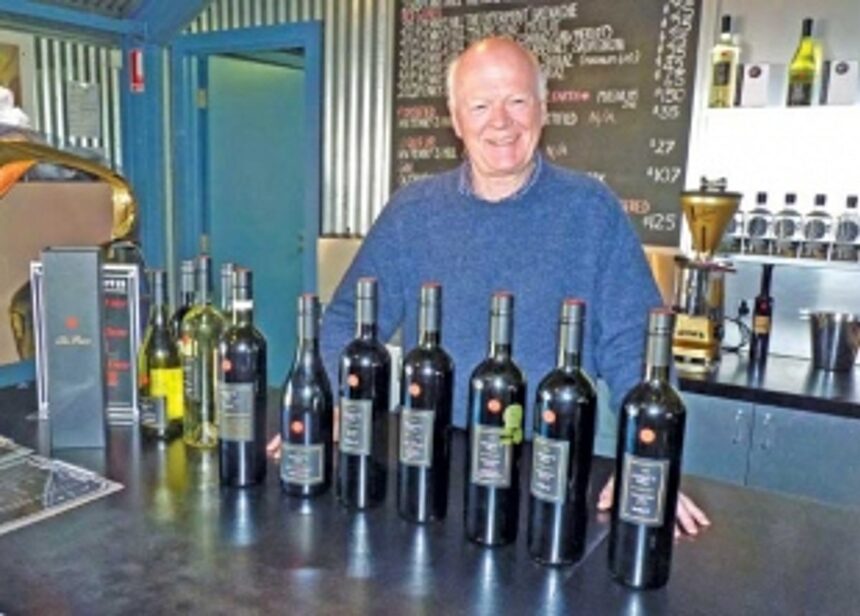
TP: Firstly, the Red Dot. I thought it necessary to develop a package which would stand out on a retail shelf, or across restaurant tables. At the time, my sister-in-law, a prominent painter, lived in the country and would telephone me during a city-based exhibition of her works to ask if I would monitor how many works she had sold. Rather than make protracted, obvious visits to a given gallery, I learned that by simply taking a glimpse, I could by counting the red dots, tell in an instant how many works she had sold. That led me to using the red dot, to exactly the same dimensions as the gallery dots.
About the nomenclature of the wines, The Cracking Black: talks about the black Bay of Biscany which cracks wide open in summer, reducing vigour by underground root thinning.
The Black Chook: is named after the black chickens we keep on the property. A chook is Australian slang for chicken.
The Handshake: defines the way we sometimes do business. No paperwork needed.
The Experiment: was just that. We took cuttings from 100 year-old bush vines and planted them to a modern trellis. Happily for our Grenache, it worked.
Skeleton Key: derives from the idea that we age the wine in bottle, under mythical lock and key.
The Footprint: tells the story. We walk the rows to find the best grapes. We footprint the vineyard for future reference.
The Piano: was a name I had registered for no special reason. It then became a tribute to my 93-year-old mother who played the piano with great passion over many decades and in an ironic twist, because a piano generally has 88 keys, it fitted perfectly with the significance of 8 or 88 in most things we have done.
Herald: Much of your wine is exported to the international market including Canada, USA, Hong Kong, China, UK, Germany and Switzerland. Have you considered entering the Indian market?
TP: We are considering India as an important market. However, from the limited experiences we have had, it is not an easy market to with very high rates of import duty and taxes being obvious constraints. That said, it is always about finding the right importer and distributor partnerships and if that comes our way, we will take wines to India.
Herald: You have participated at various wine festivals across the world. How is Australian wine compared with other wines?
TP: Australian wines benefit from our unique location, from innovative growing and winemaking techniques over many years and from learning more and more to make wines that reflect what we have, rather than emulating French or German or Italian traditions. Of course, our vines have their origins in Europe, but our flavours are our own and on that score, we compare very favourably for wines that reflect our abundant sunshine, open spaces, old soils and proximity to blue sky and wide oceans.
Our wines are primarily generous, ready to drink, easy to consume more than one glass at a time and very suited to food matching.
Herald: What experiences could visitors get to cherish at Penny’s Hill?
TP: A visitor to Penny’s Hill is at first taken by the historic significance of the buildings and farmscape. The property was first settled in 1846 and we are only the third owners. From that first impression, we offer modern surrounds in which to taste wines, to view art and to dine on locally produced foods. That generous, uncrowded use of space is perhaps what we do best. And we employ people who like people. That’s another very important experience for visitors to take away. But best of all, our wines speak volumes for themselves.