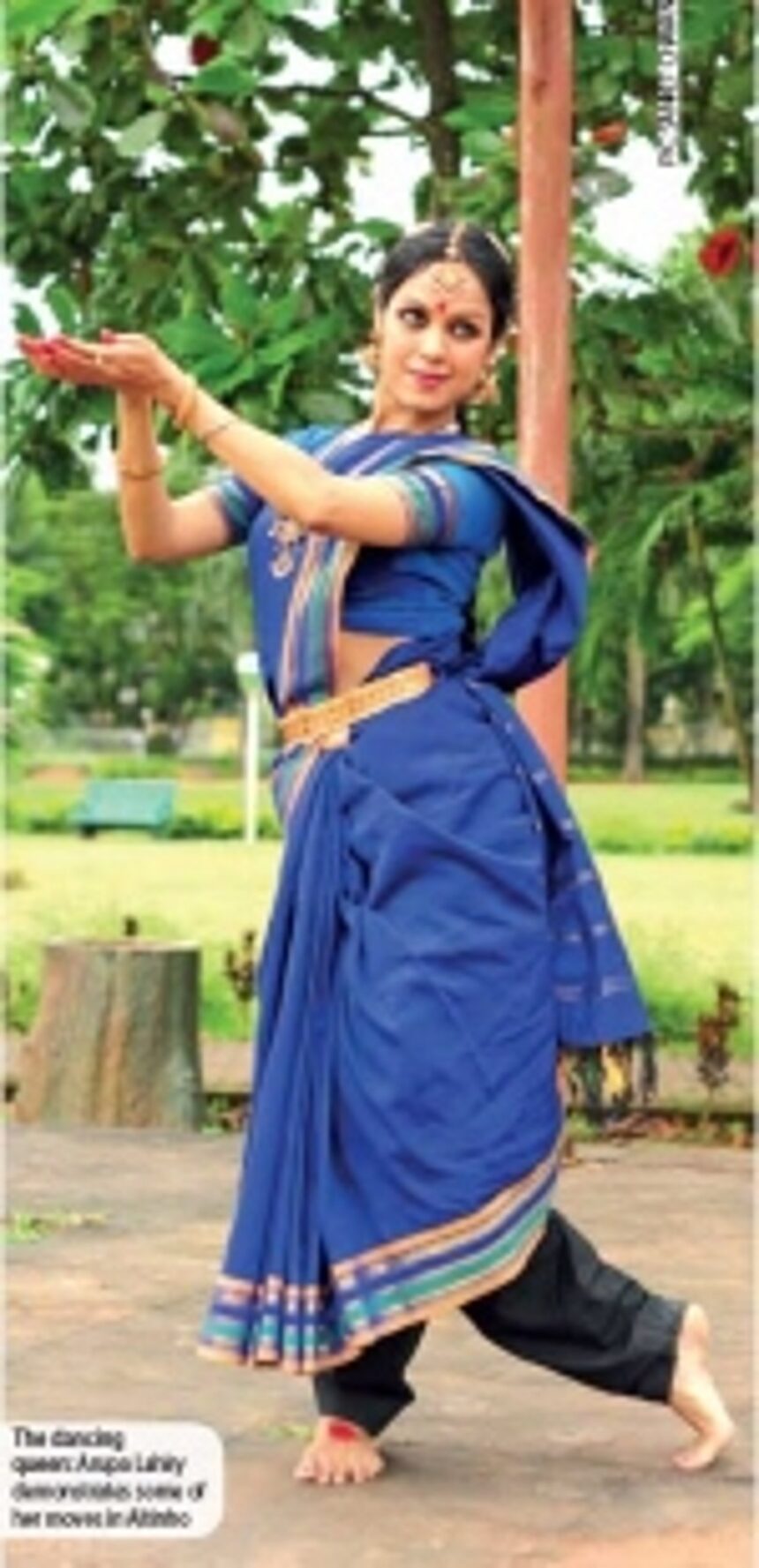
Moving with exquisite grace across the floor as she enacts the story of Krishna, danseuse Arupa Lahiry once again establishes her mastery over a dance she started learning at the age of five. Rigorously training with legendary guru Padmashri Chitra Visweswaran in Chennai for over 15 years, this Delhi- based artiste has fully embraced the Vazhuvoor Bani style of Bharat Natyam with adaptations made by her guru. “Bharata Natyam is a geometric style with straight dynamics. But our style has brought in a lot of curves and grace to it,” explains Arupa, who
has performed at various festivals and stage shows across India and abroad as a soloist and in group shows only with her guru’s repertory company.
Within the framework of this dance
structure, Arupa has nevertheless
conducted a few experiments of her
own. “I do projects with Kathakali,
but stick to my classical art form. In
a project with Hindustani classical
singer Ronita Dey, while she sang
the ‘kalpanas’, I created the imagery
through dance,” shares this dancer who
is also pursuing a PhD in English.
As a structured Indian classical
dance, Bharata Natyam seems to
be a privilege of a few. To bring it
from the podium to the classroom,
Arupa has volunteered her services
with the Indian Rural Cultural Centre
and also ‘Spicmacay’ in the lecturedemonstration
series. Conducting
workshops in various urban, rural and
even tribal areas, Arupa has, through
her interactive sessions, managed
to engage the students across the
spectrum. “I make it a point to explain
every ‘hasta’ (gesture) I perform
at these workshops. This is all the
more important to make the lyrics of
Bharata Natyam understandable as
they are essentially in Tamil as also
in Telugu, Kannada and Malayalam.
Children are the harshest critics, so it
has to be interactive and interesting,”
she maintains. “The purpose of
conducting these workshops is to
make children aware of our Indian
art and culture so that the next time
they watch any classical dance, they
are able to understand. I will expect
them to become persons of the next
generation with good taste,” she adds.
On another note, it is also aimed at
bringing back Indian classical dances
into the limelight as equally aweinspiring
dance forms as opposed
to the mass culture dances seen in
Bollywood.
Now in Goa as part of the
Directorate of Art and Culture’s Lecture
Dance Demonstration series, she is
delighted with the response of the
students, especially the unreserved
interaction and enthusiasm of students
from government schools. On a
personal note, she is happy she gets to
see a different face of Goa as she visits
schools during her one-week stay in
the far flung areas of Goa from Siolim
to Pernem.