SUJATA NORONHA
Director Sujata
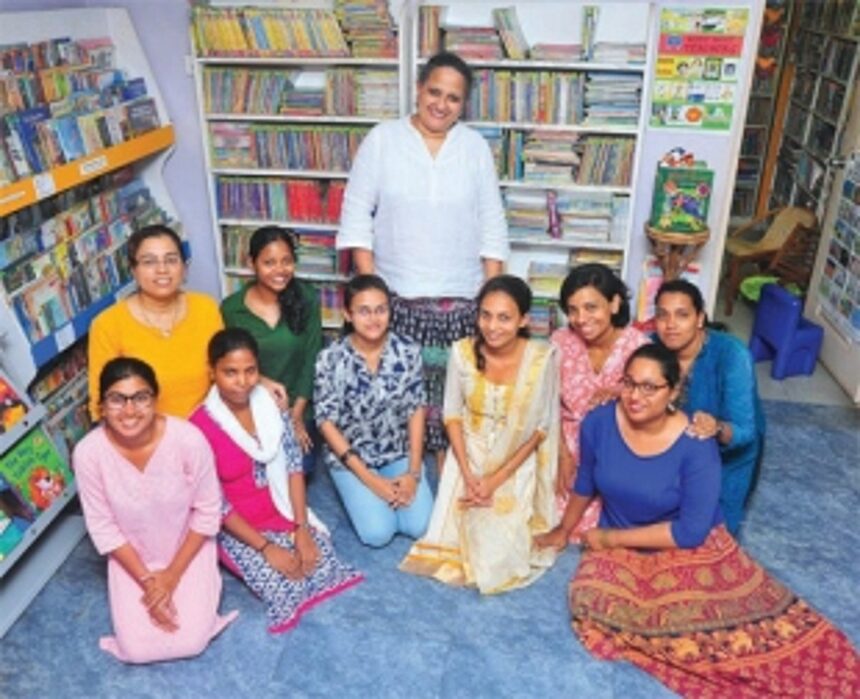
Noronha is the director of Bookworm, a library in Taleigao which received the
Goa State Best Library award. A literacy educator with extensive experience in
literacy instruction and children’s literature, Sujata and her all women team
have been tirelessly taking books to children in schools and various
communities. Starting out with the library along with Elaine Mendonca over a
decade ago, her team is now 20 members strong. Bookworm runs three programmes,
the Bookworm library, the school programmes and the Mobile Outreach Programme.
“What really keeps us going is that children are interested in stories and
books and more importantly when there is a teacher opening and reading these
books to them. That gives us the motivation to see the enthusiasm of the
children. We cater to children in schools as young as five and half years old
whereas in the Mobile Outreach Programme, we even have pre-schoolers who are
three years old,” says Sujata.

Noticing
the trend in the last ten years on how children are offered entertainment and
technology over books, Sujata feels that reading should be given more
importance. “Reading is an important part of their lives and it has been proven
by cognitive research studies that watching on screens either on the mobile,
tab or the TV, can hinder the motor movements of the child. There is very
little eye movement when they are staring at the screen compared to reading a
book where their eyes would move up, down and left and right,” explains Sujata.
ANWESHA SINGBAL
For anyone even vaguely familiar with the Konkani movement in
Goa, Anwesha Singbal needs no introduction. But for everyone else, her
industrious and diligent work for the upliftment of the Konkani language is
what makes her stand out. Anwesha started Abhinav Creationz with her colleague
Amol Kamat, with an intention to market regional language books that were the
victim of a poor marketing system. The duo started moving from school to school
with a bag of Konkani books, meeting the principals of the school. Almost all the
schools that they visited welcomed them and bought the books. While the team
covered almost 100 schools last academic year, this year, they have covered
more than 30 schools with book exhibitions. Anwesha also conducts regular story
telling sessions for children in schools, aimed at inculcating the reading
habit amongst the children.
Another important offering of Abhinav Creationz has been in the
form of a festival called Majja that has been a huge hit with school children.
Majja engages the children in the age groups of 5 to 10 in various activities
like drawing, theatre, music and craft, through the mediums of stories and
music in their mother tongue, thereby taking them closer to the environment
they are born in. The duo also introduces the otherwise seemingly boring
subjects like science and astronomy in an enjoyable manner so that children can
develop a liking for them.
Anwesha
believes that for her, Konkani is not just a language but her identity. This
makes speaking in Konkani, working for the upliftment of the language comes to
her very naturally unlike those who feel that English is the ‘in’ thing. Doing
something for the Konkani language is now a habit than a compulsion, something
that Anwesha says she believes from her heart.
JUDITH ALMEIDA
Judith Almeida is housewife from Colva who has been being active
in the field of environment and human rights for the past 15 years. She works
through an organisation known as the
Colva Civic and Consumer Forum and takes up various issues across Goa. She has
been fighting to protect the environment whether it was to oppose coal
transportation and a hub in Goa, the restoration of the sand dunes at
Sernabatim-Colva, or the dumping of waste in the Colva creek. Most recently,
she demanded an apology from Michael Lobo, saying that Goa’s own Dhangar
community had yet to obtain SC/ST status. “Goa is my only reason for taking up
these issues. For me, it is first humans and then the environment because
humanity depends on the environment. If we destroy it now, what will remain for
the future generations? I am against anything that can affect the air or water
as I feel that my generation has destroyed it and nothing will remain for our
children,” feels Judith.
She
is also supported by women at every level as she believes that women are the
first to feel the effects of the family and the environment. “Many women stand
by me and are many time stopped by their family, relatives and friends. I don’t
want them to be targeted and I take the heat but we are always united to sign
the resolution as the court demands a resolution. I want to do the right thing
as it is the only thing we can do to please Goa or else there is no meaning to
this life,” says Judith.
MEENACSHI MARTINS
Dr Meenacshi Martins maybe the face of a popular Konkani movie
that you love but behind that humble facade, she is a fiery woman. She has
donned many hats to protect the weak and to be the voice to those who cannot
shout out against abuse. Meenacshi is currently the Chairperson of the North
Goa District Committee for prevention of sexual harassment at work place. She
was a founder member and consulting Psychiatrist at Drug Abuse Prevention
Program (DAPP) in 1983. She was a student activist who was encouraged by Goan
activists like Mathany Saldanha and Satish Sonak to stand up for what is right.
“I like to be the voice of the people who suffer and have no platform to speak
about their issues. They don’t know where to address their issues. I realised
that there was a need to be vocal when I was invited as a speaker at a PTA
meeting at Don Bosco to speak about Drug abuse prevention. I was sent to
Maharashtra to open the first drug addiction centre. I was a student when I was
fighting for Konkani language agitation and also the Goa unit of India against
Corruption,” says Meenacshi.
Speaking
about whether women come out to support various issues over the years,
Meenacshi is in the affirmative. “There are many women who are very vocal at
the gram sabha meetings which are held in the villages, as they are concerned
about issues, which are affecting them directly and can have a huge effect in
their village and surrounding areas in the future. They are working on the
ground level activism, which is very important for the state. I mostly
contributed to the state level issues without hurting anything or coming in
anybody’s way,” says Meenacshi
PUJA MITRA
Armed with a Masters degree in Biodiversity Conservation &
Management from Oxford University, Puja Mitra has worked on numerous land-based
conservation work that included Elephant conflict in Assam, among others. After
moving to Goa about six years ago, this eco activist has been tirelessly
working for the conservation and protection of the marine ecosystem in Goa. One
of Mitra’s notable contributions in creating a positive impact has been in the
form of a campaign that she ran with FIAPO to counter the plan to start six
Dolphinariums or Dolphin circuses in the country, one of them being in Goa.
Mitra recollects, “We wanted to counter the Dolphinarium project
because not only is it a colossal waste of resources, but at the same time, it
is unbearably cruel to the animals. Dolphins are social animals who cannot do
well in captivity.”
The campaign gained a lot of public traction that resulted in
the then Minister of Forests and Environment through the Central Zoo Authority
(CZA) banning captivity of dolphins in India, thereby making India the fourth
country to ban it.
Soon
after that World Wildlife Fund (WWF) roped her in to study the impact of
tourism on dolphins and corals. Mitra says, “The outcome of that study was that
dolphins were already displaying an avoidance behaviour, which they do when
they are stressed. To understand the subject better, I took a ride from Baga
and was horrified looking at the manner in which dolphin-watching tours are
conducted.” After working on multiple areas that included sensitising the tour
operators, among others, Mitra found the need to found her own startup to
garner better results. Thus, Terra Conscious – a conservation oriented
enterprise, that promotes sustainable wildlife and ecosystem based tourism
practices, was born. Since then Terra Conscious, through various initiatives,
has been working on ethical travel and marine conservation.