Frazer Andrade
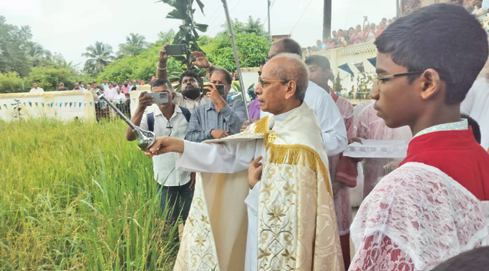
The quaint village of Raiá boasts of its mag nificent Igreja de Nos sa Senhora das Neves, built in 1699. It was consecrated by Archbishop Agustinho de Anunciação. The agricultur al life of Goa is closely tied to the seasonal cycle of rice cultivation. The staple food of Goa as everyone knows is rice, fish and curry. The cul tivation of rice begins in the month of June, and reaches maturity by mid of August which is ready for harvesting during the months of Sep tember and October. It seems that the month of August is known for celebrating newness. But what’s really new in Au gust? Well, it is the paddy crop which is on its way to maturity and gradually to the date of its harvest. The new harvest that is, and hence the month of August is known for celebrating newness or ‘novidade’. Different parishes in Goa celebrate the ‘novidade’ on different dates in Au gust. On this day, the parish priest visits a demarcated paddy field and blesses the new crop. A bundle of blessed paddy sheaves is brought to the church where they are distributed among the congregation (one sheave per family). The family then places this blessed paddy sheave onto their family altar or orato ry (sheaves of the previous year are burnt). “The mother of all cel ebrations is in Raiá on the occasion of the feast of Our Lady of Snows, on August 5, every year. The parish of Rachol, celebrates their ‘novidade’ on the Sunday following August 5. Aldo na celebrates it on August 6. The parish of Sinquerim in North Goa, dedicated to St Lawrence, celebrates the ‘novidade’ on August 10. Most of the parishes across the state celebrate the ‘novidade’ on August 15, i.e. the feast of Our Lady of Assumption. Finally, the last day for celebrat ing the new harvest is on August 24, the feast of St Bartholomew, celebrated on the following Sunday in parishes like that of Betal batim, where the parish church is consecrated to St Bartholomew”, says João Salvador Goês from Mar gão, who attends the feast at Raia every year. The history of Raiá’s care for its people during hardship also forms an important part of its story. In the early 17th century, Raia was struck with a fam ine. It was during this time that the Jesuits from Rachol played a crucial role in serv ing the residents of Raiá. At that time the church of Raiá was nonexistent. The rector of the college of St. Ignatious, Fr. Gaspar Soares was main ly involved in reaching out to those residents of Raiá, which were in need.

This memory of assistance and faith remains linked to the village’s religious identity and its later growth as a par ish centered on devotion and service. The grandest of all feasts which are celebrated in Raiá, is not celebrated by any of the confrarias of the church, but rather by the Fabrica of the Igreja da Raia. However, even though the Confrarias are not actively involved in the feast celebration, they do play an important role for this feast. The confrarias are required to take part in the salve during the Nove na while on the day of feast, the Confraria de Santissimo Sacramento, would lead the procession to the Saibinchi congi (the field where the paddy to be blessed is cul tivated), where the ritual of the blessing of the konnos (sheaves) is done. Only few confrades holding the pro cessional banner, the Pro cessional cross and the staff belonging to the Confraria de Santissimo Sacramento were once allowed inside the boundary of the Saib inchi congi along with the priest. All other confrades were made to stand outside so as to avoid overcrowding. However, by the early 2000s, confrades from all confrarias entering the Saibinchi congi was not a rare site. Today, the church comprises of just one combined con fraria which does the honours. After the Feast Mass, the confraria leads an other procession, in honour of Our Lady of Snow as it is also the feast of the patroness of the church. Mem bers of the con fraria along with members of the Communidade (traditionally ap pointed by the escrivão (clerk)), head in a proces sion accompanied by a brass band, to present the newly cut paddy sheave to the Church of Our Lady of Snows in Rachol in a way to acknowledge the fact that the Rachol Church was the former parish Church of Raia before the construction of the current Raiá church. In Rachol the sheave is received by the Parish priest in presence of the members of the Ra chol Fabrica.
The konos is also distributed to the other parishes neighboring Raia such as the church of Camorlim, Loutolim, the Rachol Seminary etc. From the Raiá church paddy sheaves were also sent to the governor’s palace in Dona Paula. “Local folklore mentions that there was once a ma jor decision to be taken as to whether Raia or Rachol should be given the priv ilege of celebrating their novidade first. Finally, since both the churches were getting their roofs ready before the approach ing monsoon, it was decid ed that the church which covers its roof first, would be given the chance to cele brate their new harvest on an earlier date. Getting to know this, the Raikars de cided to cover their church roof with coconut palm fronds, so as to win over the residents of Rachol. Thus, the Raikars won and were allowed to celebrate the feast before Rachol”, mentions Vernon Madre de Deus, of Raiá.
Traditionally, the feast was celebrated jointly by the church and the Raiá Commu nidade, with the Communi dade taking responsibility for the preparations and bearing the major expenses, Vernon adds. In fact, it was once compulsory for all Gãoncars to attend all the Novena and the Feast of their patroness.