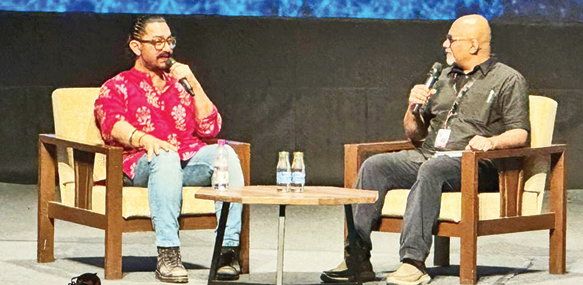
For nearly four decades, Aamir Khan has built one of Indian cinema’s most eclectic filmographies, often defying trends, resisting formulas, and challenging audience expectations. But ask him whether this was a conscious strategy, and he immediately shakes off the notion of meticulous planning. “I have always been someone who loved stories,” he says. “Growing up, I used to listen to my grandmother’s stories… Hawa Mahal on radio. I just loved stories.” This instinctive love, he insists, shaped his career more than any deliberate image-crafting. After ‘Qayamat Se Qayamat Tak’(QSQT) became a phenomenon, the industry tried to slot him into a romantic-hero mould. Yet his second film, ‘Raakh’, was starkly different. “When I’ve done a certain kind of film, I don’t want to do the same thing again. It’s boring for me. It’s not exciting,” he explains. “So right from the beginning, I’ve chosen different kinds of films.” This urge to resist typecasting also shaped his stardom. “You don’t know what I’m going to do next—and that’s exactly how I like it,” he laughs. Unlike many actors who follow the market, Aamir admits he can’t work that way: “I pick films based on my own personal excitement towards the story. Most often, that goes against the norm.” He recalls how people reacted when he signed ‘Ghajini’. “Everyone told me, ‘Action is out. Why are you doing action now?’ But I need something that excites me.” Paradoxically, he says, “By all logic, I should not have been a star. I broke all the rules.” His recent success with ‘Sitaare Zameen Par’ reaffirmed this instinct. While he was advised to return to a pan India action film, he gravitated instead toward the Spanish film ‘Champions’’. “It just won my heart,” he says. “So against everyone’s advice, I did a film on disabilities. People said audiences won’t go to theaters for such films. But they proved everyone wrong.”
One of the qualities that drew him to the original was its refreshing tone. “Those ten characters are full of life. They’re not shown with any pity. They’re just like us—maybe a little slower, but that’s it.” Working with them was a revelation: “If half our actors and technicians were as involved as them, every film would be a hit.” Yet Aamir is quick to clarify that he does not see himself as an activist filmmaker. “What is me is storytelling. When someone comes to a cinema hall, they’re not coming for a lesson in sociology. My responsibility is to entertain them, whether by making them laugh, cry, or feel.” Awards, he says, have never driven him. “At best we are incapable of judging good films, and at worst we are corrupt,” he says bluntly about juries. “Audience award is the best award.” Looking back, he finds mainstream masala films harder to pull off than realistic dramas. “In a mainstream film, logic often leaves. As an actor, to pull that off and make you believe it is not easy. That’s why I have great respect for actors like Amit ji and Dharam ji. They make you believe the impossible.” As he enters his next phase, Aamir has taken a major career decision. “From here onwards, I’m focusing only on myself as an actor. Any script for the production house will go to Aparna. I won’t even be listening to it.” Direction, however, is still on the horizon, just not immediately. “Direction is my big love,” he says. “But once I move to direction, I will probably stop acting. So I’m delaying that decision.” For now, the actor who has built a career on instinct continues to wait for the next story that will “win his heart” and perhaps surprise us all over again.