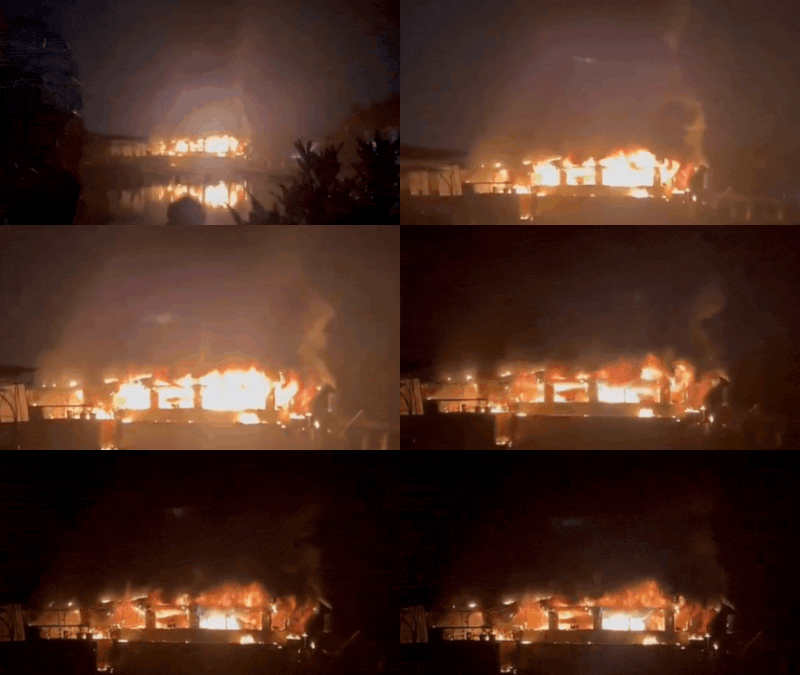
An unsettling reality of a slow-burning crisis of governance is revealing itself in Goa. Until a week ago it was neither dramatic nor visible enough to dominate national headlines, but the Arpora night club tragedy, in which 25 persons were killed, changed that. Goa made it to the international news for, not surprisingly, the wrong reason. It was not the fire that appalled the world, accidents can and do happen, but the fact that the fire and deaths occurred in a nightclub that lacked valid permissions was what shocked. That fact alone added a macabre quality to the horror and this Goa will find difficult to play down, not that it should.
Instead, it should act as a catalyst for change. Governance and corruption issues have cast long, dark shadows over Goa, and continuous scandals have eroded public trust in governance and undermined citizens’ faith in institutions. The Arpora nightclub fire has uncovered what many have long suspected but few voiced—corruption in governance. ‘The perception that there is corruption in Goa has existed for long. The Arpora fire has established it far more seriously for the people. Corruption is at all levels; without a bribe you can do almost nothing in Goa, especially in government offices, where you need someone to facilitate the work for you and for this you have to pay a bribe,’ says senior journalist and editor Rajendra Desai, mincing no words.

Serving interests, not Goans
The Arpora tragedy has established that there is a systemic fault in the working of government bodies and regulatory agencies, all of which appear to be compromised. Denial of this can only reinforce the accusations. Does then there exist good governance in the State? Political Scientist Prof Rahul Tripathi of the DD Kosambi School of Social Sciences and Behavioural Studies, Goa University, answers that question saying, ‘To say that Goa is facing a governance crisis would be an understatement. I think we are facing a situation of a deep, hidden systemic crisis, which is far more disturbing than the manifestations of it that come through tragedies like Arpora. The indicators are rising crime rate, accidents,instances of institutional corruption and systematic destruction of ecological assets which have made the state unique. For me the most depressing moment was when a senior government functionary told me out of frustration that “we have lost control”.There couldn’t have been a more severe indicator than this for me.’ There is unanimity that there is a governance failure in the State. ‘Goa,’ says curator Victor Hugo Gomes, ‘is facing a governance crisis because laws exist but are not implemented, responsibilities are blurred, and decisions affecting people are taken without transparency.
In the last decade we have seen selective enforcement, confused jurisdictions, unchecked tourism growth, coal transportation expansion, double-tracking, CRZ violations, hill cutting, collapsing heritage, unplanned real estate developments and misplaced tourism projects. All of this has created the perception—and reality—that governance serves interests, not Goans.’ He is not alone in this line of thinking. Soter D’Souza who has worked at the grassroots level in promoting panchayati raj says, ‘Goa is facing a governance crisis which can be seen in the parallel governance at local level and lawlessness on the streets with every department passing the buck to dodge the crisis. Several government departments have independent jurisdiction in a village and municipal area, apart from panchayat or municipality.
None of the departments consult or coordinate their activities with each other leading to confusion. The MLA, if from the ruling party, plays ring leader and controls the development as per his desires. Corruption is rampant at every level of governance, more so if the officers have the blessings of the party in power. This rot has penetrated deep into society institutions, including religion, with the corrupt getting glorified for their monetary support.’
Responsibility and power
An enduring governance challenge is the blurred line between responsibility and power. Good governance requires clear accountability, but in Goa, the accountability chain tends to dissolve into a maze of procedural ambiguities and overlapping mandates, and where corruption tends to proliferate.‘The solution,’ says D’Souza, ‘lies not in changing political parties and individuals. It requires a giver and taker in any corrupt transaction. The silence of the society, for whatever reason, enables a governance crisis. If any change is to come, Citizens will need to adopt healthy political thinking and behaviour which is not driven by manufactured media narratives. Citizens should not be recipients of the ill-gotten wealth of corrupt politicians in any form.’ Activists raise issues of corruption, the mainstream media reports, netizens pour out their angst on social media but that’s where it remains, as legal proceedings see few convictions. Getting a conviction in a corruption case has been rare in Goa and various factors lead to lengthy legal proceedings.
Legal Consultant & Mediator Sayonara Telles-Laad, a former District & Sessions Judge, explains this saying, ‘In corruption cases, the cumbersome legal procedures, complexity of the cases, infrastructure limitations, untrained judges, untrained public prosecutors, untrained investigators, u n t r a i n e d support staff, weak investigation, prolonged trial, hostile witnesses who don’t support the case of the prosecution as they may have been bought over or are afraid to depose, insufficient evidence, shoddy investigation and backlogs contribute to lesser conviction rates.’ Telles-Laad points out that there exists The Prevention of Corruption Act 1988 to prevent and combat corruption cases, investigating and prosecuting corrupt practices, prescribed penalties and that the Act was amended to strengthen anti-corruption measures vide the amendment of 2018, including the Lokpal & Lokyuktas Act, 2013.
‘The main objective of the Lokayukta is to investigate and address complaints of corruption against bureaucrats, elected representatives, public officials and ensure transparency and accountability in governance. There is an ongoing debate in respect of the Lokayukta’s capability to hold government accountable. In my view, it could be rather difficult, though of course it’s not impossible, if their functional autonomy and independence is enhanced and there is transparency, integrity and accountability,’ says Telles-Laad. She suggests that ‘anti-corruption agencies like CBI need to be empowered with autonomy, implement reforms to reduce money and muscle power in politics, fill up vacant posts of special judges, periodic trainings to ensure update and better performances by stake-holders, strengthen the Lokayukta with independence and transparency awareness, quicker redressal of complaints and a shared responsibility of all stakeholders.’ But, beside the legal recourse, the opposition too is unable to hold the government accountable. ‘A weak opposition is not exposing the government. In the past, in such a situation, the least the opposition would do was ask questions.
But today they gather somewhere, get their pictures clicked, give bites to the electronic media and believe they have fulfilled their responsibility. There is no one to raise a voice for the common people in Goa,’ says Desai.
Space for public participation
Perhaps the most under-discussed aspect of governance failure is the declining space for meaningful public participation. Gram sabhas, consultations and public hearings are intended to be platforms for collective decision-making but in practice they often feel procedural or diluted or descend into slanging matches. This results in citizens repeatedly expressing frustration over not being heard, decisions being made without consultation, being informed only after decisions are final and the feeling that objections ‘don’t matter’. But, are citizens also objective in their views? ‘The interests of citizens often are far too intertwined for them to demand a stronger governance for the state as a whole and make the political-bureaucratic class accountable. It is like, I may not necessarily be firm on an issue of CRZ violation so long as my request for land use change is accepted. That is why raising the collective consciousness of the citizenry on the issues which do not directly affect them is a must,’ says Tripathi. When citizens lose faith in participation, governance loses one of its most important correctives. But all may not be lost. Gomes, who sees himself first and foremost as a Goan who ‘chose to stay and fight for what’s left of our story’, has over the last four decades rescued and conserved over 40,000 objects through his museum projects. It is perhaps arising out of this—saving material history that has been neither easy nor profitable that he has plunged into a movement to reclaim Goa’s governance through clear law, honest enforcement and public will. ‘#ReclaimGoa comes from my life’s work of preserving more than 40,000 objects of Goa’s heritage dedicating over four decades of my life. If I could save our past, surely we can save our future. I started it because Goa’s identity is being diluted. The movement seeks respect for law, transparency, responsible tourism, and protection of our land, villages and culture. It is not anti-development—it is a call for development with dignity,’ says Gomes, whose movement is a step towards good governance.
More aware citizenry
I f trust is the currency of good governance, then Goa is sorely lacking it, for what the State faces today is a crisis of trust, where institutions, information, decision-making, fairness are perceived to be absent. Without it, even well-intentioned policies can be met with suspicion.‘The solution is that people should unite, raise their voice and ask questions. The common man has only his voice, he has nothing to gain by remaining silent,’ suggests Desai. Agrees Tripathi and says, ‘Citizens are certainly more aware of it and you do find them resisting in bits and pieces. But the forces they are up against are far too dominant and organized for them to make a meaningful impact. The need for them to unite and collectively raise their voice is more than ever before.’ There’s hope here as Gomes’ movement outlines areas that require change, including a transparent digital portal for all permissions, clear accountability between panchayats, municipalities and State departments, tourism reforms for high-value, low-impact, culture-rooted tourism instead of quantity-driven promotion. He also suggests an independent review of double-tracking, coal transport and major infrastructure projects and strengthen existing cultural institutions before announcing new tourism “museums” and theme parks. More importantly he calls for a revival of the spirit of the 1962 Act (Section 5 of Goa Daman and Diu Administrative Act dt 20/12/1962) that promised Goa protection and continuity of its laws.
Conclusion
Goa’s governance challenges mirror a national story of rapid development, complex interests and fragile institutions colliding. The difference is in scale: in a place as small and interconnected as Goa, governance failures are felt more intimately and more immediately. Can Goa lead the change? ‘We must re-read and live by our Constitution, particularly our fundamental rights and duties as citizens, particularly as we go to our electoral booth,’ says Tripathi. ‘I stayed in Goa by choice, and I preserved its memory out of love.#ReclaimGoa is simply the next step— so that the Goa we pass on is worthy of the Goa we inherited,’ concludes Gomes. Good governance need not be an abstract idea or an unattainable ideal. It rests on a few straightforward pillars—transparency, accountability, efficiency, rule of law and citizen participation. In Goa, each pillar is showing cracks and quite suddenly, this has become not a story of one scandal or one administration but of a system that is crumbling and governance in crisis. Tripathi’s suggestion of re-reading the Constitution and Gomes’ efforts to reclaim Goa could be solutions for the governance crisis that pervades.