VICTOR FERRAO
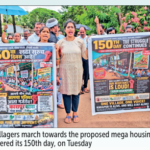
Politics is never merely about the present. It is chronopower, the pow er that seizes time itself and bends it into an instrument. It politicises time so that time produces more time for politics. In this process some forces fall upon the past. They dig up old wrongs and open old wounds, convert ing memory into emotion that shields the present and authorises whatever is done today as necessary justice or correction. Other forces gaze at the fu ture. When the present feels ruined or inadequate, they offer a horizon of promise, a tomorrow that will redeem to day. Politics can work both reg isters at once. It anchors itself in a politicised past while pro jecting a politicised future, and in that double movement, it creates the open time in which campaigns, mobilisations, and elections can unfold. Hope is not simply felt. It is evented. It is staged, timed and offered as the substance that opens the political season. Goa stands at such a thresh old. Assembly elections are expected early in 2027 or even earlier. The present is marked by discontent. Villagers resist proposals to reclassify rural areas as urban, fearing that farmlands, ecosystems, and the local character of their vil lages will be sacrificed on the altar of real estate. Young peo ple speak of scarce and inse cure jobs. Tribal communities press for political reservations. Environmental groups and cit izens raise alarms over land conversion, unplanned con struction, water disputes and the erosion of Goan identity under tourism and migration. Roads remain broken in plac es. Governance is accused of favouring outsiders and devel opers. Law and order has col lapsed. Anti-incumbency accu mulates. These grievances do not remain simple complaints. They become the raw material of chronopolitics. One current of politics reaches backwards. The mem ory of Portuguese colonial rule is kept alive. Liberation is framed not only as historical fact but as unfinished moral work. Speeches recall the cul tural wounds of conversion and temple destruction. De mographic anxieties are linked to that past. Present-day cor ruption, law and order failures and other shortfalls of the Gov ernment are hidden under the cover of the discourse centred on the injury of the past. By raising these emotive issues, the past is made to immunise the present. Some times the wrongs of the pres ent are justified as acts of putting things right. The past becomes a reservoir of moral authority that licenses current power or current opposition. It produces time for politics by keeping the wound open and the emotion available. Another current looks for ward. When the present feels constrained by unemploy ment, environmental stress or stalled projects, the future is offered as a solution. Develop ment is painted as inevitable progress. New infrastructure, investment, tourism circuits and job schemes are promised as the path that will deliver prosperity. Tribal reservation, once implemented, is said to secure dignity and representa tion in the years ahead. Wel fare measures and recruitment drives are timed to appear as down payments on a better to morrow. The ruined or incomplete present is reframed as a tem porary stage. What remains is the future as promise. Chro nopolitics here uses the fu ture to generate hope. Hope is evented through announce ments, surveys, foundation stones, new laws and vision documents. The election itself becomes the decisive event that will unlock that future. Voters are invited to invest their discontent in the ballot that will open the promised time. Both past and future are therefore mobilised to manage the discontent of the present. The same land that is defend ed in the name of historical Goan identity is also opened in the name of future growth. The same youth who are told their unemployment stems from past neglect are offered government posts and private sector opportunities as future security (that does not have any guarantee). Tribal claims rooted in historical injustice are simultaneously projected as the foundation of a more in clusive tomorrow. Opposition voices recall earlier periods of alleged mismanagement while holding out the prospect of a restored Goa under alterna tive leadership. Ruling voices emphasise continuity of devel opmental gains while promis ing acceleration after the next mandate. In each case, time is politi cised so that the election sea son becomes the open interval in which these temporal claims compete. This is how chronopower operates. It does not allow the present to stand alone in its contradictions. The pres ent is always already narrated through selected pasts and projected futures. Discontent is not left to fester as pure frustration. It is channelled into temporal stories that demand political action. The past supplies legitimacy and emotional charge. The future supplies direction and hope. Together they produce the time of politics, the months and years in which parties organise, alliances form, sur veys are conducted, and cam paigns are calibrated. Hope is not a spontaneous emotion. It is staged through rallies, policy documents and care fully timed announcements or manifestos. The election be comes the event that crystal lises this hope into a decisive moment. In Goa, the process is visible in everyday politics. Liberation Day commemorations keep the past vivid. Developmental inaugurations keep the future visible. Debates over law and order, over urbanisation pro posals all often become occa sions to insert past injury or future promise into the pres ent argument. Citizens expe rience the present as a field of pressure, yet that pressure is constantly redirected toward temporal horizons that politics alone claims to control. The re sult is that time itself becomes political property. Whoever successfully claims the right past and the credible future gains the capacity to define the present struggle. Hence, the challenge is that we Goans have to work to resist the chro nopower that hides real issues of Goa and Goans. Chronopower is therefore not an abstract theory. It is the practical work of turn ing memory and expectation into political resource. In the months leading to the next as sembly polls, both the weight of history and the lure of to morrow will be used to ad dress the restlessness of today. Past wounds will be reopened to authorise positions. Future promises will be evoked to generate hope. In that dual movement, the time for pol itics will be opened, and the people of Goa will be invited to choose which version of time they wish to inhabit. The present remains the site of dis content, yet it is never allowed to remain only present. It is always already a battlefield of times. (Fr Victor Ferrao is an independent researcher attached to St Francis Xavier Church, Borim, Ponda.)