Dolcy D’Cruz
Coconut is extremely important in Goan cuisine during Shravan, particularly in traditional Hindu households. During Shravan, when many people avoid onion, garlic, and certain other ingredients, coconut becomes especially valuable because it adds richness, sweetness, texture, and flavour to otherwise simple vegetarian dishes. Shravan is a very auspicious month for Hindus. Every Sunday is special because many women perform Aitar Puja. Yogini Acharya currently lives in Margao, but she grew up in Taleigao and got married in Canacona. “I realized that the way food is prepared in Canacona is quite different from what my mother or grandmother used to prepare. I do a lot of this cooking under the guidance of my mother-in-law, Anjani Acharya, my mother, Mangal Borkar, and my sister-in-law, Sangeeta Pai Khot. I have learned a lot from them. My mother is from Mumbai, and after her marriage, she also picked up a lot of Goan cuisine.

Her cooking is a confluence of Maharashtrian and Goan food. From my mother-in-law, I have learned how to use coconut in different curries and other dishes,” she explains. Coconut plays a different role in both sweets and savoury dishes during this month. “For ghodshe, coconut milk is used. Ponsacha Pais is another popular preparation. The pulp of ripe jackfruit used for the dish can be preserved and refrigerated for later use. Tavsali is also made with coconut. Both Ponsacha Pais and Tavsali use coconut along with sugarcane jaggery. Dishes such as Moongacho Gati and Khatkhate are made more frequently.
Different varieties of Udda Methi are also prepared, along with alu vadi (patra), which is made using colocasia, or taro, leaves. As far as coconut-based curries are concerned, several varieties are prepared, including ros, Chonachea Tondak, dalcha roast, and dal and chana roast,” she says. For Ganesh Chaturthi, dishes are prepared using the entire coconut, regardless of how much the prices may be. When it comes to Ganesh Chaturthi, a Goan will never compromise on the food as it is one of the biggest and most cherished festivals in Goa, and they celebrate it in their own special way, with food being an integral part of the festivities. “Coconut is an inseparable part of Goan culture. You simply cannot separate a Goan from the coconut. It would be very rare to find a Goan who doesn’t love coconut in some form or another.
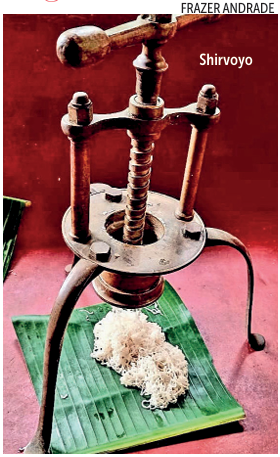
There is a saying that you may eat the greatest dishes from all over the world, but when you come home and sit down to eat a simple plate of rice with coconut sol kadhi, nothing can quite compare. For a Goan, there is something incredibly fulfilling about eating rice with a bowl of sol kadhi, it is a taste of home that can beat even the most famous dishes in the world,” says Yogini. Dietician Rama Talak loves desserts made with coconut, especially during Shravan. There is a long list of dishes that fit into this category. On the sweeter side, there are patoleos, panchakhadya, modaks, mangane, and shirvoyo, many of which are made with coconut and jaggery. “There is also a wide variety of coconut based curries. Since many people avoid onion and garlic during Shravan, these curries are often prepared using coconut as the main ingredient. Some examples include Moongachi Gathi and Ambadeachi Udda Methi, or Udda Methi.
Kadhan is made with moong dal cooked with jaggery, a little elaichi (cardamom), and coconut milk. Mangane contains sabudana and chana dal, along with coconut and jaggery. Wheet and ros which are like Idlis steamed in banana leaves or jackfruit leaves,” says Margao based Rama. Goan cooking makes use of grated coconut, roasted coconut, coconut paste, coconut milk, and even coconut oil and it can be the foundation of a dish. As the coconut is deeply embedded in Goan food traditions and religious offerings, during an auspicious month like Shravan, that connection becomes even more visible.