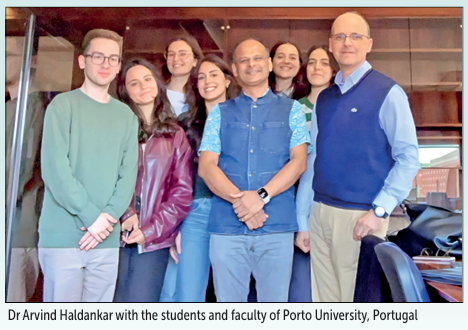
Having lived on the mar gins for long, the recognition of the indigenous tribal communities as Scheduled Tribes (ST) in 2003 marked an important milestone in acknowledging their historical presence and socio-cultural distinc tiveness. “Over time, members of Goa’s tribal community have increasingly begun to articulate their social and political aspirations,” observed sen ior Goa University faculty member Dr Arvind Haldankar during a re cent interaction with students from the University of Porto, Portugal.
The Scheduled Tribe (ST) popula tion in Goa accounts for 10.23% of the state’s total population. Based on the 2011 Census, this equates to roughly 1,49,275 tribal individuals out of the State’s 14,58,545 resi dents. While Goa and Portugal share a common history, a perceived knowl edge gap about Goan society still exists among the young Portuguese generation, especially regarding the indigenous tribes. Aiming to bridge this information gap, Dr Haldankar, Associate Profes sor in Sociology and Vice Dean (Ac ademic) at the D D Kosambi School of Social Sciences and Behavioural Studies, Goa University, recently appraised students of Portugal var sity students about the lives of Goa’s indigenous tribes.

He was awarded a prestigious scholarship under the Erasmus+ MOBILE 24 Project to undertake an Academic Staff Mobility Programme at the Faculdade de Letras, Uni versity of Porto. The mobility programme was organised through the collaborative efforts of the Directorate of In ternational Cooperation and Exchange, Goa University, the University of Porto, and the European Commission. During the five-day academic engagement, Dr Haldankar delivered lectures and participated in scholarly interac tions focusing on four major thematic areas: indigenous society in Goa, livelihood transitions, tribal political mobili sation, and ethnographic insights. “I touched upon the fact that the indigenous communi ties of Goa, primarily the Gawda, Kunbi, and Velip, consti tute an important component of the State’s social and cul tural landscape. Although STs account for a relatively small proportion of Goa’s population, these communities pos sess a distinct historical identity and are often regarded as among the earliest inhabitants of the region,” Dr Haldankar told O Heraldo. Their social organisation, cultural practices, and close relationship with the natural environment have contribut ed significantly to Goa’s cultural heritage. The recognition of these communities as Scheduled Tribes in 2003 marked an important milestone in acknowledging their historical presence and socio-cultural distinctiveness. “At the same time, demographic indicators such as the favourable sex ratio among STs in Goa suggest certain pos itive social characteristics, even though these do not nec essarily translate into broader socio-economic well-being.
The livelihoods of Goa’s tribal communities have under gone considerable transformation over time,” he said. Traditionally dependent on agriculture, forest resources, and local ecological knowledge, these communities devel oped sustainable practices closely linked to their surround ing environment. Modernisation, economic restructuring, and develop mental interventions have altered traditional livelihood systems, leading to increased engagement with wage la bour, migration, and market-oriented activities. “However, the experience of constitutional recognition also contributed to new forms of tribal political mobilisa tion in Goa. Although the conferment of ST status raised expectations regarding socio-economic advancement, pro gress during the years immediately following recognition was perceived as limited by many community members,” Dr Haldankar said. This situation encouraged the formation and consoli dation of collective platforms such as Gawda Kunbi Velip Dhangar (GAKUVED) and the United Tribal Association Al liance (UTAA).
These organisations played an important role in articu lating tribal concerns, mobilising community participation, and engaging with the state on issues related to welfare and representation. Dr Haldankar, whose research expertise primarily encompasses the Sociology of Tribes, Ethnography and Goan Society and Culture, engaged with faculty mem bers and students of the University of Porto through a series of academic discussions and knowledge-sharing sessions. The programme witnessed the participation of faculty members and students from the host institution.