VITHALDAS HEGDE
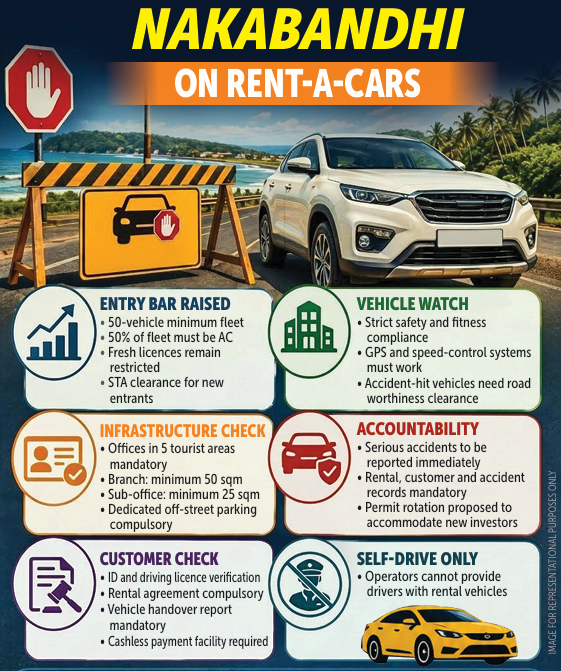
The Goa government is preparing to overhaul the rent-a-car sector with a regu latory framework that could make it considerably harder to enter the business while im posing tighter controls on op erators, vehicles and tourists renting them. A draft Standard Operating Procedure (SOP) for Regula tion, Monitoring and Enforce ment of rent-a-car operations, in possession of O Heraldo, proposes restrictions on the number of operators and ve hicles, even as the government continues its moratorium on is suing fresh rent-a-car licences. The draft makes it clear that the government wants a small er, more tightly controlled rental sector rather than an unrestricted expansion of the business. It describes the cre ation of a ‘sustainable busi ness model’ through limits on licences and vehicles as one of its objectives. Under the proposed frame work, existing restrictions on issuing new licences would con tinue. Fresh applications would not ordinarily be entertained where the restrictions remain in force unless specifically cleared by the State Transport Authori ty, according to a highly-placed government official. For those seeking to operate, the proposed entry barrier is substantial.

An operator would have to maintain a minimum fleet of 50 motor cabs, with at least half of them air-con ditioned. The vehicles would need valid permits, insurance and fitness certificates, with taxes paid up to date. Operators would also have to demonstrate that they have adequate parking facilities out side public spaces and provide documentary proof of owner ship or lease of the premises. The proposed framework would additionally require op erators to establish branch or sub-licensee offices in at least five tourist-important locations across Goa. Branch offices would have to measure at least 50 square metres, while sub-licen see offices would require a min imum area of 25 square metres. The stringent conditions ef fectively raise the bar for small er players while giving the gov ernment greater control over who can enter and operate in the sector.
At the same time, the government is considering a sys tem of rotating permits to create space for new investors while balancing them against existing operators. How such a mechanism would work, however, remains to be spelt out. The proposed SOP also seeks to close loopholes around the actual use of rental vehicles. Rent-a-car operators would not be allowed to operate their vehicles as tourist taxis or provide drivers to customers. The vehicles would remain self-drive rentals, although a hirer could arrange for a person holding a valid driving licence to drive the ve hicle. The government is also proposing greater scrutiny of customers before vehicles leave rental premises. Opera tors would have to verify the customer’s identity, driving licence and contact details and record the period for which the vehicle was hired. Every handover would have to be backed by a condition report recording the vehicle’s mileage, fuel or battery lev el, existing damage, tyre condition and emergency equip ment. Rental companies would be required to maintain de tailed records of their operations, including rentals, ve hicle maintenance, complaints, accidents and regulatory compliance.
Every transaction would have to be supported by a written or legally valid electronic rental agreement containing details of the hirer, vehicle and operator, licence particulars, rental period, charges, conditions and emer gency contacts. The draft puts considerable emphasis on vehicle safety, requiring operators to ensure that brakes, steering, tyres, suspension, lights and seat belts are maintained in proper working condition. Speed governors and vehicle-tracking systems installed in the vehicles would also have to remain operational. Importantly, vehicles involved in serious accidents would not simply be allowed back into service after repairs. They would have to be certified as roadworthy by the competent authority before returning to the roads. Operators would also face mandatory reporting obliga tions. Accidents involving deaths, serious injuries, major property damage or suspected criminal activity would have to be reported immediately. During investigations, rental companies would be re quired to hand over rental agreements, customer records, vehicle inspection reports, GPS data, insurance documents and repair records to the authorities.
The proposed framework therefore goes beyond licensing and seeks to bring the entire rent-a-car chain—from who can enter the business and where vehicles can be parked to who hires them, how vehicles are monitored and what hap pens after an accident—under closer regulatory scrutiny. The draft comes at a time when the government has kept the rent-a-car licensing process under a moratorium. Its eventual implementation could therefore determine not only how existing operators continue in business but also whether, and on what terms, new players are allowed into Goa’s rental-car market.