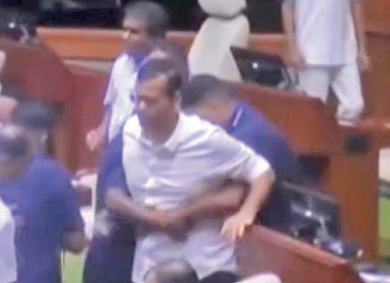
In a climbdown, the Pramod Sawant-led government on Monday backed away from intro ducing its controversial anti-conversion Bill in the Goa Legislative Assembly, bowing to mounting oppo sition from political parties and growing unease within its own ranks over legis lation that critics warned could deepen communal divisions in the State. The Goa Prohibition of Unlawful Conversion of Re ligion Bill, 2026, had been cleared by the State Cabinet just days ago and was list ed for introduction on the opening day of the ongoing monsoon session, with Chief Minister Pramod Sawant scheduled to move it. But the government pulled the plug at the elev enth hour. Minutes before House proceedings began, Sawant held a meeting with Catho lic MLAs from the ruling side amid strong reserva tions over the proposed legislation. The Bill was subsequently dropped from the Assembly’s Busi ness List, effectively shelv ing its introduction for the current session. Independent MLA Aleixo Reginaldo Lourenco said legislators had been in formed that the Bill would not be tabled, adding that objections had come not only from the Opposition but also from within the ruling camp. Siolim BJP MLA Delilah Lobo, who attended the meeting with Sawant, con firmed that the legislation would not be introduced.
Calangute MLA Michael Lobo said the proposed leg islation required wider dis cussion and consensus be fore being brought before the House. “There should be a discussion on the an ti-conversion Bill or any other Bill. There must be a consensus, and everyone should be taken into confi dence,” Lobo said. He said Goa was already facing several disturbances and that a proper study was necessary before bringing in legislation that could give the impression that a particular community was being targeted. “Everyone is free to prac tise their religion. There should not be any distur bance,” Lobo said, while maintaining that forced conversions should not be allowed. He added that such practices did not occur within the Roman Catho lic community, but said gatherings for conversion witnessed in some places should not take place. The government’s deci sion comes days after the State Cabinet approved the proposed legislation, triggering strong criticism from Opposition parties and sections of civil society. Leader of Opposition Yuri Alemao accused the government of attempting to disturb Goa’s communal harmony. “This govern ment only knows how to divide and rule. The Bill is intended to create divisions in society,” Alemao said. Benaulim MLA Venzy Viegas also questioned the government’s priorities, saying Goa was confronted with several more pressing issues. “The government is trying to confuse the peo ple. There is nothing on Section 39A, land issues or high electricity bills,” Vie gas said. He questioned the need to push an anti-conver sion law when families were preparing for Ganesh Chaturthi and dealing with rising household expenses. Former Margao MLA Uday Bhembre also criti cised the proposed legisla tion, arguing that there was no evidence of widespread forced conversions in Goa to warrant a separate law.

Bhembre said legal action could be taken in individual cases involving coercion or fraud, but maintained that a blanket State-wide law was unnecessary. He alleged that the proposed legislation was driven by an RSS-backed political agen da rather than any genuine local requirement. The Bill had proposed stringent penalties for re ligious conversions carried out through force, coercion, undue influence, allure ment, fraudulent means or marriage. It envisaged imprisonment of up to life and a minimum fine of Rs 50,000, besides compensa tion of up to Rs 5 lakh for victims. It also proposed declar ing a marriage void if it was found to have been solem nised solely for the purpose of unlawful conversion or if conversion was carried out through marriage. Those facilitating unlaw ful conversions, including religious figures such as priests, karmkandis, maul vis or mullas, could face im prisonment ranging from three to 10 years. The proposed legislation further provided for en hanced punishment where the person allegedly con verted was a minor, woman, person with a disability or mental illness, or a member of the Scheduled Castes or Scheduled Tribes.
With the Bill now off the Business List, the gov ernment’s decision effec tively puts the proposed anti-conversion legislation on hold for the current session. The move follows growing political pressure and concerns within the ruling camp over the pos sible social and communal fallout of introducing the measure without wider consultation.