MARCOS GONSALVES
The deaths of minors in recent road crashes as well as cases in which vehicles alleged ly driven by minors have claimed the lives of other road users, have raised a disturbing question in Goa – Who is allowing children to get behind the wheel in the first place? In the latest cases, a 16-year-old boy died in a motorcycle accident in the Sonsodo-Curtorim area, with his father reportedly booked for allegedly allow ing him to ride. In Bicholim, another 16-year-old boy was killed in a head-on collision in volving a motorcycle and a car, with police reportedly booking his father. But the consequences of underage driving do not end with the minor behind the wheel. In December 2022, a speeding motorcycle al legedly ridden by a minor at New Vaddem, Vasco, knocked down 56-year-old Mamata Shetye, who died on the spot. The minor was taken into custody and sent to a remand home. Similarly, in the 2026 Goa Velha rent-a-car case, a minor allegedly drove a rental car that was involved in an accident in which a biker died. The incidents put the focus on why minors are being allowed access to motor vehicles on public roads despite clear legal restrictions.

The num bers suggest this is far from a handful of isolated incidents. According to a transport official the cases involving minors driving or riding were in the thousands and not hundreds. For activists, the figures point to a problem that cannot be addressed mere ly by booking minors after violations or accidents. Parents and vehicle own ers who facilitate access to vehicle must also be made to confront the con sequences of their actions. GOACAN coordinator and road safety committee member Roland Martins said the issue would be taken up at a special road safety meeting, where a focused Information, Ed ucation and Communica tion (IEC) campaign on underage driving would be proposed.
“First thing is that we will be having a road safety meet ing very soon, wherein we are going to propose many things, including a special IEC campaign focusing on un derage driving,” Martins said. He said the campaign should be backed by publicly avail able data on underage-driving cases and their consequenc es, arguing that the seriousness of the problem was still being denied. “The denial syndrome has to go. The implications for parents will also be mentioned,” Martins said. According to Martins, the police should systematical ly compile and publish data on underage driving — a demand he said had been raised for years — so that the scale and consequences of the problem cannot be brushed aside. The growing availability of high-end motorcycles and cars has added another dimension, he said, with young people increasingly exposed to a culture of displaying and riding powerful vehicles. “Many hire such bikes and showcase this, which creates an impact on the younger generation.
There is a need for a focused campaign,” he said. Martins said road-safety awareness should also extend beyond the police and transport authorities to panchayats and municipal bodies, with stronger local-level coordina tion needed to address violations. While penalties for traffic violations were already strin gent, he stressed that enforcement had to match the sever ity of the laws. Social activist Auda Viegas said the deaths of young people were particularly disturbing because many of them were being allowed to ride or drive by their own parents. “It is unfortunate that we are losing young lives in acci dents, and that too when they are being allowed by their parents to ride bikes or vehicles. The law clearly prohibits riding a bike unless the person has attained the permitted age.
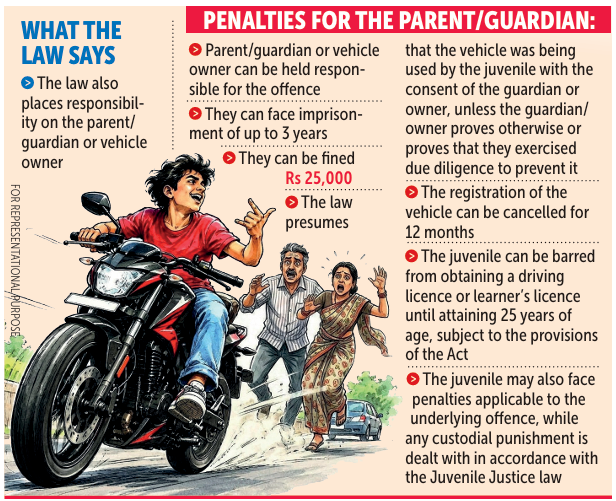
I do not know what makes parents permit them to do so. Parents should be fully responsible,” Viegas said. The consequences, she pointed out, can extend far be yond the family of the minor. An inexperienced underage driver can turn an ordinary road user into the victim of a crash. The recurring cases also expose the limits of treating un derage driving as simply another traffic offence. A minor may be the person physically controlling the vehicle, but in many instances, the vehicle belongs to, or has been made available by, an adult. With thousands of minors being caught every year, activ ists say the government cannot rely on sporadic enforce ment after accidents have already occurred.