AMITA KANEKAR
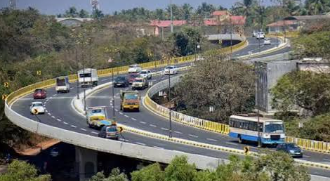
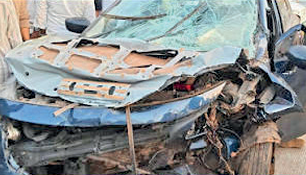
Much has already been said about the horren dous flaws in the new 641-crore Porvorim flyover which was inaugurated with much fanfare last week. What I want to talk about here is ac countability. Just the day after Union Roads Minister Nitin Gadkari and Goa Chief Minister Pra mod Sawant basked in the in auguration limelight, congrat ulated themselves and their “double-engine” governance for the “elevated corridor”, and boasted how it would reduce the travel time between Ma pusa and Panjim to ten min utes, two people were dead in a crash at the south end of the flyover. Both Gadkari and Sawant disappeared, and we learnt that the flyover was actually the responsibility of the Public Works Department (PWD). It was the PWD Min ister Digambar Kamat who faced the cameras now, to blame rash driving, declare a ban on two-wheelers using the flyover, and a closure of access to and from the flyover at Por vorim. Kamat’s “solutions” were not just an admission that the flyover was fundamentally flawed, they are also very stu pid. First, and most ridiculous of all, was his statement that the crash was caused by rash driving. Seriously? Does he think we don’t know that? The real question is: where is the law enforcement that stops rash driving? About that, Ka mat said nothing.

Second is the two-wheel er ban. Anybody who has seen the video of the crash knows that it was the crazi ly-speeding four-wheeler that slammed into the two-wheel er, killing its rider on the spot. If anyone is to be banned, it should be four-wheelers; they are, in fact, responsible for most “accidents” on Goan roads. Kamat’s decision to tar get two-wheelers – the victims in most Goan crashes – re minds one of the time his old colleague Manohar Parrikar announced a decongesting of Panjim’s roads; his solution was to ban the most harmless of vehicles: the handcart. Thus hitting the livelihood of the poorest, while not touching the personal car usage of the rich: no restriction on num bers of cars, or on car size, or usage. Kamat has also chosen to hit the vulnerable poor rath er than the speeding rich. As for the hapless people of Porvorim, who suffered for years for this “dream project”, only to discover worse traffic woes now as well as a ban on their access to the flyover, this is nothing but political betray al. And this is the heart of the issue: accountability.
Kamat should not even be talking of solutions, when his PWD is actually responsible for the disaster. Not only did they clear this dangerously flawed design, they apparently also ignored the warnings of Goa’s Traffic Police, submitted months ago, precisely about the design. So, are we going to see any responsibility accepted by Kamat as PWD boss? You can bet your life against it. Are we going to see the Chief Minister sacking him for complete in competence? This sounds like a joke. It took months of strug gle, suffering, and a huge pro test to get the Union Education Minister to resign a couple of months ago, despite the gigan tic scandal of leaked exam pa pers. This is not a political cul ture which takes responsibility for even the starkest of failure. It just hopes that we will forget or, better still, accept incom petence/failure/corruption/ whatever as a fact of life so that we are not surprised by the next such incident. Remember Romeo by Birch Lane? Twen ty-five people dead and no official arrested except small fry at the local level. Life (and death) goes on. Kamat will claim that he’s not responsible. It was the PWD planners, engineers, traf fic analysts, etc. who produced the flawed design, not him. But if Kamat has nothing to do with what’s happening in the PWD, why is he there? Why do we need ministers at all if they are not responsible for their ministries? If they can waste public money to take credit for ‘achievements’, why aren’t they responsible for disasters? This tragedy is an eye-open er – and not the first one – to the lack of accountability in our corrupt and hierarchical political system. Anybody who has worked in any kind of or ganisation – office, building site, restaurant, school, what ever – knows that it’s the boss who makes the difference. When you have a good boss, you get good work. When you have a stupid/corrupt boss, everything is ruined. And when every successive boss who takes over is corrupt… this is the situation we have reached. We have ministers who are in charge of departments but do nothing to improve things there. In fact, they often hap pily take charge of multiple de partments – not two or three, but six or seven, the more the better.
They can ‘handle’ any number of portfolios, be cause they do not intend to do any serious work connect ed to those departments. It’s all about having more power, making more deals, and thus more money. And when there’s a problem, instead of taking responsibility, they disappear or offer “solutions” that don’t change anything. An Australian engineer col laborating on the Bombay air port renovation many years ago once described in an in terview his experience of how Indians worked. Only the boss talked during project discus sions. Lower-level engineers and other technicians would attend but silently. They were expected to keep their mouths shut in front of their boss. No body corrected even obvious mistakes made by the latter. This was the reason for poor engineering in India, he felt – the fact that power and hier archy are more important than work quality. In Goa, we have a road that is nothing less than a wonder of the world. The Ponte de Lin hares, the causeway over the Mandovi backwaters between Panjim and Ribandar, is still doing its job 400 years after it was built. Compare that road to the scam-roads of today: multi-crore disasters that cost us our lives. With this political culture of zero accountability, we can expect nothing less. (Amita Kanekar is an architectural historian and novelist)