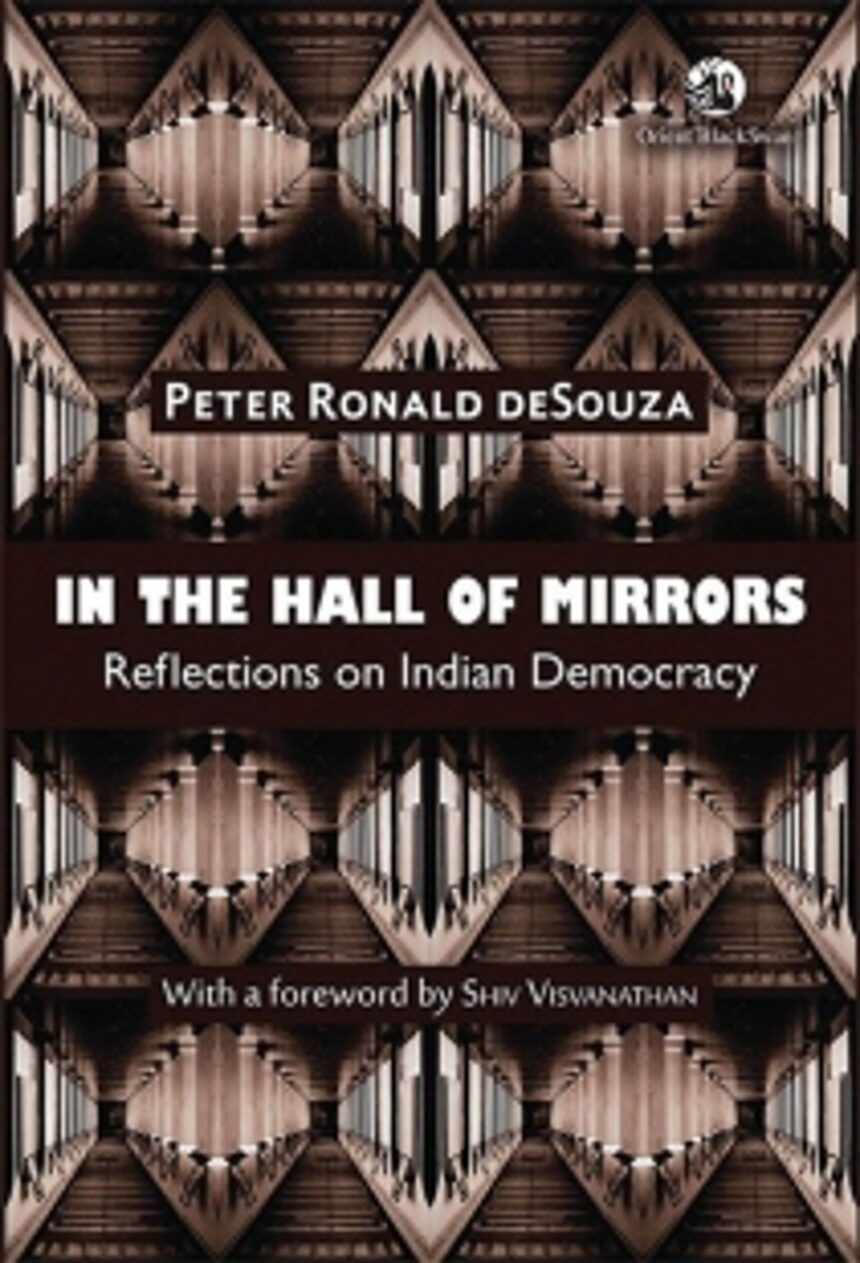
The book, ‘The
Hall of Mirrors: Reflections on Indian Democracy’, is a masterful ode to Indian democracy, celebrating
its pluriversal dynamism. The author, Peter Ronald DeSouza, marvellously
deconstructs Indian democracy and sets it free from monolithic frameworks that
seek to homogenise and render it static. In the words of Shiv Visvanathan, we
can aptly trace the location from where Peter comes into the drama of democracy
as it is played out in our country. Visvanathan rightly states that Peter, as a
social scientist, regards democracy as a great social experiment and India as a
site for that world’s greatest exploration. Peter investigates the eventful
march of democracy in our country and asks a fundamental question, ‘what has
India done to democracy and what has democracy done to India ?’ Scholars locate
Peter’s contribution to democracy and political studies among the second
generation of intellectuals of the Centre for the Study of Developing Societies
(CSDS), New Delhi.
The title of the book democratises and pluralises the field of
study and assists us to understand and contemporise the state of democracy in
our country. It captures the complex dynamism of our democracy with the
metaphor of a ‘hall of mirrors’. The hall of mirrors is a powerful epistemic
location. Peter rightly states that it simultaneously serves as critique as
well as a recommendation. It critiques the mainstream representation of Indian
democracy through a single mirror. Such a picture of our democracy is certainly
deficient and deceptive. The ‘hall of mirror’ overcomes this defect and makes
room for a greater explanatory scope for the dynamic complexity of our
democracy. Several mirrors of different sizes, and focal points, lying side by side
allows us to view our democracy from wider and deeper horizons. The metaphor
the ‘hall of mirrors’ therefore becomes an apt hermeneutical lens to view the
dynamism of Indian democracy. It is like the bed room of a Mughal place where
the ceiling is dotted with mirrors but which, when a single candle is lit,
gives a sense of the starry night sky, a sense of the universe that is India.

The text of the book is dynamic and speaks to the reader from
different positions in multiple voices. These multiple voices emerging from
different directions remain profoundly critical as they open up space for the
excluded, marginalised and those passed over in silence. In a powerful way, the
book manifests different censors and their sources that often stifle, constrict
and paralyse our thinking, studying and representing of the theatre of
democracy in our country. The book therefore presents the real unedited version
of Indian democracy where we can trace a conflictual pursuit of the highest
ideals, utopias and aspirations of democracy muddled by mundane concerns of
bigotry fanaticism, covetous desires of corruption, and arrogant ego clashes of
the several political and thought leaders. Drawing from our civilisational
resources Peter finds dharma (which is both religion and righteous conduct) as
a critical tool to analyse the health of our democracy. He interprets it as
merit acquired by performance of duty following the lead of P V Kane. Peter
employs dharma to analyse Raj dharma (conduct of the ruler) and Buddhi dharma (conduct
of the intellectual) and invites us to explore the merit acquired by our
political leaders and our public intellectuals though their engagement with the
dynamic saga of democracy in our country.
The book of this
length and breadth is rightly acclaimed by several scholars of repute. Arindam
Chakrabarti, the distinguished professor, department of Philosophy, university
of Hawaii, says, “Should we be pragmatic or principled, realistic or
idealistic, intellectual or activist, interpreters or changers of society? With
courage and caution, Peter DeSouza usher us into a realm of ‘reflections’ where
we feel an obligation to be both. The reflections are important, but J L Austin
reminded us, importance is not important, truth is. They ring true.” Harsh Shethi,
consulting editor, Seminar, New Delhi also succinctly says, “A liberal
predicament in post-Independence India this book turns the spot light on
society that is seeking to bridge the demands of constituents simultaneously
occupying different, sometimes irreconcilable, mental universes. The essays
here should force serious introspection both among political and thought
leaders.” These scholars appreciate Peter’s contribution towards the
understanding of the working of contemporary democratic processes in our
country.
The 53 essays that
comprise the 395-page book have been classified into five clusters based on the
concerns that they bring into the reflection on the democracy. The first
cluster, called the ‘Analytical Frames’ tries to open several doors through
which we can enter the field of studying Indian democracy. The second cluster,
‘Aspirations of a Young Nation’, introduces us to the ambitions that people
from different classes and communities, had for India. The third cluster, the
‘Anxieties of a Plural Democracy’, is concerned with some problems and social
constraints that Indian democracy faces and focuses on the moral issues that
emerge therein. The fourth cluster, the ‘Accommodations of a Layered Society’,
draws our attention to many compromises a polity has to make as it tries to
attempt to attend to competing claims on what is the best way forward. The
fifth cluster, the ‘Ambivalences of Constitutional Polity’ suggests a peculiar
condition that is specific to Indian democracy which often finds itself at
cross roads unable to trace a path forward. Although the essays can be read
singly, when read within the cluster to which they belong they profoundly
illuminate several dimensions of our democracy. Though Peter sometimes seems to
appear to stay open to the pragmatic side of politics, he clearly prefers the
principled and the ethical side of politics that is close to the heart of most
Indians.
The
book is published by Orient BlackSwan, Hyderabad and is available at Broadway
book shop in Panjim.