Secularism was used as an electoral opportunism in the past. Today same is true of Hindutva in our country. The only common denominator between the two regimes is political opportunism. There is another thing that seems to afflict both Congress and BJP is the sense of entitlement to rule India. Although there is nothing much to choose between the two parties, yet post-1990s with the embracing of new liberal economic policies, one can see steady rise of right wing politics in our country. Post-1990s our economy got depoliticized and our culture that was ways political become virulently politicized in new ways. It prepared us to accept the seventy years of Congress rule as a wasted experience and paved the way to take culture as politically contested space. This was so because economy was no longer a contested site. There was consensus on economy and we reaped its benefits with growth under UPA touching the 8th% mark. This is why it may have to be said that BJP as a political party was the biggest beneficiary of the neo-liberal economic policies. The accelerated growth of culture as a contested site was brought about by globalisation that seriously challenged national as well as cultural boundaries. We gave up the contest between the left and right of the political economy and the only field that seems to be left for politics was one of culture and identity. Even now a failing economy does not seem to disturb us. Politics centred on identity issues is winning the day.
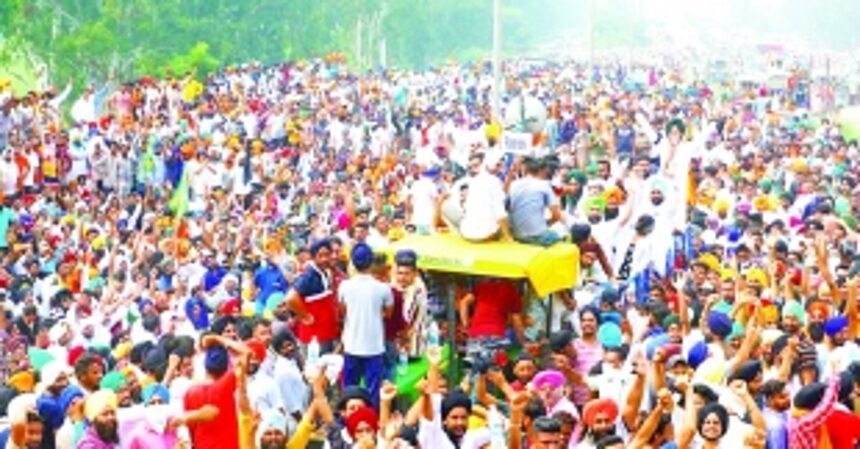
Intoxicated on the politics of culture, the economic failures can be easily blamed on the 70 years rule of the Congress. Nehru can become a villain even after he is dead and gone. Even today amidst the famers agitation, we are tolerant of the intolerance and heartless insensitivity of the Government towards the famers who have laid a siege on the borders of Delhi for mother than three months. Economy does not seem to hold water for us. Even when our economic resources are being handed over to a select elite, our political imaginary is limited to cultural polity. This Government has become two and half corporation Government. The sense of cleaning up has allowed us to accept another misfortune that may be discerned by future generation as another wasted experience. But for now it offers greater control over the capital to the ruling benches.

The concentration of capital is bad for liberal democracy. Our old system, although corrupt, allowed the spoils to be widely shared. It implicated almost all of us in some way. This suggests that old system was more democratic and power centres were dispersed. The new system that we have stepped in has concentrated power and capital and we are democracy that has dropped into an oligarchy. Wherever in the world we saw greater concentration of capital in alliance with state, we have seen greater repression. Negotiation and dialogue is incompatible with concentration of capital. This is why what we see is simply pretence of negotiations whenever it is displayed. The case of agitating farmers is a good bench mark to understand this myth. Government is seen in dialogue with the leaders of the farmers but is not willing to climb down on the farm laws. Same is true in Goa. The public hearing of CZMP have gone haywire as the Government seems to have just erected a fake drama of public hearing. This means the ruling benches are using technologies of pressure to contain dissent and disagreement as well as theatre of pretense to make think people agree with it. With the concentration of capital and power, we have lost our space of dissent and disagreement. This means Indian capital has become dangerous to our democracy as it provides the machinery of propaganda and information control to the ruling elite. This means we are fast losing the battle for liberal democracy in our country.
Paradoxically, the ruling elite of the kind that we have in India today, requires a perpetual mobilization of a people against a social cultural elite. This is why Pakistan, Muslims, other minorities, Khan market, Lutyen’s Delhi, tukde tukde gang, supposed Bollywood excesses do matter. This professed anti-elitism, although fake for several reasons has good resonance with the people. But it does become a force of the political power of the ruling elite who continues to construct and manage a sense of victimhood in the majority community. This is why we have the challenge to think ahead of the political curve. The political curve is converging at a Hindu singularity at one point while also closing at the economic elite on the other point. We have the challenge to understand these two points of the political curve. It has the power to reveal the truth of political inclusion along side economic marginalisation of the Hindu majority. What is thought to be the Hindu moment is actually the moment of the economic elite. This is the reason why we also have the challenge to understand that we are standing on an illiberal ground of nationalism spear headed by Hindutva. This illiberal nationalism is only increasing state power. We have accepted without questions that citizens have to be transparent to the state while at the same time the state does not have to be transparent to the citizens. This keeps the state power beyond the needle of suspicion. All that it does is assimilated as good for the nation. To keep this façade on, the state has to continuously perpetuate this feeling in the people by constantly going after errant citizens. This is why we have legitimized the use of all types’ repressive laws (even colonial ones) and technologies because we feel that the delinquent citizen has to be put under check.
(The author is Professor of Rachol seminary)