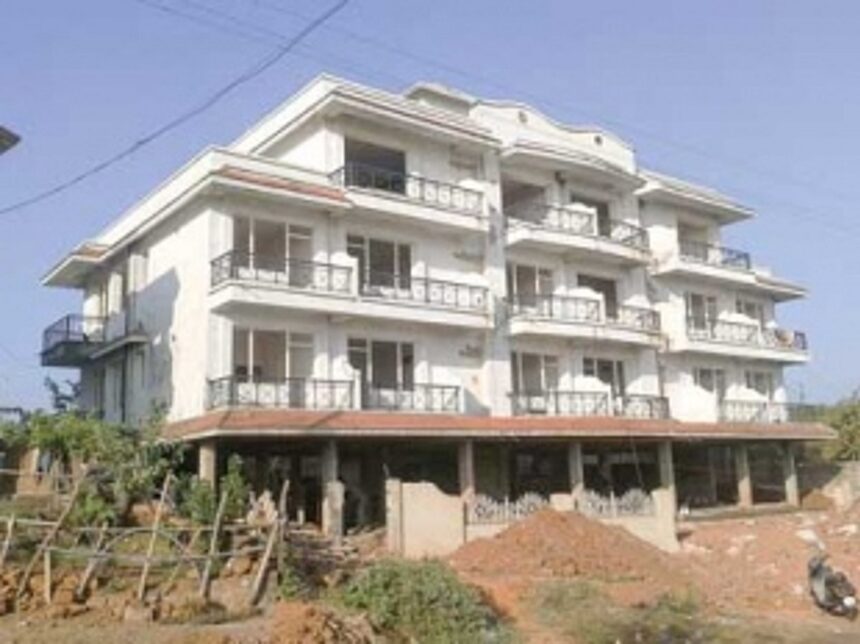
PANJIM: There has not been much to celebrate for anyone who conducts business in Goa given the sense of depression that engulfs the entire economy.
The ban on mining had an effect on various sectors of the economy and reality is no different. Business has slumped over the past six to eight months and builders are now stuck with unsold flats.
Desh Prabhudessai Credai Goa chapter President said that the business was poor and several builders had revealed that they were now stuck with out standings from banks and unsold flats.
This also meant that the construction of new buildings had reduced dramatically with builders prepared to wait it out rather than increase their financial burden.
He said “Price is not a problem here. People are usually not really concerned about the cost of the flat especially those from Delhi and Mumbai but now there are just no more buyers. There is no one walking in through the door asking for flats. It has been like this for the last 3 to 6 months. I expect the situation to get worse before it will improve”.
Asked in his estimate how many flats were empty in the state he said it would not be exaggeration to say that approximately a 1000 flats were lying empty around the state. These flats were built and are now lying unsold all over the state. The average cost of a 2 bedroom flat is approximately Rs 45 to 50 lakh depending on the location though in Panjim it can easily go into the Rs 70 lakh price range.
He said usually people would go around talking to various builders before deciding on a property and that was not happening now.
The builders even in such times had not reduced the price of the flats because of the high cost of construction.
Builders the Herald tried to contact refused to speak saying that they did not really want to add to the gloom that was existing in the industry. A reality broker from Panjim who has been in the business for 18 years who did not wanted to come on record due to the subject being discussed said that earlier it was par for the course to sell atleast two flats a month but that had not happened for over a year now.
He said “Three years ago it was not unusual to sell two flats a months, and earn brokerage by cracking rental deals. Today if I am able to sell a flat then I have to chase the builder to earn my commission. It is really tough.”
In his opinion the market would remain like this for another six to eight months and the only hope would be the central budget next year.
This drop in sales however is not unusual. Home sales across top six cities in India saw a quarter-on-quarter drop of 25% in the September quarter, the lowest sales since 2009 while unsold inventory rose to a high of 815,000 apartments as investors are slowly deserting the property market as prices have peaked, according to property research firm Liases Foras.
This is the highest ever unsold stock implying that the ready but vacant flats will take at least four years to sell, which means home prices have not only peaked in India’s financial hub, Mumbai, but in other parts of the country too. The report covered six cities—Mumbai Metropolitan Region (MMR), the National Capital Region (NCR), Bangalore, Hyderabad, Chennai and Pune, which contribute round 70% of the total apartments built in India.
While sales in the national capital region (NCR) have dipped 34 percent to 11.51 million sq feet quarter on quarter, sales in Mumbai were down 9% to 10.22 million sq ft from the last quarter. But get this: the productive markets of Bengaluru and Chennai have been hit the most, with sales dipping by 43% and 46%, respectively, from the previous quarter. The average price increase in the six centres was just 1%.
Across India, the number of new flats built dropped by 7% from the previous quarter. Of the new supply, 36% was in the cost range of Rs 50 lakh to Rs 1 crore, and 29% was in the range of Rs 25 Lakh to Rs 50 Lakh. This means that most of the unsold flats are still too unaffordable for the aam aadmi. And with the government easing norms to allow foreign investors to invest in real estate, prices are going nowhere but up.
Projects worth Rs 9 lakh crore in the construction sector were stalled as on 30 June due to weak macro-economic environment and prolonged delays in getting clearances and land acquisition, ICRA said in a report.
“The Indian construction sector over the last few years had faced challenges arising from weak investment cycle and delays or uncertainties in policies leading to weak order inflows as well as slowdown in execution. As of 30 June, projects involving investments of Rs 9 lakh crore were
stalled,” the rating agency said.
Commissioning of projects also witnessed a decline from Rs 3.6 lakh crore in FY13 to Rs 2.2 lakh crore in FY14. Similarly, new project announcements declined by 17 per cent in FY14 led by sharp contraction in private sector projects owing to subdued business confidence and inordinate delays in getting approvals.
Commissioning of projects also witnessed a decline from Rs 3.6 lakh crore in FY13 to Rs 2.2 lakh crore in FY14. Similarly, new project announcements declined by 17 per cent in FY14 led by sharp contraction in private sector projects owing to subdued business confidence and inordinate delays in getting approvals.
Delays increased the uncertainty on the projects’ viability and also reduced the risk appetite of developers.
ICRA said besides held-up projects, there are sizable projects which are slow moving or facing some implementation issues including prolonged delays in getting clearances, as well as difficulty in land acquisition.
“There have been several sector-specific concerns which have impacted investments in new projects as well as implementation of on-going projects,” ICRA Senior Vice-President Rohit Inamdar said.
According to ICRA, the power sector accounts for an major share of stalled projects, even though the government has taken several policy actions in the past couple of years.