Dolcy D’Cruz
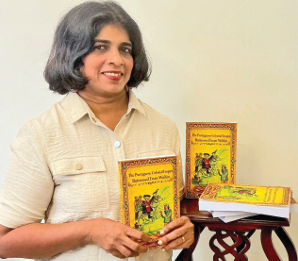
Dr Sharmila Pais e Martins has a passion for educating people, whether in the classroom as an Associate Professor of History at St Xavier’s College, Mapusa, or through her growing body of historical writings that bring Goa’s past to a wider audience. Her new book, ‘The Portuguese Colonial Empire Buttressed From Within’ explores how Portuguese rule in Goa survived and remained strong until the nineteenth century with the support of local people, institutions, and networks. The book will be launched at Fundação Oriente, Panjim on June 3 at 6 pm. Dr Sharmila is the author of ‘The Encounter with the Ballot in Colonial Goa: A Historical and Analytical Study (1821–1961)’ and co-author, along with Prof Prajal Sakhardande, of ‘The Quest for Goa: History and Heritage of Goa from Ancient Times to 2019’. She is also a member of the International Group for Studies of Colonial Periodical Press of the Portuguese Empire (IGSCP-PE), Goa Chapter. “The title of the book is a journey of four years of persistent research now reaching its fruition. It has taken me through an arduous journey of archival records, parliamentary reports, government bulletins, and a wide array of secondary data to complete this work.

Material gathered during my earlier month long research to Lisbon also contributed significantly to this work. The title employs the term ‘buttress’ in a metaphorical sense. In architecture, a buttress is a structure that provides support and stability to a building. Similarly, this work examines the local support system that sustained the Portuguese colonial empire for centuries. These included local interpreters, elite groups, envoys, feudal lords and merchant intermediaries who mediated between the colonial state and the Goan society. This work also explores the themes of language, gifts land, diplomacy, and calculated alliances in the New Conquests which became crucial to the sustenance of colonial rule in Goa,” explains Dr Sharmila.
The book is organised into ten chapters beginning with the foundation of the Estado da Índia and the strategic alliances that strengthened Portuguese expansion. “This work proves that the Portuguese colonial empire survived for many centuries, not merely by the power of their sword or naval supremacy, but because it was also actively buttressed or supported from within the Goan society. The Estado da Índia became increasingly dependent upon local recruits for their military requirements. This was because not many Portuguese men were willing to settle away from their country,” she informs. She further adds, “A part of this work highlights how the Portuguese Crown encouraged the rise of interpreters to serve their colonial interests. For many local elite, this role also provided opportunities for social mobility and a brush with diplomacy under the colonial regime. They were chosen for their ability to communicate with local rulers and merchants or even serve as advisers to European explorers. A handful among the local intelligentsia in Goa had gained proficiency in multiple languages including Portuguese, Marathi, Kannada, Persian, Gujarati and Arabic. Interpreters were selected to build friendly relationships between the Portuguese and the neighboring rulers.
Educated men who possessed proficiency in multiple languages found employment as línguas. Undoubtedly, connections and loyalty towards the government played an equally important role in the selection process. Evidence suggests that influential individuals sought favours in order to obtain these positions. What began as an informal function was gradually institutionalized as a full-time profession.” The book also analyses sagoates, or gift-exchange diplomacy, as a means of negotiation and alliance building. Gift-exchange diplomacy was equally crucial to sustain an empire. Although gifts continue to form an important aspect of diplomacy till this day, they are largely symbolic. She explains, “Back then, they were used as essential tools to build trust, strengthen relationships and gain commercial benefits. In all of these, local envoys and translators acted as frontline diplomats who travelled between courts, while the interpreters managed the strategic communication. They helped the Portuguese to understand local customs and conventions. The Portuguese too, either desired to befriend some dominant powers or avoid conflicts with powerful adversaries. Therefore, they reciprocated the gesture of goodwill of Asian rulers through a befitting sagoate or a gift.” She further adds, “In the course of time, several Goan families; initially Catholic and later Hindu, were also granted honours and coats of arms for their loyal service to the colonial regime. Such grants were accompanied by official documentation and, in some cases, landholding privileges and pensionary benefits.
They could be hereditary, lasting for two or three generations or limited to the lifetime of the recipient. This policy led to the emergence of a class that depended on the Crown for their upward mobility and financial prosperity. The viceroy of the State of India, together with the Archbishop of Goa and the Governing Council came together to prepare an annual list of such deserving ‘servants.’ To be a part of the list, an applicant had to petition to the state and present documentary evidence demonstrating that his ancestors had faithfully served the Crown for many generations. After this procedure, the Certificate of Justification of Noble Status was awarded to the petitioner.” Certain issues associated with private ownership of land have been researched in the work. In Goa, land was looked upon not only as a source of wealth but as a strategic instrument of political control for centuries. “The dessaido and sardessaido systems as well as other private land holdings existed in Goa prior to 1510 and were continued after the 18th century. The government granted certain concessions to the inhabitants of the New Conquests that were generally not extended to those in the Old Conquests.
These measures specifically concerned usages and customs, and the functioning of representative institutions,” she says. This study is an attempt to show how power was negotiated at regular intervals by colonial administration for its benefit and those of its stakeholders. The investigation has also examined how the State maintained its authority through regular interventions, particularly so in the New Conquest territories from the 18th century. “As this work is presented to readers, I hold the words of an anonymous writer close at heart: ‘The past cannot be changed, forgotten or erased; it can only be accepted.’ As a student of history, I believe that no history should be disowned because of any ideological pretensions. In the same spirit, the book is offered to readers and the public with the hope that it will enlighten minds about our past,” concludes.