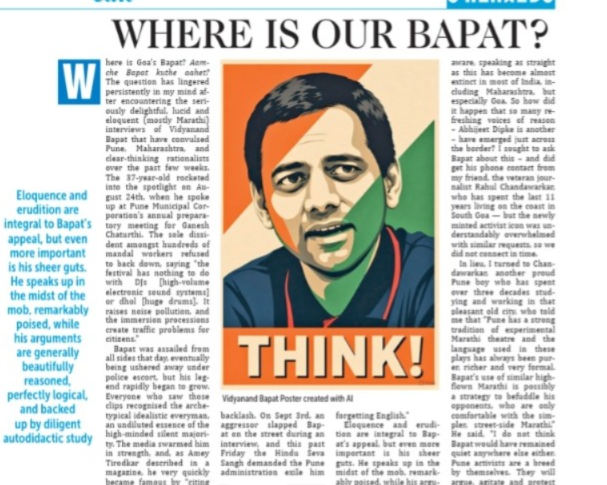
Where is Goa’s Bapat? Aamche Bapat kuthe aahet?
The question has lingered persistently in my mind after encountering the seriously delightful, lucid and eloquent (mostly Marathi) interviews of Vidyanand Bapat that have convulsed Pune, Maharashtra, and clear-thinking rationalists over the past few weeks.

The 37-year-old rocketed into the spotlight on August 24th, when he spoke up at Pune Municipal Corporation’s annual preparatory meeting for Ganesh Chaturthi. The sole dissident amongst hundreds of mandal workers refused to back down, saying “the festival has nothing to do with DJs [high-volume electronic sound systems] or dhol [huge drums]. It raises noise pollution, and the immersion processions create traffic problems for citizens.”
Bapat was assailed from all sides that day, eventually being ushered away under police escort, but his legend rapidly began to grow. Everyone who saw those clips recognised the archetypical idealistic everyman, an undiluted essence of the high-minded silent majority.
The media swarmed him in strength, and, as Amey Tirodkar described in a magazine, he very quickly became famous by “citing shlokas from the Mahabharata and other Sanskrit texts, as well as examples from Latin and Greek literature [and describing] himself as an atheist, a rationalist, and part of the tradition of Socrates and Narendra Dabholkar. His command of Marathi, Sanskrit, English, and Hindi, delivered without a fumble and in a consistent tone across every interview, made him a sensation in Pune and Maharashtra within days.
As Bapat’s popularity grew, BJP leaders and supporters backing DJs at the festival reached for a familiar counter. They began raising questions about noise pollution during the Eid-e-Milad night, celebrated this year on August 26. Pune Police, whose credibility has come under strain in recent times over unrelated matters, booked four people for noise pollution during Eid-e-Milad.
In response, Bapat and his supporters, who by now saw him as a figurehead against noise pollution, said they opposed noise pollution across all castes and religious festivals equally.
There has been some unfortunately predictable backlash. On Sept 3rd, an aggressor slapped Bapat on the street during an interview, and this past Friday the Hindu Seva Sangh demanded the Pune administration exile him for the festival dates, and force him to apologise “for disrespecting Hindu deities, Ganeshotsav and religious sentiments.”
These kinds of threats have generally worked in the recent past, but not this time, as an impressive cross-section of Pune, Maharashtra, and the Marathi-speaking world has instead become enthusiastically enamoured by their new intellectual hero.
These tweets are representative: from @renukaVyavahare, “Every time someone twists my words or misquotes me, I shall henceforth channel Vidyanand Bapat” and, in translation, by @andhwazir “I felt like falling in love with Marathi all over again. To the point of completely forgetting English.”
Eloquence and erudition are integral to Bapat’s appeal, but even more important is his sheer guts. He speaks up in the midst of the mob, remarkably poised, while his arguments are generally beautifully reasoned, perfectly logical, and backed up by diligent autodidactic study.
Here, indeed, is Gramsci’s archetypical “organic intellectual”, grown from his peth like an organ inside its body, like Lenin, or Subhash Chandra Bose, or, closer to home, the great Savitribai and Jyotirao Phule, each of whom educated themselves in opposition to the dominant narratives of their times, and stood up to be counted when it mattered the most.
His current focus is noise pollution, but the implications of this principled young man’s pursuit are manifold across every other aspect of civics and governance.
“I have no thoughts of going into politics,” he told Loksatta, “but one important thing for democracy is the activeness of citizens. If that is not the case, even if there is constitutional democracy in a society, it still becomes an autocracy. I think we have democracy only on paper. In countries with such technical democracy, the rulers start acting like kings, so that democracy does not exist.”
As we are all painfully aware, speaking as straight as this has become almost extinct in most of India, including Maharashtra, but especially Goa.
So how did it happen that so many refreshing voices of reason – Abhijeet Dipke is another – have emerged just across the border?
I sought to ask Bapat about this – and did get his phone contact from my friend, the veteran journalist Rahul Chandawarkar, who has spent the last 11 years living on the coast in South Goa — but the newly minted activist icon was understandably overwhelmed with similar requests, so we did not connect in time.
In lieu, I turned to Chandawarkar, another proud Pune boy who has spent over three decades studying and working in that pleasant old city, who told me that “Pune has a strong tradition of experimental Marathi theatre and the language used in these plays has always been purer, richer and very formal. Bapat’s use of similar highflown Marathi is possibly a strategy to befuddle his opponents, who are only comfortable with the simpler, street-side Marathi.”
He said, “I do not think Bapat would have remained quiet anywhere else either. Pune activists are a breed by themselves. They will argue, agitate and protest in any corner of this land. And they are not worried about the consequences either.
In one of his latest interviews to a Marathi TV channel, Bapat nonchalantly remarked, ‘What is the worst-case scenario. They will kill me. They gunned down Narendra Dabholkar too. Dabholkar was relentless in his fight for anti-superstition. I am also in this for the long-haul. I am not deterred by threats.’
Having schooled in one of the prominent Marathi schools situated in the conservative peth areas of Pune and being an active member of the Pune Marathi Granthalaya (the 115-year-old haven for Marathi books and literature), Bapat has obviously inculcated all that is good about Marathi and more importantly Pune culture.
Most old-school Punekars, are righteous, fiercely independent thinking, law abiding citizens. Bapat, is clearly reminding his fellow Punekars, in Bob Marley speak, “to get-up, stand-up, don’t give up the fight!”
(Vivek Menezes is a writer and co-founder of the Goa Arts and Literature Festival)