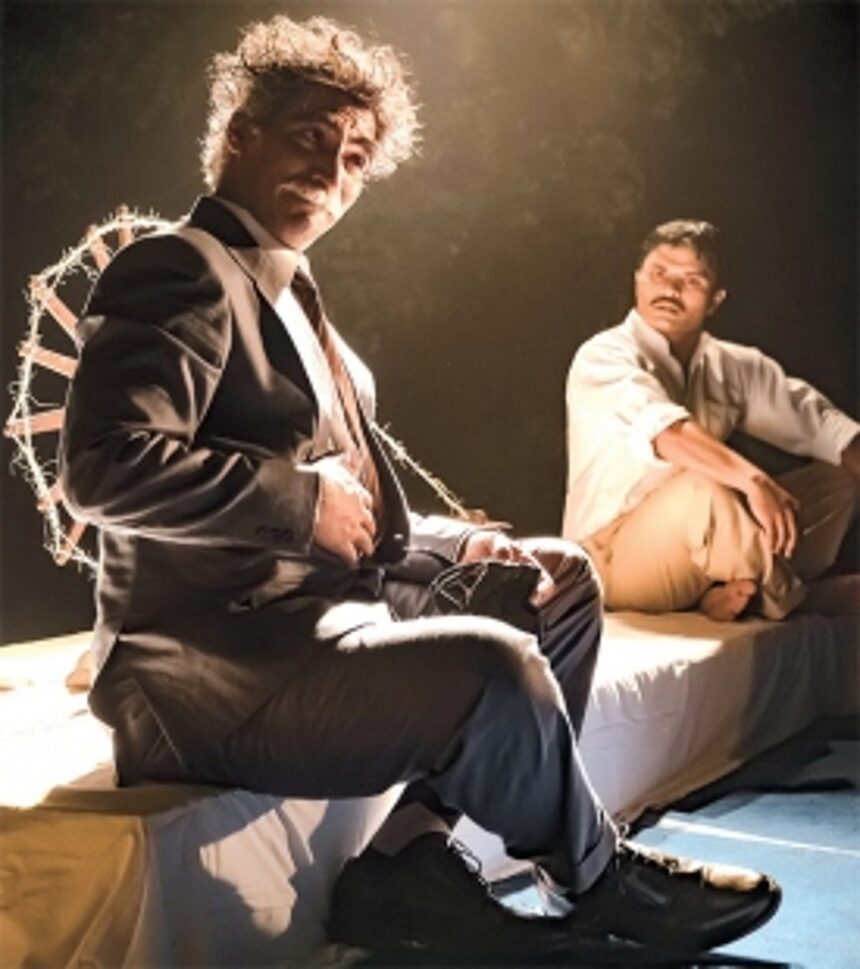
A well-received English play by the Goa-based theatre group, Imaya, ‘Two Fathers,’ focuses on
the personal lives of two great minds, Albert Einstein and Mahatma Gandhi, and
their troubled relationships with their respective children. The play, while
exploring little known (and often surprising) details of their lives, is
actually universal and an audience always connects it with their own emotional
lives and relationships. The play, which was greeted by a full house and heaps
of praise at the recent Goa Arts and Literary Festival as well as subsequent
performances in Parra and Nerul in December, was performed at the Kala Academy
Black Box on January 26, 2018. Its next show will be at Musuem of Goa (MOG),
Pilerne, on January 30.
The play has been entirely rehearsed in Goa and Imaya Shows
plans to take it to Mumbai and other metro cities soon.

“despite being new, Imaya Shows is one of the pioneering theatre
groups in Goa that wants to promote the theatre culture here. It has produced
two plays since last year; the first was a comedy. ‘Two Fathers’, on the other
hand, deals with complex emotions in human relationships. It’s the story of
Albert Einstein and Mohandas Karamchand Gandhi, both extraordinary men but
ordinary fathers. ‘Two Fathers’ delves into questioning many emotions that come
with parenting and being a human that are relevant more so in these fast pacing
times, when parents increasingly find less and less time to spend with their
children,” says Sheeba Shah, the co-founder of Imaya and Producer of the play.
“It is exciting for us to do an original English play, specially
commissioned and written for us by Sundar Sarukkai, instead of the usual play
about and from Western culture,” says Srinivas Bhashyam, the co-founder of
Imaya and Director of the play.
Srinivas has worked as a graphic designer, film reviewer,
assistant director (with Girish Kasravalli in Karnataka, and Kamal Haasan,
Singeetam Srinivasa Rao and Mani Ratnam in Tamil Nadu) before writing and
directing three feature films – ‘Paisa Vasool’ (co-written with Anurag Kashyap)
and ‘Love Khichdi’ (co-written with Manu Joseph) in Hindi, and ‘Shanthi!
Shanthi! Shanthi!’ (co-written with Pradeep Sebastian and Utkal Mohanty) in
Kannada.
The playwright, Sundar Sarukkai, is professor of Philosophy at
the National Institute of Advanced Studies in Bangalore. He is the author of
the following books: ‘Translating the World: Science and Language’, ‘Philosophy
of Symmetry’, ‘Indian Philosophy and Philosophy of Science’ and ‘The Cracked
Mirror: An Indian Debate on Experience and Theory’ (co-authored with Gopal
Guru).
Srinivas explained that he first thought of the idea after he
was captivate by a play that Sundar had written about Einstein and his troubled
relationship with his daughter. “He was a lousy father and very open about it.
You can’t be good at everything and this is true for a lot of people in real
life,” adds Srinivas. Having always felt deeply about parenting, he was struck
by the idea of combining the story of Einstein and Gandhi, who also had
troubles with his son, Harilal. “While one was the Father of Science, the other
is considered the Father of the Nation, but both of them had troubles being
fathers to their respective children and we looked at how we could play on this
irony,” explains Srinivas.
Srinivas and Sheeba spent several months writing and rewriting
the script until they were completely happy with. While Sheeba also plays the
daughter of Einstein, Srinivas plays the role of Gandhi, establishing his
prowess as an actor by depicting such an iconic character.
It took them many months to find the right people for the play
and they finally chose theatre actors from Goa. Reggie Goveas and Valentino
Diaz delivered powerful performances as Einstein and Harilal respectively.
Reggie is also a singer and designer, whereas Valentino is a first time
performer.
“Although
our play deals with the lesser known aspects from the personal lives of two
historical legends, the emotions it evokes are so universal that after every
show of ‘Two Fathers’ so far, people come backstage and speak to us about how
it connects with their personal relationships with their own parents or
children or both….that is so satisfying for us,” adds Srinivas.