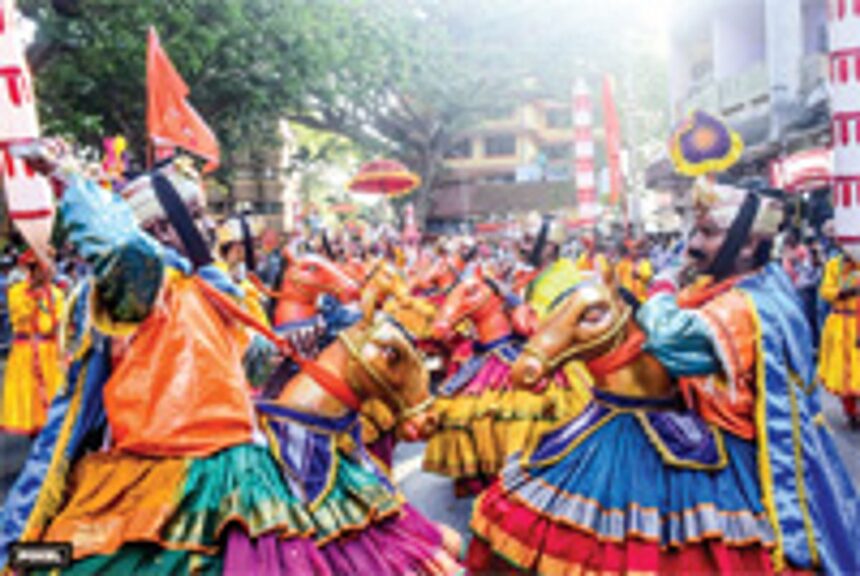
Shigmo, also known as Shimgo in some parts of rural Goa, is just around the corner. Besides
being a scintillating display of creativity, colour and faith, Shigmo is, in
its true form, a cultural exhibition of Goa’s history from time immemorial.
Over the years, this festival has remained true to its core nature and except
for a few minor changes in the way it is held every year, not much has changed.
However, there have been significant changes in the way it is promoted and
presented. For the past few years, the Department of Tourism has put in more
energies in setting the mood for this festival, thereby giving a glimpse of the
unique cultural side of Goa to all the tourists that frequent the capital city.
Days before the actual parade, the capital city is seen decked in elements of
the Shigmotsav; the sight, especially in the night, is splendidly beautiful.
The chhatri or the umbrella hanging from the tree, colourful flags
adorning the road, and larger than life cut-outs and character figures on the
roundabouts in the city help create the festive atmosphere and something
similar can be expected in a few days’ time.
For the last 28 years, Panaji Shigmotsav Samiti has been trying
its best to preserve the tradition of Shigmotsav to retain its authenticity.
While speaking with Herald, Mangaldas Naik, Working President, Panaji
Shigmotsav Samiti had said, “To maintain the sanctity of the festival, we
refrain from endorsing brands of liquor, tobacco and anything and everything
that does not align with our culture. The committee has also been strict about
ensuring participation of only those cultural folk art groups that are serious
about their art form.”

This year, the Shigmo festivities are scheduled to take place in
various cities and towns across Goa from March 3 to 17, 2018, with the capital
city witnessing the annual Shigmo parade on March 10. For those oblivious to
the fascinating phenomenon that Shigmo is, the actual rituals begin with an
invocation to folk deities at the sacred square or stage in the village called
the Maand. This is followed by beating of indigenous instruments like dhol
(drums), tashe (cymbals), ghumat, etc. This is then followed
by the procession that begins with the brass bands reminiscent of the Maratha
conquerors, followed by a series of Kunbi folk-dances performed by village
tribal women bedecked in gold and brightly-coloured sarees. Besides costumes,
every performing group is judged on the basis of how they hold their sticks and
march to the beats. This is then followed by colourful and artistically put
together tableaux featuring mythological characters brought to life by the
creative energies of Goan artists. Yes, there is prize money involved but it is
hardly a motivating factor, for the involvement of people in Shigmo is driven
by their immense love for this ancient tradition and culture of the land.
Goans,
especially from the Hindu community, have had a strong belief in supernatural
powers – be it ghosts or holy spirits. Often, the holy spirits are regarded as
guardians of villages, protecting against other spirits and natural calamities.
While the festivities during Shigmotsav (mostly in the month of March every
year) witness the age-old tradition of Gadotsav being celebrated in many parts
of the state, the villages of Sal, Kudne and Pilgao in Bicholim taluka are the
most popular ones known for this unique custom. The gade or the devotees
of the local deity take a vow to carry out the tradition if their wishes are
met, dress in white dhotis and at midnight run towards the village crematorium.
After the commencement of the 3-day Gadotsav in Kudne, the phenomenon follows
in Pilgao, which celebrates the tradition for just a day. Thereafter, the
village of Sal celebrates Gadotsav for three days.