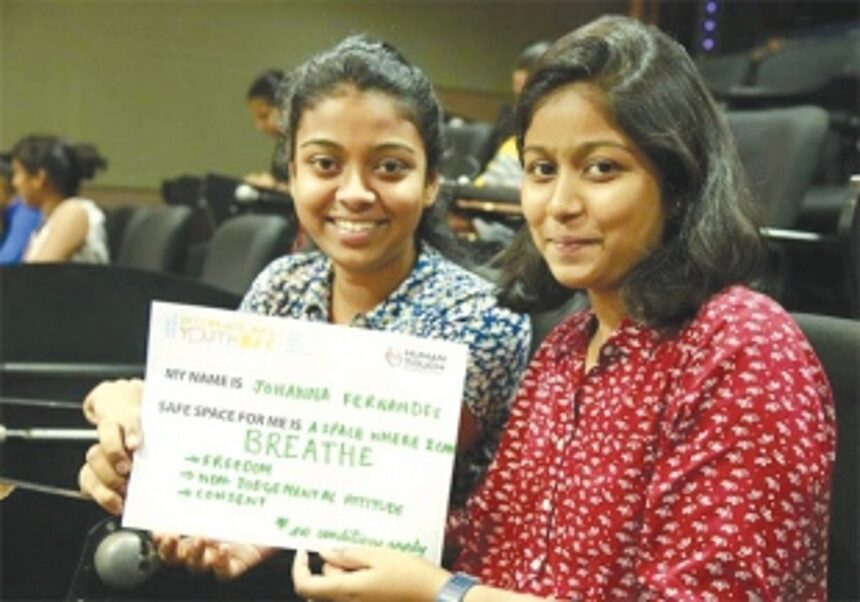
Human Touch Foundation marked International Youth Day with a panel discussion in line with the
theme for the year, ‘Safe Spaces for Youth’. The event, held at the Lecture
Hall of Sanskruti Bhavan, Patto-Panjim, received tremendous participation from
the youth.
The panellists for the discussion were Elvis Gomes, President of
Goa Football Association; Esther Torres, Former member of the South Goa Child
Welfare Committee; Sangeeta Naik, Executive Editor Digital Media Goa; and
Kenneth Alvares, student and young entrepreneur from Don Bosco College. The
session was moderated by entrepreneur Evencio Quadros.
Sangeeta, while speaking about ‘Enabling
online safe spaces for children and youth’, gave the audience an insight into
the digital spaces and use of technology productively. She also gave the youth
a list of helpful links to aid them to expand their horizons.
While speaking about ‘child-friendly safe
places for children in need and girls’, Esther stressed that in terms of
spaces, Goa does not lack in anything, but the safety of such spaces is a
question.
Elvis,
who spoke about ‘Creating safe spaces for young people through sport’, said
that though there are a lot of opportunities in sports, these can be an unsafe space too. “It all comes down to
the fact that the children and youth need to have access to somebody who won’t
betray their trust, and we need to give them that,” he said.
Representing the voice of the youth, Kenneth spoke about
‘Creating safe spaces – a youth perspective’. He pointed out that there needs
to be a space in the educational system that can help children grow from a
young age and make the right choices for their career.
Safe Spaces for Youth are platforms where youth can come
together to freely express themselves, engage in activities and interests and
participate in decision-making processes. Available and accessible physical or
virtual spaces can help youth feel valued and advance their cognitive,
emotional and social skills!
The people at Human Touch Foundation believe that youth from
diverse backgrounds especially need to be assured of respect and self-worth.
Similarly, without the existence of safe space, youth from different
race/ethnicity, gender, religious affiliation or cultural background may feel
intimidated to freely contribute to the community.
Earlier,
while giving an opening remark, Peter F Borges, CEO of Human Touch Foundation,
reminded the young people that they need to get more
engaged in spaces and policy making with the government. He highlighted that by
2020, India will be the youngest country with an average age of 29 and hence
the young people will be demographic dividend. “International Youth Day is a
reminder for the whole world that youth is an essential segment of the world
population; therefore we should all celebrate them, support them, empower them and depend on
their energy to change the world, “ said Peter.
“Providing youth with safe spaces will always allow them to be
more creative and to reveal the best of them and to engage more with their
countries and its development,” he added.
The event also announced the winners of the short film
competition ‘Get High on Life’ organised earlier this year by the Human Touch
Foundation. Maryanne De Souza won the first place in the open category for her
film ‘Irrevocable’, while Nitish Naik won the second place for his film
‘Jinechem Darpan – EkValakh’, and Mcvean Pereira won the consolation prize for
his film ‘6 Teen’.
The
winners in the student category were BTS Productions for the film ‘Kick’ in the
first place, Devraj Parab Gaonkar won the second place for his film ‘Jivanachem
Moll’ and Sheena Pereira secured the consolation prize for her film ‘Crushed
Final’. The evening ended with the screening of the winning films,
‘Irrevocable’ and ‘Kick’. The film competition was sponsored by GKB Hi-Tech
Lenses Pvt. Ltd. Tivim.
How the World prioritises Safe Spaces for Youth
The 2030 Agenda for Sustainable Development, specifically Goal
11, emphasises the need for the provision of space towards inclusive and
sustainable urbanisation. Furthermore, the New Urban Agenda (NUA) reiterates
the need for public spaces for youth to enable them to interact with family and
have constructive inter-generational dialogue.
Additionally,
the World Programme of Action for Youth (WPAY) which is the UN framework for
youth development, prioritises the provision of ‘leisure activities’ as
essential to the psychological, cognitive and physical development of young
people. As more and more youth grow in a technologically connected world, they
aspire to engage deeper in political, civic and social matters, and the
availability and accessibility of safe spaces becomes even more crucial to make
this a reality.