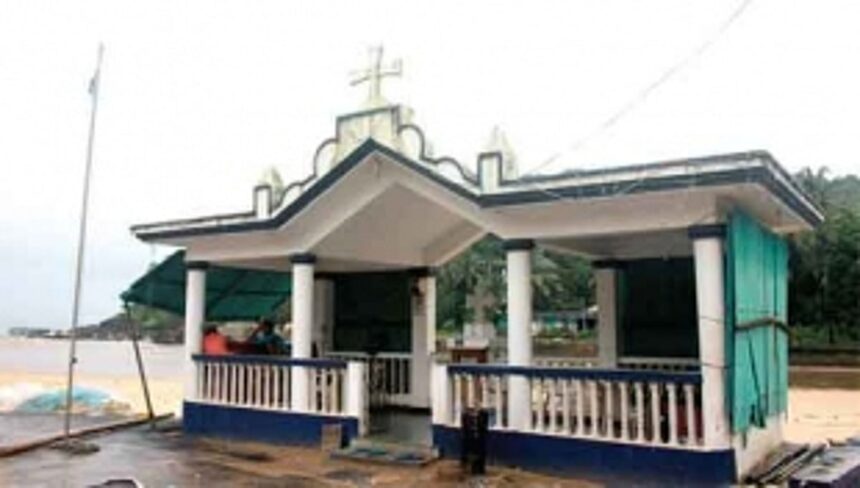
Just
a few days before the big day, fishermen repair their
old fishing nets, paint the old hulls and plug any possible leaks in
their boats, while others purchase new boats and equipment. These
boats are then decorated with colourful buntings, flower garlands and
paper flags. August 1 will mark the lifting of the fishing ban. Since
the job of the fishermen who venture into the deep sea is a risky
one, among the many that visit the Holy Cross Chapel at Baradi are
the traditional fishermen and the trawler owners, praying for a safe
and fruitful fishing season from August of the current year to June
of the next. People from the fishing communities of Quepem, Canacona
and Salcete throng to Baradi during this time of the year.
Manuel
D’Silva from Velim, who is involved in the fishing business, says
that he visits the Cross to pray for a bountiful fish harvest, safety
of the fishing boats and the fish in the sea. The families of trawler
owners and ramponkar
are
also seen visiting the Cross with the hope that the season would keep
them peaceful, strong and without any danger to life and livelihood,
asking for strength and guidance during rough weather and stormy
seas. Felicidade Mascarenhas, a fish vendor from Raia, said that that
she invokes blessings for all and prays for the best fish harvest
this season.

In
the village of Morjim, the fishing community live in harmony and are
part of all the celebrations. Vilas Morje is a member of the fishing
association and highlights the importance of prayers before the
fishing season commences. “In Morjim, we celebrate the festival of
Narali Purnima or the Coconut Festival with great fervour. An elder
of the community leads the procession of people to the temple where
the coconut is offered and prayers for a good catch and safety of the
fishermen are made. The elder has to maintain a vegetarian diet. From
the Kuldev temple, we then proceed to the Devi Morjea and then to
Shree Satpurush Temple and finally to Morjim beach. This is a
tradition followed by our forefathers and we continue following it in
the same manner. Working villagers also take the day off, especially
to be a part of the celebrations,” says Vilas.
The
blessed coconut is immersed into the sea during high tide in the
morning. There are around 100 families belonging to the Hindu,
Catholic and Gawde communities involved in the fish trade.“The
feast of St Lawrence is celebrated at the Church of Our Lady of
Miracles at Morjim when the parish priest blesses the sea,” adds
Vilas.
Ronny
Fernandes is the President of the Holy Cross Committee at Baga. Every
year, on August 1, the fishing community at Baga gets together at the
cross and then head to the Retreat House, just opposite the Cross, to
participate in the Holy Eucharistic celebrations. “We have been
venerating the Holy Cross for generations but since it is a cross and
not a chapel, we have started celebrating mass at the Retreat House
since the last ten years. There are nearly 50 families that take part
in the celebrations and we offer fresh fish, miniature boats and nets
during offertory,” says Ronny Fernandes who is also President of
the Sant Khuris Fishermen Association, Calangute.
Another
fishing community that comes to life before the fishing ban is lifted
is situated in Ribandar. Michael Fernandes, President of St Peter
Chapel, Old Goa, says, “Every year for over 100 years, we have been
celebrating Sangodd to pray for the safety and bounty of fishermen
from Ribandar. The celebrations begin when the Parish Priest of Ajuda
Church take the statue of St Peter in a procession from Ajuda Church,
Ribandar. The priest gets onto the two boats that are tied together
in the river right from the church to the Goa Institute Management
where it takes a turn and comes back to St Peter’s Chapel. The
water is blessed with holy water and the Litany is said at the
chapel,” says Michael, who has been taking the lead of the
fishermen’s culture activity for the past 12 years.
“The
evening activities begin when all the villagers get together for a
procession in the traditional canoes in the river known as
‘Traditional Sangodd’. The community is very active in Ribandar and
the festivity isn’t just enjoyed by the traditional fishermen and
their families but all the people who are now living in Ribandar, no
matter what the community. The number of participants is increasing
every year. For the last 17 years, we have been organising the annual
fishing competition on August 15 and this year too it will be a grand
affair. We want to encourage youngsters to continue with this
traditional trade,” adds Michael, who is also a member of the
Ribandar Fishermen Association.
The
feast of St Lawrence at Sinquerim marks the beginning of a successful
post monsoon fishing season for the villagers. The peaceful greenery
of the hillock where the Church is located has been preserved by the
villagers. St Lawrence Church dates back to 1688 and will be
celebrating the feast of their patron, St Lawrence, with a unique and
meaningful celebration on August 10, as is the yearly practice. The
sea is blessed by the parish priest after the solemn Mass and the
fishermen can venture into the sea. According to the traditions,
without the blessing of the sea, the fishermen would not start their
fishing season. The sea is first blessed and then the fishing
activities begin. Many people from different walks of life make
petitions to St Lawrence.
During
the Portuguese time, a captain boat would be taken into the sea at
the entrance of the Mandovi river with the parish priest and the
Confraria members. The parish priest would bless the sea with a sword
and 21 cannons would be fired at the sea to mark that the sea is open
for fishing. This whole area, right from the Candolim junction to the
hill, was occupied by the Portuguese and they did not allow anyone to
walk in. Villagers were allowed to attend Mass and the Portuguese
soldiers would also attend Mass with uniform and artillery. Since
venturing mid-sea in a boat is no longer feasible, the blessing takes
place from the bandstand that faces the sea.