An initiative highlighted last week closely looked at a very pressing issue in the
state: waste management. It has been well-documented that Goa has a major issue
with waste management, and much has been also said about how when it comes to
any issue, looking away is not going to make it disappear. Along with a group
of individuals, Clinton Fernandes founded ‘Team Up To Clean Up Goa’ in a bid to
(as a first step) keep Goa’s coast pristine.
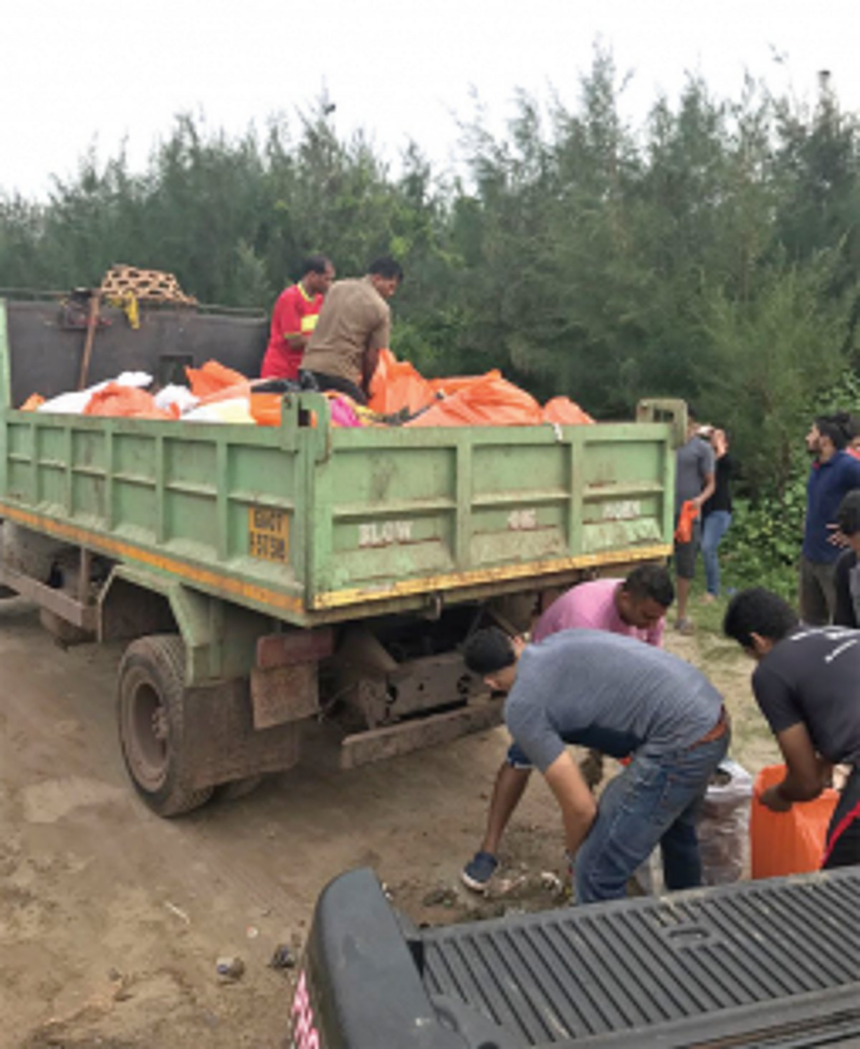
Thus far, Clinton and his troopers have managed to clear the
beaches along Reis Magos and a large section of Caranzalem. Every single piece
of litter that was deposited along the shoreline was picked up and segregated
on the basis of whether it was plastic, paper, glass, metal, non-recyclable
rubber or styrofoam. At Reis Magos, even a dead dog that was thrown into the
sea was buried. At Caranzalem, the group picked up close to 1,000 kilograms of
litter from the beach, and the trees and shrubbery lining it. The amount of
broken alcohol bottles found on it was also massive. However, while Clinton’s
model has seemingly yielded results, the question remains as to why the same
impetus can’t be given when it comes to the in-land.

Sharing his views on the matter, and how to ensure the system
works, Clinton says, “The big issue is reaching people. You can be assured of
10% of the people who support you on social media platforms actually turning up
to the place on the day. Hence, if you need 50 people as the realistic number
of hands on deck, you need to find a way to reach out to 5,000. Even as a
follow up to what we did, many people were curious as to where all the waste
that ‘Team Up To Clean Up Goa’ collected went. When they were all invited to
the waste treatment plant to see what happened, 28 people confirmed and only
about seven of those turned up. That’s the reality of the situation.”
However, one major bone of contention here could well be that
while the beaches are ‘for everyone’, the private spaces are more of the
residents’ concern. Here Clinton points out that in every area, there needs to
be one dynamic person who wants to lead from the front, and who is willing to
quite literally get his/her hands dirty to take on the task at hand, without
which this cannot work.
Clinton’s views are further highlighted by a tale that is told
by a resident much further down south. It’s a tale that shows how very often
these situations are, of course, the creation of a lack of neighbourhood
coordination itself. Prem Anand, a resident of Comba, shares his harrowing
experience, with attempting to deal with waste management. “There used to be a
couple of bins placed by the municipality, between where I live and a colony
called Indira Apartments. I used to place all my garbage in the bins there. One
day, as I was doing so, a man from the colony accosted me, and told me that I
couldn’t put my garbage there as it was ‘reserved for the colony’. When I
questioned why, given that the bins were along the main road and not within the
colony’s boundaries, I was physically assaulted and told that if I continued to
do so, it would be at my own risk. After that, every time I kept my garbage
there, it would be moved to the side, on the road. After a while, I just
started finding bins further away from home. It’s been years since the episode
now, and I’ve put it behind me. It is this attitude, where we selfishly address
only our own interests, that keeps us from progressing.”
Citizen initiatives are the best hope for a cleaner future.
Looking back to 2015, in a then unprecedented move, the Kamat Estate Housing
Co-Op Society in Tonca had become the only housing colony in the state that
successfully managed to treat 100% of its own waste. The organic project of
converting kitchen waste to compost that was used to grow a kitchen garden was
hailed as a huge step forward.
Perhaps
we need Clintons or Kamat Estates to set the tempo for what needs to be done.
Or perhaps we should just keep waiting for people like them to turn up and do
the job, and just become those people ourselves, instead.