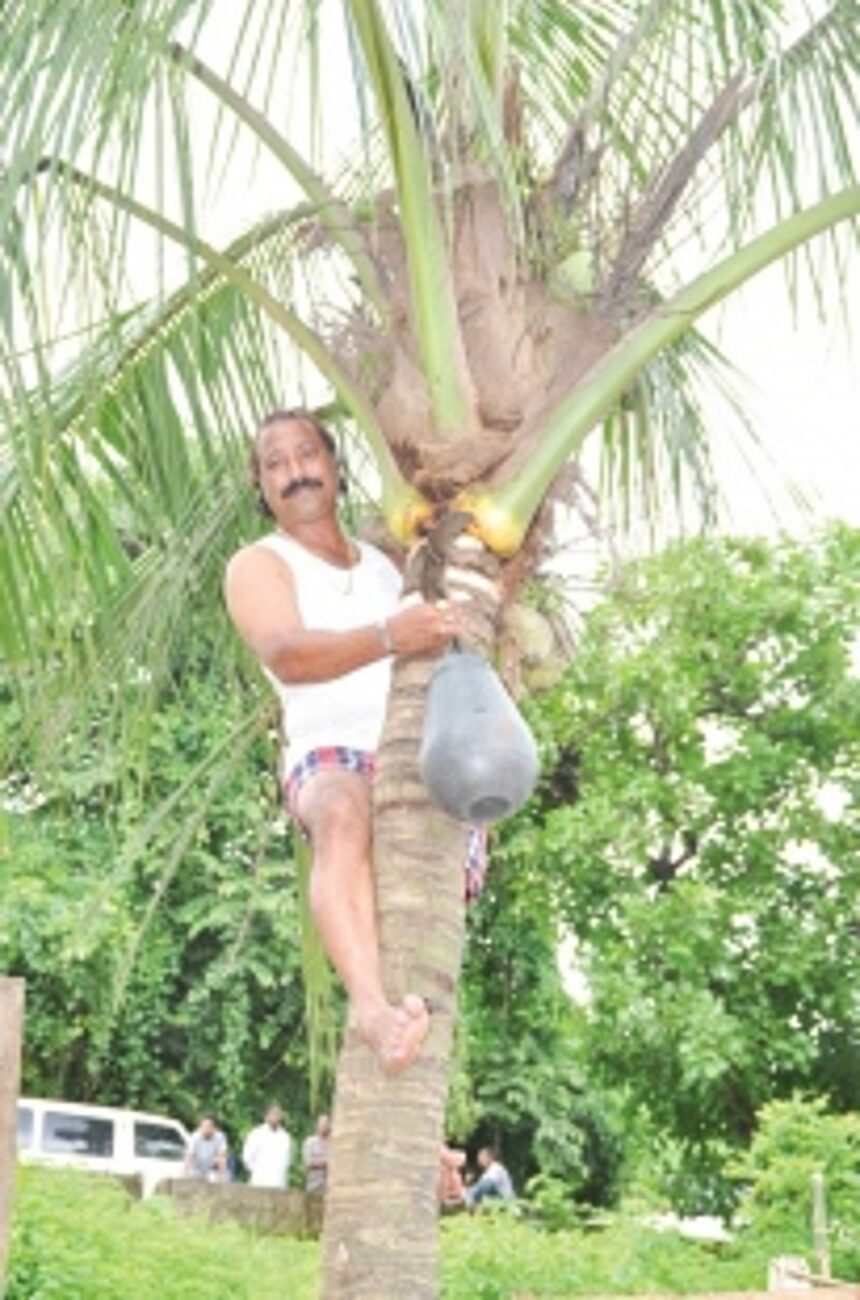
Though it once was a common sight, spotting
a coconut plucker painstakingly climb up a coconut tree is now a rare vision.
What was once one of coastal Goa’s most important occupations in now finding
few takers.
Gaspar Afonso from Velim is the President
of All Goa Toddy Tapper Association. He has seen the days when the ‘paddeli’
was a glorious occupation and watched as its importance slowly dwindled. “The
trade is dwindling as there are less ‘paddelis’ and those who are currently in
the trade are mostly aged above 60. The next generation is not interested in
taking on the ancestral occupation and feels that there is no respect in being
a ‘render’. They can make fast money by just working abroad for a few months
and buy a house and car. I tried convincing many youngsters to join the
occupation,” says Gaspar.

Under their association, they usually
charge between Rs 40-50 per tree while the daily wage is Rs 400 for half a day
and Rs 800 for a full day’s work. “Earlier, we used to add manure for the trees
in the month of August by digging the mud around the roots and adding leaves
and grass and covering it up. Now, we only pluck the coconuts. Most houses with
a few trees prefer letting the coconuts fall off the tree instead of employing
a ‘paddeli’ for plucking just 2-3 coconuts from a single tree,” he adds.
Vicente Silva from Benaulim, being a
‘bhatkar’, has a lot on his mind. “In the olden days, we used to have many
employees at our disposal. In fact, the role of the conventional ‘bhatkar’ was
quite diverse and required tending to several responsibilities. In doing so, we
would have a set of ‘padekars’ who would regularly tend to our trees. However,
now, it is much more tedious to arrange for this labour. Even if the labour can
be sourced, agreeing on a fee for services rendered can be time-consuming and
laborious. An all day wage can go up to Rs 1000 per person.”
Maxwell D’Souza, a youngster from Kodxella,
a small coastal village in Bardez, found the idea of climbing coconut trees
using the machine rather interesting. Though he had watched his ancestors make
their living by tending to the trees in the vast coconut groves in the
vicinity, he wanted to do the same in a safer manner. “I attended the one week
course offered by the Goa State Horticulture Corporation Ltd (GSHCL) and they
gave us a machine and a certificate. I was always worried about the marks the
rope would leave at the ankle but the device which is made of steel square
pipes is very stable and doesn’t put a strain on the legs,” says Maxwell.
He was accompanied by more than 20
youngsters who completed the course and are now plucking coconuts around the
state. “The nominal fees are Rs 45 per tree and a coconut. There are many
coconut trees and it is an advantage to use the machine and earn something,”
adds Maxwell.
It is interesting to see the contrast in
reactions from across the state and we can only hope that the youngsters in the
state find ways of adopting traditional occupations and keeping them, and the
ethnicity of Goa, alive.