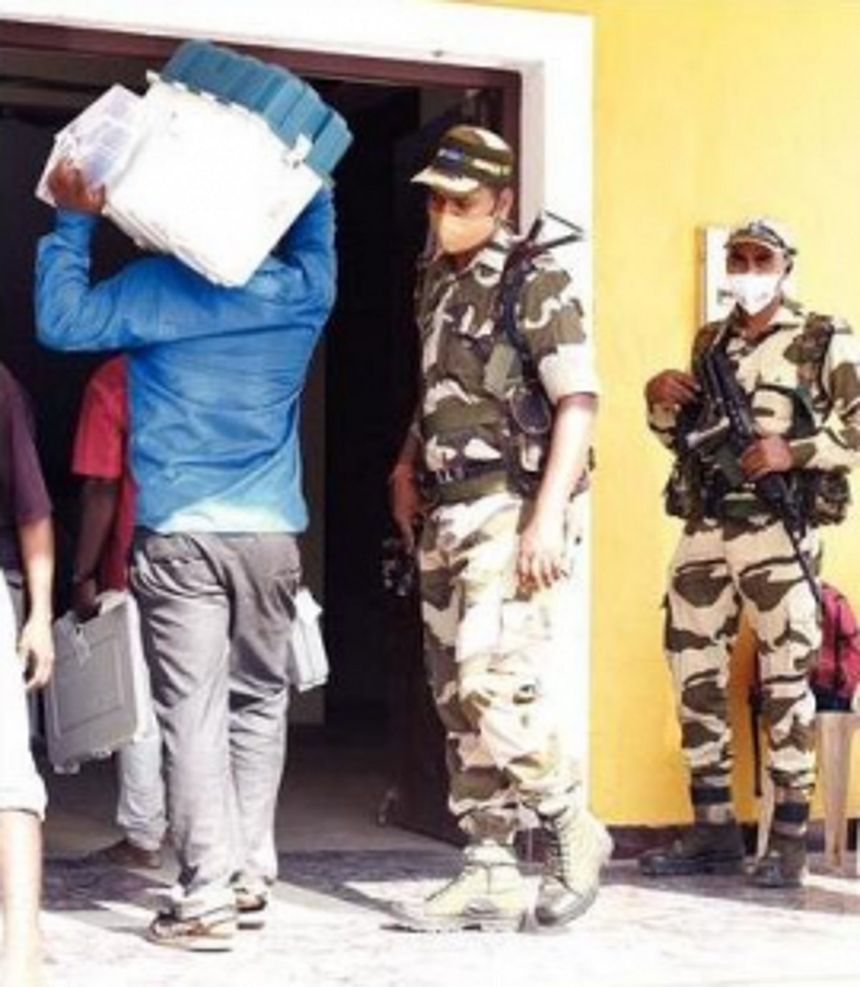
Elections are over. EVMs are packed and sealed. Psephologists are busy. TV channels are in overdrive. Voters and candidates are anxious. Thanks to an irresponsible Election Commission of India the suspense will prolong unto the last phase. Well what else could the ECI have done?
Newspapers reported “The Chief Election Commissioner Sushil Chandra said the voting in UP will take place in seven phases starting from February 10, voting in Manipur will take place in two phases starting from February 27, while Punjab, Uttarakhand and Goa elections will be conducted in a single phase on February 14. Results of all the assembly polls will be declared on March 10.”

For one, the ECI ought to have been more circumspect in fixing the election dates for the States other than Uttar Pradesh, where elections are held in seven phases.
What exactly is the logic for the ECI to hold the elections for Goa and the other two States some three weeks, before the counting date? Why should these States be burdened to keep 24-hour security to safeguard the EVMs, for a period of three weeks? Would it not have been ideal, if elections to these three States were held with the last polling phase on March 7 with the counting three days later? Are people wrong in openly proclaiming that something is rotten in the ECI? Are the skeptics not justified in claiming, (perhaps wrongly) that the ECI has created this prolonged gap between voting and counting to facilitate tampering with EVMs? And what exactly is the purpose in extending the “code of conduct” till the declaration of results?
Due to the pandemic these elections have involved restrained campaigning. Most constituencies have seen genuine full-fledged triangular, quadrangular and even pentagular contests. So it is difficult to foresee the results. And in all this confusion, it is only the Revolutionary Goans a brand new party that can accurately and fairly claim that it has fielded candidates untainted by the malaise that afflicts other parties. However about their abilities, no data is available. The other parties, BJP, Congress, AAP and TMC-MGP are a collection of defectors, cross-defectors, discards and other unsavoury characters. Can these be trusted to provide a government superior to the previous dispensations?
It is of course easy to blame the politicians. But do the politicians not come from the same citizenry? Are the politicians not in power because the voters have placed them there? Is it not, that the more serious the allegations the greater are the chances of victory? Is it not the voters, who go to the MLAs seeking jobs for their wards by circumventing recruitment procedures? Has it not so openly happened in the Health Department, where a huge majority of recruits are from Sattari Taluka? How can honest voters elect and more particularly re-elect such leaders? So do the voters not have to share the responsibility for the mess?
I was largely an observer, in the present campaign. And as far as I could see, for the majority of voters the issue was just one. Who doles out more? For the first time, I could see the same group of “workers” accompany most of the candidates, (except those of the RG), in the door to door campaign.
Now the question, was it always so? In my experience the answer is an emphatic no. Politics in the years following liberation was different. There was clear-cut commitment to a cause and the party that espoused it. The MGP did not recognise that Goa had a separate identity and believed it was part of Maharashtra and worked for its merger, with that State. The UGP was for Goa to maintain its separate identity and successfully defended its stand, at the Opinion Poll. For the first about a quarter century, Goans voted entirely on issues. Money was no consideration for a vote.
Why was it so and how did it change? For four hundred and fifty years the Old Conquests were under the rule of the Portuguese, who stamped their deep imprint on the life of the people. The impact of such rule was less intense on the New Conquests. Nevertheless, it is this Portuguese influence that makes the whole of Goa different from the rest of the country. Otherwise, Goa would be just another piece of the Konkan littoral, between Malwan and Karwar, with nothing to choose between them.
Even, a diehard opponent of Colonial rule may not be able to coherently dispute, that the Portuguese brought discipline and order into our society. And this facet continued to hold, so long as those born and brought up in pre-liberation Goa managed to dominate the social and political discourse, in the years following liberation. Gradually and inevitably by the 1980s, the old order began to change as the Congress seized power and signaled the commencement of the degeneration, we witness today. The regional parties which until then adhered to the old style became redundant. And thus Goa came to join the national mainstream. And like all new converts, we tend to be more Indian than the original, displaying the fervour of the new convert with great vigour.
Is there a way out of the morass? Certainly there is. Today, it is virtually impossible for genuine persons even to think of contesting elections. It will remain so, as long as the majority of voters continue to behave, as commodities. Will the voters reform? Or will the voters continue to blame the leaders, whom they unflinchingly elect and re-elect?
(Radharao F. Gracias is a senior Trial Court Advocate, a former Independent MLA and a political activist)