Wash wash wash your hands. Ah, yes, we have water and enough of soap cakes. That Lux or Dove soap that aunty Conceicao brought, or one of those organic soaps from Thailand. And again, wash your hands. Ah, but how? We have no water, our landlord says that since you are not paying rent, I cannot be out of pocket and pay for your water and electricity consumption.
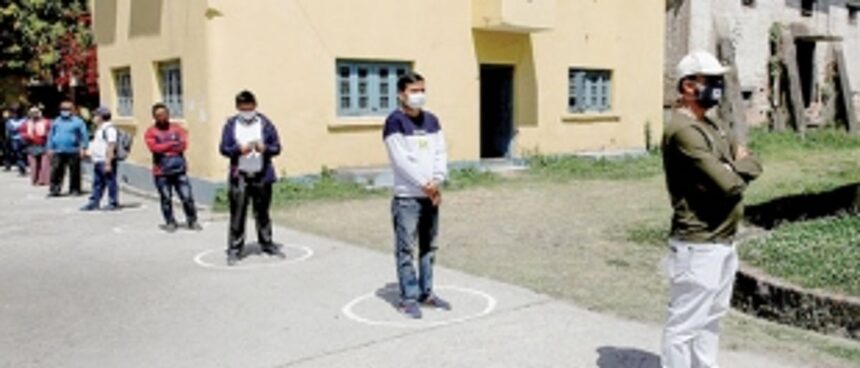
Stay at home to prevent transmission. Oh, yes, I can. I, Jitendra, have a spacious house and transmission prevention is possible. I don’t really need to go out anyways. Stay at home and keep distance. Really? But how do I do it within a cramped space where ten of us are housed. Wear a mask. I have a pharmacist friend and he got me some ten masks. Wear a mask. But there is a shortage of masks. Oh, but the self help groups are making the masks. Yes, they made the masks. And they were paid Rs 6 with cloth provided to them, but the price of the mask was Rs 40. I couldn’t afford the masks and the detergent to wash them. And, er…. Ministers are made of different matter. They don’t need to wear masks.

But what about food provisions? I, Marinella, live in a gated society, and we had branded bread, and vegetables and fruits and provisions at our gate steps, with some efforts from the building society. What about food provisions? Bakeries were told to close, and you had to ask for bread from the bakery delivery person, but there were no mobile numbers available, and when we – nameless people – went out because we needed provisions, it was as if the Central Industrial Security Force or the police were set upon us. And vegetables? We spent half a day to get vegetables, and other provisions, even if we had some money. And some of my friends didn’t even have the money.
There is an announcement that rations and food are being made available via home delivery. I get my provisions delivered at home. Even cooked food if I ask for it. Home delivery? But I am a garbage collector and I was not at home during delivery timings. I am a king when I am roaming with the mobile garbage bin. Without it I am nobody. But I also cannot afford the aggregator food rates and the helplines are not working.
Lockdown. Ah, no problem. Holiday. I did a lot of courses, attended a lot of webinars. When I worked from home, my internet was in order generally, and I had a cousin I could call upon to instruct me if I couldn’t work something. Lockdown. Stay at home. No water. Breathe each other’s smells, think of my people back home. My mother, my son, my wife….my didi…. What must they be eating? I cannot send any money to them also.
Offices closed. Work from home. No problem. I have an internet connection and can work from home. Offices closed. Work that I do cannot be done from home. I am the office peon. The employer says I didn’t work, so he cannot pay me for work I never did. But there is a Government circular that he must pay. Well, I don’t even figure in his employment records. And if I make a noise, I have no job possibilities post lockdown.
Section 144 CrPC is on again now. But I can meet through an app. What meetings are those that will be prevented? What are the avenues to register protests for the masses of people? I don’t know. Technology for all is not what I heard in any scheme. Also, the app is spying, they say. Anyways some people get arrested anyways, under UAPA, which is a very useful law to the powers that be to check dissent. Now they have a more useful weapon. And Section 188 IPC can cover just about anything and everything they want to find wrong with you.
They started transportation of mining. Ah, trucks moving up and down. Respiratory problems for us on the wayside, which bring down our immunity further. But we are the dis-gracados, no?
So as you can see the advisories/directives/ guidelines or whatever they are called, but which have binding value, following the pandemic, have had different consequences for different people. If anything, the COVID- 19 pandemic has seen a reinforcement of existing prejudices, but the silver lining is that it has also foregrounded these inequities. The inequities of caste, class, gender, ethnicity, age. These issues have been on the frontlines.
It is true that the diseases like COVID-19 are beyond these axes of discrimination, or, for that matter, environmental disasters too – they strike a person irrespective of who it is, or a location irrespective of who lives in it. But as can be seen the fact remains that there are social and economic determinants that determine the way in which a disaster takes effect on populations and impacts them. The pandemic has therefore, in a sense, morphed into a crisis of public policy, be it in India or in many other parts of the world.
The public policy measures that thrived on keeping marginalised people at the mercy of politicians for securing what is rightfully theirs, were once again in display in the manner in which matters were being prioritised. Goans v/s non-Goans v/s Goans, trawlers v/s fishers, corporates v/s people, America v/s China v/s America, Hindus v/s Muslims, landlords v/s tenants, – all these racists, casteist, and classist tropes were recycled again, albeit in different forms.
Am I suggesting that people of dominant castes and classes did not suffer? No, they probably also did. But not in the manner and measure that others did. Their networks would have ensured that they did not go hungry, barring a few exceptions that is – like old people or the terminally ill who despite the means could not get help. But on another note, were the many displays on social media of cooking and gardening adventures and hobby horsing, which means that this proved to be a respite from the routine of life for the dwij gracados (the doubly blessed). Which is not to say that this should not have happened. Everybody needs a good break. Everybody needs a good pandemic, perhaps to sit and take note of the utility or futility of some or all of the things that we do, is what I can sarcastically say. What remained hidden is the brunt of COVID19 measures being borne heavily by the dis-gracados – the already disadvantaged sections of society.
(Albertina Almeida
is a lawyer)