Goa’s long history as a Portuguese territory, spanning right from the early 16th Century until the middle of the 20th Century, is undoubtedly visible in living traditions practiced within its society.
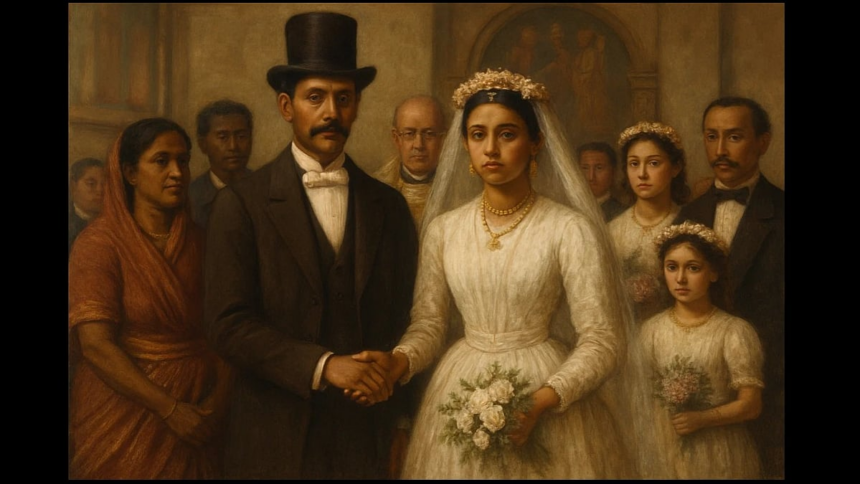
Uniqueness of Goan tradition is due to the homogenous blend of European culture with that of the indigenous. One such unique practice traditionally observed among the orthodox Goan Hindu community is that of gifting idols of a particular God or Goddess to a girl at the time of her wedding.

Some Gaud Saraswat Brahmin families in Goa follow a practice wherein the Bride’s mother gifts her daughter an image of Lord Ganesh who is believed to be the Lord of knowledge, an image of Goddess Lakshmi as being the Goddess of wealth so that the couple setting out to establish a new family may be blessed with prosperity and an image of Baby (‘Bal’) Krishna in a cradle hoping that the newly married couple would be blessed with male child very soon (a male child in India was culturally considered as the lamp of the house, in Goa referred to as ‘ghoracho divo’). These idols were given as part of the wedding trousseau and were generally made of silver or other precious or semiprecious materials. The idols along with the complete trousseau are displayed for the viewing pleasure of close family and friends on the occasion of the wedding. This formal display of the trousseau and dowry is locally known as ‘rupawat’ or ‘rukwat’.