SHASHWAT GUPTA RAY
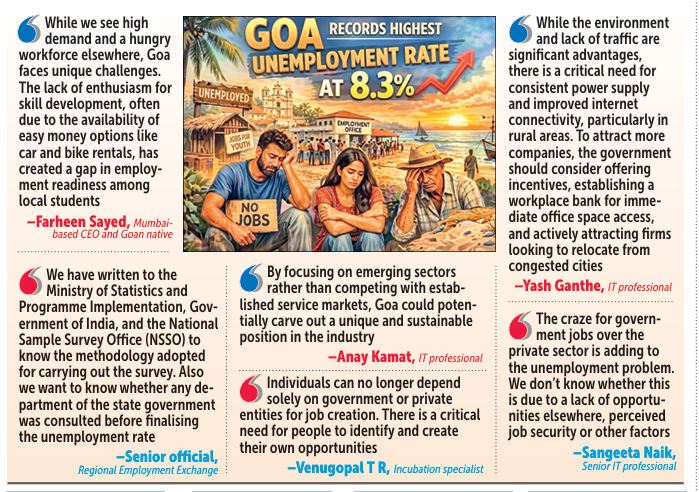
The Goa gov ernment’s promise to fill around 22,000 vacancies before the next Assembly election may offer hope to thousands of job seek ers, but industry experts and professionals say the announcement also ex poses a deeper crisis: a State with India’s highest unemployment rate and few signs of a sustainable strategy to create long term solutions. According to the latest Periodic Labour Force Sur vey (PLFS), Goa’s unem ployment rate stands at 8.3 per cent — nearly three times the national average of 3.1 per cent. The figures have placed Goa, often projected as one of India’s most prosperous States, at the top of an unenviable na tional ranking. Against this backdrop, Health Minister Vishwajit Rane made headlines by declaring that Chief Min ister Pramod Sawant is a ‘magician’ capable of cre ating and filling 22,000 government vacancies before the next assembly elections. The statement reignit ed a familiar debate: why are thousands of educated youth still chasing scarce government jobs in a State that has struggled to at tract large-scale private investment and create a diversified employment ecosystem?

For many professionals, the answer lies in a combination of policy inertia, infrastructure shortcomings and a grow ing mismatch between industry requirements and work force preparedness. Farheen Sayed, a Mumbai-based entrepreneur and CEO of AI-skilled talent company Vanillakart who hails from Goa, said the State’s employment challenge goes beyond the availability of jobs. “While we see high demand and a hungry workforce elsewhere, Goa faces unique challenges. The lack of enthu siasm for skill development, often due to the availability of easy money options like car and bike rentals, has created a gap in employment readiness among local students,” she said. Sayed noted that previous generations were more will ing to invest in acquiring new skills, while many younger job seekers today appear reluctant to make the same effort in an increasingly competitive economy. Others point to the State’s inability to create conditions that would attract knowledge-based industries.
Yash Ganthe, an IT professional who returned to Goa af ter working in Pune, said quality of life alone is not enough to persuade companies to set up operations in the State. “While the environment and lack of traffic are significant advantages, there is a critical need for consistent power supply and improved internet connectivity, particularly in rural areas. To attract more companies, the government should consider offering incentives, establishing a work place bank for immediate office space access, and actively recruiting firms looking to relocate from congested cities,” he said. The lack of a concentrated technology ecosystem has also limited opportunities for professionals seeking career growth. Anay Kamat, another IT professional, observed that un like established hubs such as Pune and Bengaluru, Goa’s technology companies are scattered across different loca tions, making collaboration and mobility more difficult. “By focusing on emerging sectors rather than competing with established service markets, Goa could potentially carve out a unique and sustainable position in the indus try,” he said. Yet the strongest evidence of the State’s employment im balance may be found in the overwhelming rush for gov ernment jobs.
Senior IT professional Sangeeta Naik pointed to the re cent recruitment process conducted by the Goa Staff Se lection Commission, where more than 24,500 candidates applied for just 479 police constable posts — an average of 51 applicants for every vacancy. “The craze for government jobs over the private sector is adding to the unemployment problem. We don’t know whether this is due to a lack of opportunities elsewhere, perceived job security or other factors,” she said. Naik argued that the State must focus on creating an eco system that encourages entrepreneurship and risk-taking rather than reinforcing dependence on government em ployment. That concern was echoed by incubation specialist Venu gopal T R, who said neither government departments nor private companies can be relied upon indefinitely to ab sorb the growing workforce. “Individuals can no longer depend solely on government or private entities for job creation. There is a critical need for people to identify and create their own opportunities,” he said, while cautioning that entrepreneurship requires patience, commitment and a willingness to move beyond the comfort of guaranteed employment. The government’s response to the alarming unemploy ment figures has been cautious.
A senior official from the Regional Employment Exchange questioned the methodol ogy used by the Centre to arrive at Goa’s unemployment rate “We have written to the Ministry of Statistics and Pro gramme Implementation, Government of India, and the National Sample Survey Office (NSSO) to know the meth odology adopted for carrying out the survey. Also we want to know whether any department of the state government was consulted before finalising the unemployment rate,” a senior official at the Regional Employment Exchange coun tered. But for many observers, challenging the numbers does little to address the reality confronting thousands of young Goans searching for work. The larger question remains whether the recruitment of 22,000 employees will mark the beginning of a broader employment strategy or merely serve as a temporary polit ical remedy ahead of an election.