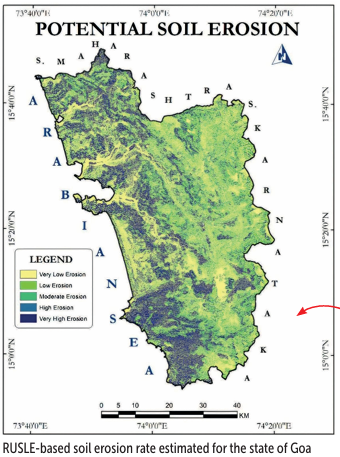
Over 24% of the State’s land mass has been found to be highly suscep tible to soil erosion due to poor conservation practic es, which cover nearly 94% of Goa’s area, says a study. The study shows that the impact of increasing rain fall intensity and changing temperature patterns is ac celerating land degradation in Goa. If timely soil conservation and sustainable land management strategies are not implemented, the eco logical balance and longterm productivity of the re gion could be at serious risk.
Titled ‘Mapping and Quantifying Integrated Land Degradation Status of Goa Using Geo-statisti cal Approach and Remote Sensing Data’, the study has been published in the jour nal Nature Environment and Pollution Technology. “It focuses on mapping and quantifying integrated land degradation in Goa using ad vanced geospatial techniques such as remote sensing, GIS, and geo-statistical analysis,” said Dr Venkatesh Prabhu Gaonkar, lead author of the study and Assistant Profes sor, Department of Geo-in formatics, Government of Goa’s Autonomous College of Multidisciplinary Studies and Research, Margao. “It evaluates how different environmental and human factors, such as rainfall, land-use changes, soil character istics, and terrain, contribute to soil erosion,” Dr Gaonkar added. The research also examines how variations in rainfall intensity and surface temperature conditions influence land degradation patterns.

By applying the RUSLE model, the study provides a scientific understanding of how soil loss is spatially distributed across the State. “The study was undertaken because land degradation is becoming a serious environmental concern in Goa, driven by rapid urbanisation, deforestation, mining, and chang ing land-use patterns. Additionally, changing climatic conditions, including increasing temperature trends and intense rainfall events, are accelerating soil erosion and reducing land productivity,” Dr Prabhu Gaonkar said. Despite Goa’s ecological richness, there has been a lack of comprehensive spatial assessment of land degradation. “Hence, this research aims to provide a scientific and data-driven approach to understanding degradation pat terns and supporting sustainable land management,” he said. The findings have strong implications for environmental planning and policymaking in Goa. They help identify high-risk zones where soil conservation measures must be prioritised. “The study highlights the need to manage tempera ture-driven climatic stress along with rainfall impact, as both influence soil stability and erosion. It supports sustainable land-use planning, especially in ecologically sensitive areas like the Western Ghats and coastal zones,” he said.