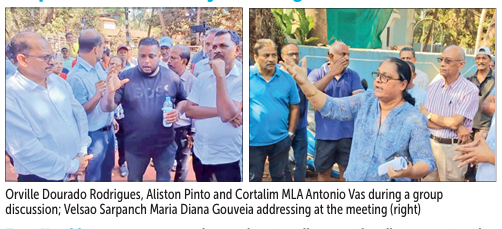
A crucial vil lage meeting held near the railway gate in Velsao on Thursday witnessed an initial phase of sharp ex changes before discussions moved towards a collective search for solutions over the long-pending proposal for an underpass or flyo ver connecting Dando to Primeirovaddo, with resi dents ultimately resolving to form a 10-member vil lage panel to pursue the matter with the Railways through Cortalim MLA Antonio Vas. A large number of villag ers attended the meeting, along with Cortalim MLA, his supporter Aliston Pinto, social worker Roquezinho D’Souza, as well as Sarpanch Maria Diana Gouveia, panch members and senior villag ers including Orville Doura do Rodrigues and Max De Souza. Police personnel were also present. The issue has been a long-standing source of tension within the village, with rival groups often at odds amid the ongoing double-tracking works and what many residents de scribe as inaction and lack of clarity from authorities. At the outset, the sar panch informed those gath ered that she had not been formally alerted about the meeting but chose to attend after seeing messages circu lating widely in the village. A large number of residents turned up, reflecting the se riousness of the issue. The central grievance re volved around difficulty in crossing the railway tracks, with villagers stating that connectivity between the two sides has severely dete riorated. Several residents said some homes alongside the track have effectively become landlocked, with no proper vehicular access and, in certain cases, even pedes trian access proving difficult. A recent fire incident was cited as an example of the risks involved. Villagers said the fire brigade was stuck on the opposite side of the track and could see a house burning but could not cross. With a culvert also dam aged, the fire tender had to take a long detour via neighbouring Arossim be fore reaching the site, by which time the affected family had suffered signifi cant losses.

Residents cautioned that even if an underpass is constructed, height re strictions could prevent ambulances and fire tenders from passing through, and questioned how landlocked families would access such a structure in the first place. The Sarpanch highlighted the plight of fishermen, describing them as the main community in the village, and said they cannot afford to be stranded at the railway gate for long periods with their fish catch en route to market, as delays directly impact their livelihood. She added that an underpass with height restrictions could also block their vehicles. The discussion then turned to the possibility of a flyover, with villag ers recalling that an earlier railway proposal had the alignment passing through private properties. Max De Souza explained that the flyover plan is not directly linked to the ongoing double-tracking works but forms part of a broader Central Government railway initiative to eliminate manned level crossings. Tempers initially flared over the nature and content of the discussion. The MLA stated that he had not come to debate past issues and that if he wished to speak about the past, he could present a detailed counter, but preferred to focus on present concerns and future solutions. In response, some villagers said this was the first time the MLA had vis ited the area during the current period of difficulty and that references to past issues were meant to explain how residents had been affected, not as a political attack. They added that their concerns were being raised politely in the hope of finding a resolution. One affected local appealed for the matter to remain free of politics, stating that villagers have suffered for years and need practical solutions. Some villagers also questioned whether feasibility studies had been con ducted before the track expansion, given the inconvenience now being faced by residents. Villagers further pointed out that in the past police had been called when railway officials visited the site, and expressed disappointment that there was no meaningful intervention at the time despite rising tensions. As the meeting progressed, tensions eased and both sides agreed to move for ward collectively. It was decided to form a 10-member village panel to formally pursue the matter with the Railways through the MLA and compile past corre spondence between villagers, the panchayat and various authorities, including the Railways. It was pointed out that many of the letters addressed to authorities had been marked to the MLA’s office. It was also agreed that the committee should include around four technically qualified members. The objective, residents said, is to seek clarity from the Railways on their plans, request alternative proposals if one option proves unfeasible, and assess the technical feasibility of the options placed before them. It was acknowledged that there had been a prior discussion on the issue, but that this time it would be revisited through the proposed panel to ensure a solution is reached. The Sarpanch recalled that the panchayat had previously written to the Rail ways regarding drainage and other concerns but had not received satisfactory responses. She said that when the panchayat sought to review plans specific to Velsao, the Railways had presented a plan relating to Cansaulim instead. Another issue discussed was a railway proposal, conveyed in writing last year to the panchayat, to build a three-metre-wide road by taking 1.5 metres from affected landowners, with the Railways contributing the remaining 1.5 metres at its own cost. It was pointed out that such a plan would require No Objection Certificates from the landowners. However, a section of locals, particularly those who have approached the courts, contended that the Railways do not own nor possess specific title docu ments for the land in question. They referred to a letter issued in the past by the Directorate of Settlement & Land Records (DSLR) stating that in the absence of title documents placed on record by the Railways, the land could not be certified as Railway land. They further stated that around 46 respondents from the vil lage have been taken to court and that the matter is pending before the Inspec tor of Land and Survey (ISLR) Court. Speaking to the media, Roquezinho questioned why a stay order had not yet been secured and remarked that as the project is a Central Government initia tive, the MLA cannot halt the work and only the courts can. He added that in the meantime, workable solutions must be explored. Separately, Orville said the ISLR Court had indicated that it could not grant a stay and had informed the petitioners that they would have to approach the dis trict court for such relief. Following this, a section of the petitioners approached the district court, where the last hearing was held on Wednesday, and the next date is scheduled for March 2. The MLA said he was already in discussions with Railway authorities and that, with the panel now formed, they would formally seek detailed plans and clar ifications. He added that the purpose of the meeting was to ascertain whether villagers preferred an underpass or a flyover and to collectively decide the way forward. Villagers also questioned how double-tracking work was proceeding while the matter remains sub judice, stating that work should ideally have been halted until legal issues were resolved. They felt that if the work was stopped, there could be more peaceful and effective planning of solutions, rather than carrying out work they consider damaging to local interests while simultaneously dis cussing alternatives. The meeting, which incidentally marked the first time the two groups en gaged face to face at the site to find a solution to the issue, concluded with the immediate focus shifting to the next round of talks with the Railways.