MARGAO: When Tony Fernandes returned to Goa in 2015 after his stint in the UK’s food industry, he never imagined that he would one day become the most sought-after open water swim coach in South Goa. He says his tryst with the sea began earlier than he remembers, in his native village of Benaulim, where his grandfather and father were both traditional fishermen, and taught him the ways of a ramponnkar at a very tender age.
“I’m a Kharvi, so I will always be a fisherman, no matter where I go,” smiles Tony, whose lithe physique belies his 50 years of age. “In the old days, we used to walk everywhere, and later, we used to cycle. Our arms were strong from all the rowing and the casting of the ramponn. Today, most fishermen my age have switched to motorboats and travel by motorbikes, and it has taken a toll on their health,” he quips.

While sea swimming is second nature to Tony, he found the sheer number of drowning deaths reported across India’s coastal States, and especially Goa, very distressing. “For a country with such a massive coastline, there is so much fear and ignorance of the ocean, and we hear of people who are fantastic swimmers in a pool also drowning in the sea. It is something I could not digest,” he says, explaining why he began offering open water swim lessons.
While Tony has lost count of the number of people he has taught over the past few years, he has coached around 500 students, from ages 6 to 80, in the past one year alone. Of his students, 60 to 70 per cent could already swim in a pool but were woefully clueless when it came to treading sea waters. Tony’s classes do not follow a rigid structure, but are tailored to suit each individual student.
“The first time I meet a student, and watch them enter the sea, I’m able to assess their confidence and comfort levels; and tell if they will take to the ocean immediately, or if it will take time and patience to get them to relax in the water,” he explains. Tony’s coaching classes range from a few days to a few months.
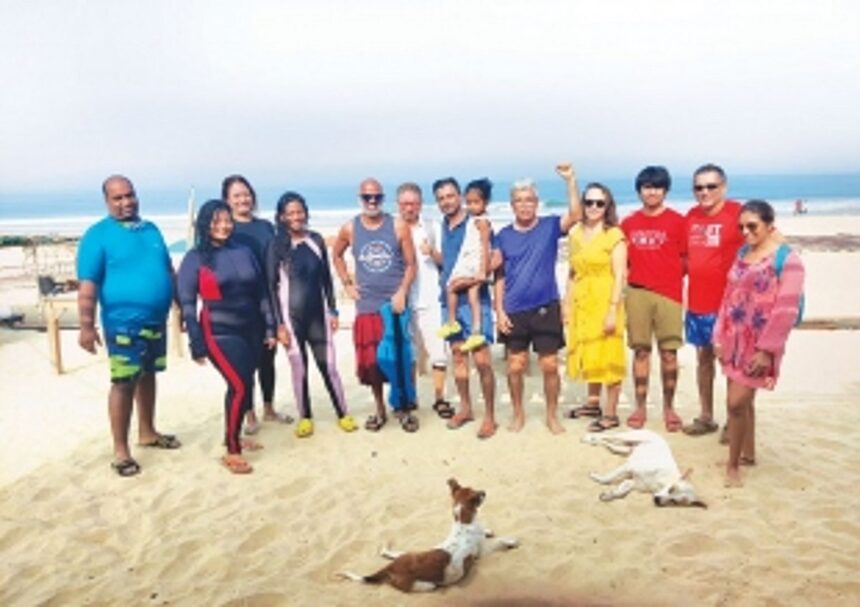
“However, on Sundays, there are no classes; only free swimming and whoever wants to join me is welcome,” says Tony, who has a circle of old students and swimming enthusiasts for whom he organises 2-km and 5 km sea swims every Sunday, in the summer.
“My aim is to teach people to have faith in the water. The human body is by default buoyant, it is not easy to be submerged in sea water. When students are scared, I remind them that they spent several months swimming in amniotic fluid, in their mother’s womb- so swimming is instinct for all mammals. We lose this instinct as we grow up, due to fear and conditioning,” he quips.
On a regular summer morning, Tony and his students can be seen on Benaulim beach, doing warm-up exercises, and practising the strokes while lying on the sand. “The first step is to be able to read the sea- noting the direction of the wind and the drift and understanding the shapes and sizes of individual waves, where they swell and where they break. If the waters are choppy, with five waves coming in at the same time, you should not enter the sea,” he warns. “And even if you are Michael Phelps, you should not enter the water, be it the sea or a lake or quarry, if you have been drinking alcohol,” he adds. An incredible hype man, Tony prefers to go step-by-step while coaching, starting from breathing techniques, moving on to floating and doggy paddling, before teaching strokes.
Now that the monsoon has begun, Tony is taking a short but well-deserved break, before he begins coaching swimmers for the upcoming triathlon in October. “I encourage them to master tackling the longshore current along Benaulim and Sernabatim beaches, after which one can swim anywhere,” he says.
Tony still swims out into the sea with his net, to catch catfish and sturgeons. “Oh, and the occasional sting ray,” he says, fidgeting with the scar on his wrist, where he was stung a few years ago. “The pain was excruciating, I felt I needed to cut my arm off and throw it away. I somehow managed to swim back to shore. There is no anti-venom for a sting ray’s venom, which remains in the bloodstream for seven hours. I will never forget the pain, but well, I managed to catch him and make a meal of him, so I guess we are even,” he smiles mischievously.