About eight years ago, Bruce and Moureen Gavin visited an attraction in Goa that is
neither famous nor a must-see tourist site and is rather difficult to
locate—the Naval Aviation Museum at Bogmalo.
“Ya! The lads at Aggie’s told us about it,” says Bruce, a
“pensioner” from Leicestershire, adding that not too many locals know about the
museum either.
Aggie’s, or Aggie’s Cafe, is a family-run shack on the sands of
Calangute that the Gavins have been patronizing since the early ‘90s. And
Bruce’s experience typifies the “shack experience”—local, friendly, good
food—for many first-time as well as repeat visitors to Goa.
“You can say the waiters and owners inevitably become your go-to
guides during your stay in Goa,” says long-time, long-stay visitor Marlon Deng
of Leeds.
But the tide is slowly turning.
“I remember when there were just a couple of shacks (in
Calangute),” says Dolly Watchorn from the Isle of Wight. Today, 373 shacks
operate across Goa’s coastline, with over a 100 in Calangute alone.
There’s also the atmosphere.
Apart
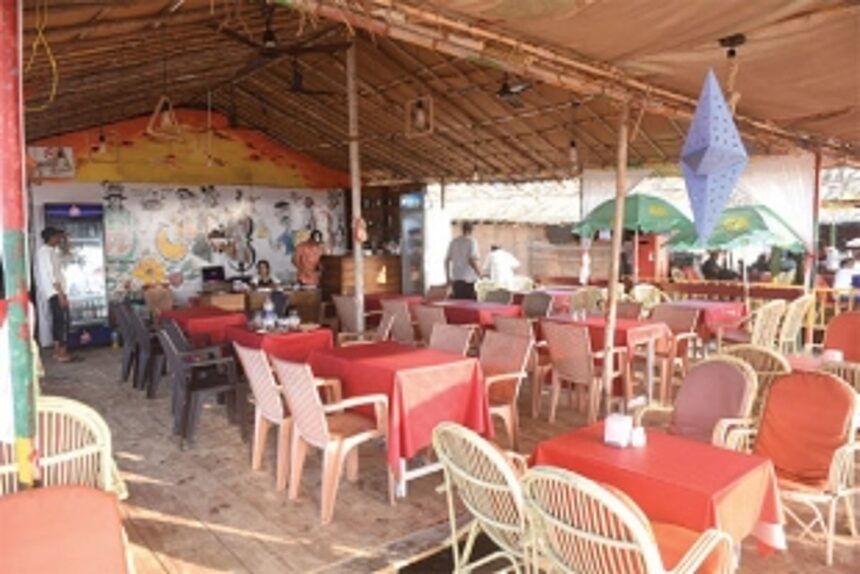
from dining, shacks—temporary structures made from eco-friendly material—also
offer beach beds for lounging.
Jamaica farewell?
Caribbean air has vaporised, as Indo-Russian tourists say ‘Jab we met’
“In past years, Goa’s shacks wore this chilled-out, ‘Caribbean’
air, down to Bob Marley and the Wailers wailing from a mono-tracked sound
system,” remembers Joe Benson of Newcastle. Bob Marley still ‘wails’, but on
Benaulim beach on Saturday, his reggae beats were drowned out by the Bollywood
and Russian fare
blasting out of adjacent shacks.
“It can drive you crazy,” says Michelle Thomas of Surrey, who is
“seriously thinking” of changing her favourite shack next season if things
don’t change.
Recalling that shacks once relied on candles and
generator-supplied electricity, a shack operator in Baga says he has had to
switch to garish neon lighting to attract the changed clientele.
“Russians and Indians are very similar,” opines the shack
operator, wishing not to be named. “They are both loud in their ways and want a
similar type of atmosphere.” He adds his move has also been inspired by the
very low tourist turnout this season.
No
‘familia’: Families no longer run shacks
Then there are the waiters and in some cases the very people who
operate the beach shacks. “When shacks started in Goa in the ‘60s they were run
by families, often those living by the sea. But when the footfalls (of
tourists) increased, others started entering the business. First it was those
from other parts of Goa, then it also became outsiders (from the rest of India and
sometimes even abroad),” says Cruz Cardoso of the Shack Owners Welfare Society.
So
grave was this ‘outside threat’ that the Society tied up, eight years ago, with
the Centre for Responsible Tourism, to draw up its suggestions to the
government for a Beach Shack Policy that would “safeguard the interests of the
local community”. They pitched for the shack licenses to be issued to only
Goans.
“Outsiders can’t give the same hospitality,” says Cardoso who
runs Pearl’s Beach Café at Cavelossim.
On Benaulim beach, an “outsider” who runs a shack—sub-letting of
shacks is a common practice thanks largely to the instant and big money that
can be made by a licence-holder—says respect is what matters the most, “to the
locals, the language and the state”.
The
Maharashtra-native, who’s been a Russian tourist guide in the past, and who’s
been living in Goa for 11 years, says he has taught his staff—about 13 young
men from different parts of the country—how to greet (foreign) guests with a
Namaste, make them comfortable, and how to explain the spices used in Indian
food, which is largely promoted at the shack along with Continental fare.
“There are over 1,500 types of spices and they don’t just add flavor but are
also medicinal and are beneficial for westerners’ digestive systems,” says the
39-year-old. Ask him about serving Goan food and he says, “If a guest asks, we
do have a special cook for Goan food, but a guest can get Goan food in the
village too.”
It’s
not cooking when you ‘also’ get Goan food and the cooks aren’t Goan
Cardoso points out that getting a local Goan cook to work on a
shack is very difficult. “They work for a few years and then go for better
prospects abroad or join ships,” he says. “Even if you train those from other
states to cook Goan food, it does not turn out authentic.” He too has built a
tandoor and has a tandoori chef. “Which is why I’ve changed the shack’s name to
Pearl Beach Café from Pearl Beach Shack,” he says of his 28-year-old
establishment.
For the Gavins and Watchorn, Indian cuisine is what they prefer.
“I’ve tried Goan sausages… Naa! I like the Indian food that I’m used to from
back home,” says Bruce.
Watchorn points out that “in the past you only got little bits
of food in a shack; now you can get almost anything”.
“The chef, Mary, has stayed the same at Bono’s Shack in
Candolim, though the rest of the staff has changed,” says Anne Dennis from
Grimsby, N.E.L., who recently visited her favourite shack after 10 years.
Ask
her to describe the change and she says the staff is now “young boys”, mostly
from other parts of India. “They used to be older before. Goans used to be at
the shack,” says Dennis.
While she hasn’t had much interaction with the new lot, given
that she “now stays in the back of the woods” when she’s in Goa, she recalls the
past waiters as helpful. “They’d put you on the straight and narrow if you
wanted to know anything about Goa,” she says.
Her
husband, Colin, says he’s noticed there are “a lot many more shacks in Goa now” compared to past
years.
Moureen Gavin recalls the waiters at Aggie’s as being friendly
and helpful. “They’d laugh at our jokes,” she says.
Watchorn
has noticed a similar change to Dennis, and feels the new lot of staff work
just as hard as the previous lot. “They really look after us,” says the 67-year-old.
Cardoso points out that
while the shacks of the past were smaller family affairs that needed just a few
hands to serve, today’s shacks are much larger and need at least 15 to 20
staff. “Locals don’t apply even though we advertise, so then you have to take
outsiders,” he says.
Alok Podder a
24-year-old waiter at Rafael’s in Benaulim explains that the number of
outsiders working in shacks is high because those already working there are
able to get relatives or friends from back home whenever hands are needed.
While Podder, a native
of Kolkata, whose family moved to Vasco in 2001, speaks Konkani and can guide
tourists to places to see in Goa, his colleague Praveen Dhek, 33, is from
Uttarakhand and has been working across the northern and southern beaches of
Goa for the last six years. Though very shy, he too “knows Goa”.
The places rattled off are of course the
usual—Old Goa for the churches, Baga-Anjuna for night life, Dudhsagar
waterfalls and Arambol “for peace”. No naval aviation museum in that list.