VELSAO For the last two years, from June 19, 2020, to May 9, 2021, there has been a collective conscience in Goa where people from all backgrounds have relentlessly fought against the railway double-tracking project as they feared it would not only spell destruction to Goa’s precious protected forests but it would also lead to the unthinkable demolition of hundreds of heritage homes along the dreaded railway track.
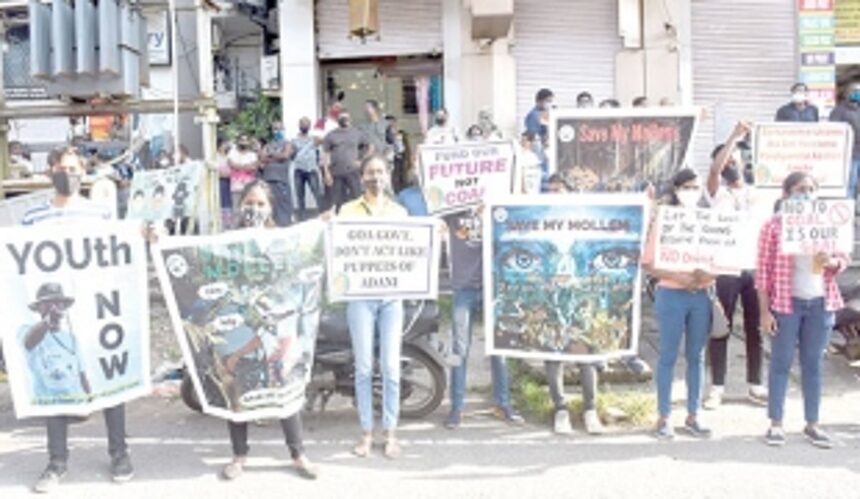
Living in these houses has been a nightmare for the residents but the campaign against the double-tracking project has not been limited just to them but had the overwhelming support from Goans living across the State. Be it holding agitations on the streets, on the railway tracks even at midnight, or walking from Vasco to Mollem, the protestors have done it all to defend Goa’s forests, biodiversity, and lands from being destroyed, converted, and used to provide infrastructure support for a Coal hub that will only benefit other States.

Here’s a look at some of the key milestones in the journey of these double-tracking protests that have gone from strength to strength despite the daunting Covid pandemic and police action
June 19, 2020: Notices were issued by the Mormugao Dy Collector, the Competent Authority stating that 103 survey numbers had been marked for the acquisition of a total area of 60,177 square meters for the special project- namely doubling of Hospet- Hubbali-Tinaighat- Vasco in Goa state’. In this, the coastal stretch of 15,205 square meters of land intended to be acquired from Cansaulim to Issorcim, which has the maximum of heritage homes, fields, and structures, is where the local opposition was most fierce
June 26, 2020: Members of ‘Villagers Action Committee against Doubling of the South Western Railway track’ along with the then Cortalim MLA Alina Saldanha met Chief Minister Pramod Sawant assurances were given that a joint inspection of the track would be held on July 2..
July 1, 2020: Goa cabinet approved procurement of 1,235 square meters of land for Madgaon-Vasco Doubling Project, SWR in Majorda village of land On the same day, locals receive no confirmation about the planned inspection..
July 7, 2020: On the deadline day for receiving responses for the notices issued on June 19, more than 1,500 objections are filed before the office of the Mormugao Dy Collector. Given that this was during the Covid lockdown period, an extension of a few days was granted for any further objections.
July 17, 2020: Goencho Ekvott organizes an awareness programme on Independence Day which gets a tremendous response. At different locations, groups from respective villages, holding placards and banners hold protests near the railway tracks and speak about not only about how their lives will be affected but also heritage homes and a chapel too.
August 15, 2020: Goencho Ekvott organizes an awareness programme on Independence Day which gets a tremendous response. At different locations, groups from respective villages, holding placards and banners hold protests near the railway tracks and speak about not only about how their lives will be affected but also heritage homes and a chapel too
October 2, 2020: On Gandhi Jayanti, a large number of citizens from all walks of life participated in a unique symbolic ‘peace walk’, from Mollem to Vasco. A message was sent that the three linear projects which include the double-tracking would damage Goa’s environment.
October 9, 2020: Locals receive the first lot of notices for personal hearings with regard to the objections they had filed against their land being acquired. A week later on October 16, Goencho Ekvott members write to the Mormugao Dy Collector and ask him to call off the land acquisition process and personal hearings.
October 19, 2020: People’s organizations and politicians descend on the office of the Mormugao Dy Collector. Not a single hearing takes place.
October 27, 2020: Anti-coal protesters led by Goyant Kolsso Naka gather at the level crossing at Sao Jose De Areal at midnight to protest the work of double-tracking. The protestors held candles and continued their protest but the Railways went ahead with the work as planned.
November 2, 2020: Goa witnessed one of its biggest protests that went on for days. The District Magistrate had given permission to SWR to close the level crossing at Chandor between 12 midnight and 5 am to facilitate double-tracking work. However, thousands of people from all age groups gathered at Chandor and blocked the railway tracks despite the prevailing Covid pandemic. Police filed FIRS against the protestors and Goyant Kolsso Naka convenors, which led to a #ArrestMeToo campaign.
November 29, 2020: : Locals from Chandor and Velsao resolve to fight unitedly against the encroachments that were done by the railway authorities. They demand that all the debris that was dumped in private property including that of the church be removed immediately. Concerns were also raised about damage to low-lying areas and water bodies in the vicinity.
December 19, 2020: Youngsters, backed by Amche Mollem group organized a peaceful protest holding black flags on the steps of Panjim Church, on the day the President of India was visiting Goa. young children, many of them without their parents, were forced to enter police buses and were ferried from one police station to another until the functions of the President in the State were concluded.
January, 2021: Youngsters, backed by Amche Mollem group organized a peaceful protest holding black flags on the steps of Panjim Church, on the day the President of India was visiting Goa. young children, many of them without their parents, were forced to enter police buses and were ferried from one police station to another until the functions of the President in the State were concluded.
January 24, 20: The Central Empowered Committee (CEC) concludes its three day visit in Goa and meets NGOs, environmental activists, political leaders and hears their objections to the three linear projects, which includes double tracking. The groups that managed to get an audience with the CEC emphasized that three linear projects should be dropped.
Feb 18, 2021: Chief Minister Pramod Sawant along with the then Cortalim MLA Alina Saldanha inspected the existing railway track to get first hand information on the proximity between the track and the heritage houses of Pale, Velsao and Cansaulim. However, members of the civil society were not invited for the inspection. The then and present environment Minister Nilesh Cabral had also inspected the tracks a couple of months before that. The concerns of the protestors were ignored as the project continued nevertheless much to the dismay of the locals.
April 23, 2021: The CEC that was appointed by the Supreme Court releases its fact-finding reports and gives its recommendations on the three linear projects. Local groups who hailed the recommendations were hopeful that the Supreme Court would decide on the matter quickly and that it would halt the land acquisition proceedings for double-tracking.
May 19, 2021: The Mormugao Dy Collectordisposed off the cases related to land acquisition for double-tracking even though the State was reeling under the impact of Cyclone Tauktae and Covid wave. Litigants were informed less than 24 hours before the hearings were rescheduled and by this time there were around 2,800 objections.
June 2021 to March 2021: On multiple occasions, railway authorities are stopped at various places such as Velsao, Guirdolim, and other places during the work of land surveying of private areas, cutting of trees, and dumping of debris in low-lying fields. The land acquisition officer also disposes of a few appeals that were filed by affected landowners. Goencho Ekvott vowed to fight this in the High Court once the families receive the final order.
April 7, 2022: Supreme Court accepts the recommendations of the Central Empowered Committee. In its report, the CEC raised serious concern over the double-tracking of the railway line from Castle Rock to Kulem stating the project would “destroy the fragile eco-system of the Western Ghats”, recommending the project be scrapped.
April 14, 2022: Four persons of the 5,000 persons who had protested at Chandor in November 2020 were issued summons by the Judicial Magistrate First Class (JMFC) based on the FIRs and chargesheet that were filed by the Railway Police. This led to a wave of support for the four accused who condemned the filing of FIRs. A large number of concerned citizens even showed up for the first hearing that was held on April 16. This hearing was adjourned to June 15
May 9, 2022: Supreme Court accepts the recommendations of the Central Empowered Committee. In its report, the CEC raised serious concern over the double-tracking of the railway line from Castle Rock to Kulem stating the project would “destroy the fragile eco-system of the Western Ghats”, recommending the project be scrapped.