The picture shows in the tributary of Mandovi River, not PVC pipes but areca nut tree poles in Konkani called MADIEO. These are sunk on the half side of the river to cast net and catch fish.
In fishing, business is called fishing stakes and in Konkani called HARRIS – plus one inter-spaces is called one mag in Konkani. Here in the picture shows four interspaces means four mags.
There are also more in numbers sunk according to the breadth of the river. The stakes’ life throughout in the river is one or one and half year. Centuries gone by, this traditional fishing stakes method was cleverly invented by our forefathers under the guidance of the then Portuguese Government during that period when man-made navigational movement was being followed. These fishing stakes were strictly controlled by the then Captain of Ports (department) and the auction of the fishing stakes was held annually.
The main ambitious vision of the Portuguese Government was that the traditional fishing community inhabiting on the river banks should get one by one an opportunity to bid for the auction and earn to fill their stomach without any discrimination. After every three months the Captain of Ports men used to patrol on boats to supervise the fishing stakes development. The Portuguese Government strictly nurtured the Goan rivers and helped the fishermen to earn resource and also gave enough substance for the fishing community.
In fishing stakes business to yield good harvest (catch) first one requires strong pressure of low tide current and continue the operation for two and half or three hours. At that time there was no material in the river which blocked the water flowing pressure. The high and low tide water movement was pure like a crow eye — no threat to the marine life and the riverine ecology; no cry of fishermen’s family about the depletion of fish catch. When fishermen pulled up their nets the baskets were full of catch. The fish catch was then the only available fish in city and local tintos.
After liberation we entered into new democratic era, the traditional fishing community started to decline in their fishing business and non fishing-community like politicians, ministers, MLAs, Sarpanchas and freedom fighters kith and kin entered into the fishing business. There was no regard left for the traditional fishing community. The fishing stakes’ charge was taken by the Director of Fisheries Department for some time and then the All Goa Fishing Stakes was taken over by the society called Akhil Gomantak Harkari Shakari Saunstha Ltd Panjim, Goa, on commission basis. Later it was leased to the holders on permanent basis. However, the rent was exhorbitantly increased without considering the pros and cons of the fishing business.
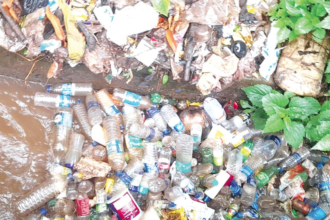
Centuries has gone by, now our rivers have become shallow and there is no strong pressure on the low tide current. Our rivers have become a deadly mixed cocktail of pollution in all respects. Sadly, 20 years have passed since the fishermen family cries about fish famine. When they pull up their net they get waste and plastic bags.
The government failed to assess the damage and the danger to the riverine ecology and has no agenda to save the rivers from pollution when the fishermen’s livelihood keeps going from bad to worse.
Prior to the mining ban, damaged fishing stakes are still lying non operational. Fishermen fear that if they sink new stakes spending thousands rupees they may get run over again. Heavy laden iron ore barges are known to damage fishing stakes, nets and poles in the fishing stakes activities while navigating in the inland water ways channels of Mandovi and Zuari — putting the livelihood of fishermen into serious jeopardy.
Repeated complaints to the ex-Fisheries Minister, the Director of Fisheries, Captain of Ports and even to the Akhil Gomantak Society several times, have fallen on deaf ears and nobody is willing to give a patient ear. Now the mining has re-commenced and the apprehension grows that the mining activity will repeat the same damage to the fishing-stakes. It is learnt that heavy tonnage barges find traditional fishing-stakes in the channels as their main navigational obstruction.
Shortly the nationalisation of rivers for infrastructural development will come up and navigational traffic will increase.What will then be the fate of traditional fishing-stakes?
Is not the way to free the navigational route? The Government has to give help either to the fishing operators or to the barge operators so that each one’s activity is not a source of hindrance to others.