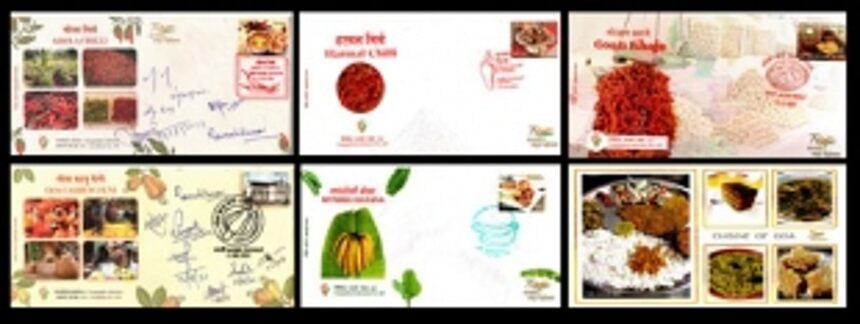
A geographical indication (GI) tag is used for an agricultural, natural or a manufactured product (handicraft and industrial goods) originating from a definite geographical territory. Typically, such a name conveys an assurance of quality and distinctiveness, which is essentially attributable to the place of its origin. In Goa, Feni, Khola Chilli, Harmal Chilli, Myndoli Banana, Goan Khaje have already been allotted the GI tag.
Khola Chilli

The most famous chilli of Goa is the bright red Khola chilli that grows exclusively on the hill slopes of Canacona taluka in the district of South Goa. Also known as Canacona chilli, this variety derives its name from the mountain village, Khola, where it is grown.
According to historians, chillies were introduced in Goa by the Portuguese somewhere in the 1500s. Gradually, chillies came to be named after the place where it was cultivated and graded as per usage, pungency, colour etc. Locals say that their ancestors were the first to produce this particular type of chilli that is used in the preparation of the lip-smacking Goan papads. It is widely believed that this chilli has been cultivated in this village for at least 120 to 150 years if not more.
Canacona chilli cultivators follow the traditional organic practices implemented by their ancestors. This chilli grows well along the slopes of the mountains as well as on the rocky plains of the village. The proximity of the village to the Arabian Sea, well-drained loamy soil rich in iron, manganese and copper and nutrients, low temperature and high humidity prevailing in the month of July and the hot and humid weather conditions during October renders it its distinctive brilliant red colour, pungency and taste.
This chilli is medium pungent in taste, has an attractive red colour and is widely used in the preparation of local delicacies. It has a thick outer smooth skin which enhances its shelf life and reduces breakage. This native chilli is used for edible or food grade red colour because of the high content of the pigment Capsanthin which lends it its bright red colour. Khola chilli is rich in potassium, manganese and magnesium. This indigenous Goan chilli received the Geographical Indication Tag (GI) in 2020.
Goa Cashew Feni
In the traditional method of making cashew feni, only tree-ripened cashew apples that have fallen are picked and taken for the crush. The cashew apples are de-seeded and then dropped into the stomping area. This area is called a collmi and is usually a rock cut into a basin shape. The cashew apples are stomped to release the juice. Stomping has now gradually been replaced by the use of a press called a pingre (cage). The pulp is then hand-patted into small mounds traditionally using a particular vine, nudi, which is snaked around it to hold it together while a heavyweight (typically a boulder) is placed on top. The juice produced through this second extraction process is known as Neero/Niro, and is refreshing to drink; however, it is not used in the fermentation process generally for making feni. The first juice extract, obtained by stomping cashew apples, is transferred traditionally in a large earthen pot called a koddem, which is buried halfway in the ground and left while the juice ferments for several days. Delicate earthen koddem have now been replaced by plastic drums for the sake of practicality. The juice is then allowed to sit for three days as it ferments. No artificial yeast or nutrients are added to hasten the process. Fermented cashew fruit juice being transferred into pots for distillation.
Cashew feni is distilled employing the traditional pot, which is still practiced. A traditional still for feni is still known as a bhatti. The use of an earthen pot as the boiling pot has now been replaced with copper pots, both known by the same name, bhann. The distillate is collected in an earthen pot called a launni. The tradition of cold water being continuously poured on the launni to condense the distillate has now been replaced by immersing a coil in cold water.
Cashew feni is a triple-distilled spirit. The first distillate of the fermented neero is known as Urrak. Urrak is then mixed with neero in a proportion determined by the distiller, and redistilled to give a spirit called cazulo or cajulo. Cazulo or cajulo is again distilled with Urrak to give a high-strength spirit called feni.
Harmal Chilli
The famed Harmal chilli derives its name from the area of cultivation, Harmal which is a coastal village in the Pernem taluka in North Goa. Elders in the village say that this chilli has been grown extensively in the traditional way for about 150 – 200 years. Each and every household is in some way or the other actively involved in the cultivation of this renowned spice. Harmal chilli also known as Harmal Mirsank in the local language was one of the many varieties of chilli introduced by the Portuguese 400 years ago.
Harmal chilli is very unique in size, pungency and colour and has a non-wrinkly skin texture which is attributed to the soil characteristics and hot and humid climatic conditions. The tropical climate with good annual rainfall is very conducive for cultivating this type of chilli as the warm and humid weather is useful during the plantation and growing period and the dry weather is useful during the maturation period. The lateritic soil which is slightly acidic is rich in minerals like iron, manganese and copper which also supports the growth of chilli.
Goan Khaje
Khaje is a sweet confection served at temple zatras and church feasts in Goa. Goan Khaje, a traditional sweet delicacy served during temple Zatra and church feasts, has been granted Geographical Indications (GI) status under the food category class 30.
Myndoli Banana
One of the most exotic fruit crops of Goa is the famous Myndoli banana or Moira banana. Known as Myndoli kellin or Myndoli keli in Konkani, this banana is one of the most popular and tastiest banana found in this region. This native banana is cultivated in Pernem, Bardez and Bicholim talukas in North Goa district. Myndoli banana plantations are generally found in areas along the river tributaries of Chapora and Mapusa rivers which provide the well-drained soil rich in organic matter, iron, manganese and copper.
Myndoli banana is the longest size native banana available in Goa. It has a long shelf life (up to 10 to 12 days), is firm with medium thick skin, lesser seeds and sinfully sweet and therefore used in the preparation of desserts, milkshakes, ice creams and others. A lot of local delicacies like the Myndoli Kelyachi Halwo and others are prepared from this banana. This banana is also steamed, roasted and lightly fried in ghee.
Bebinca
Bebinca’s origins are unclear. The use of egg yolks is typically Portuguese, but the term seems Asian. Historian Fatima da Silva Gracias recounts a story that it was first made by a nun called Bebiana in the Convent of Santa Monica in Old Goa, who baked layers “to symbolise the seven hills of Lisbon and the old city of Goa.”
Bebinca or bebinka, (Konkani; bibik) is a layer cake of Indo-Portuguese cuisine in Goa, India. In traditional baking, Bebinka has between 7 and 16 layers, but bakeries can modify the cake recipe as per convenience and taste. It is especially popular during the Christmas season, but is available all year round due to tourism in Goa. It is also easily available to carry and preserve for a long time or eaten fresh.
The writer is a retired chief scientist, Physical Oceanography Division, National Institute of Oceanography, Dona Paula.)