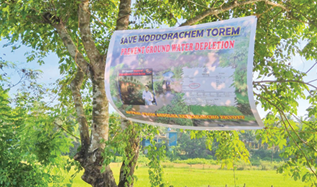
Concerned over drying wells, barren fields and the disappearance of migratory birds, villagers of Assolna have launched the “Save Moddoranchem Torem” campaign to protect their lake and revive farm ing activity around it. The initiative, taken up under the banner of Assolna Xetkaran cho Ekvott, was flagged off at the historic Dr Ram Mano har Lohia–Dr Juliao Menezes Chowk in the village. As part of the movement, the Assolna panchayat’s Village Development Com mittee (VDC) has invited residents to a public meeting on Sunday at 4 pm at the Me nezes Lohia Chowk, Assolna. The discussion will centre on the issue of groundwa ter depletion, with notable speakers expected to share their knowledge and suggest solutions. Organisers said the meeting will also serve as a platform to decide the next steps in protecting the lake. Locals describe Mod doranchem Torem, also known as Bainfol Lake, as the lifeline of Assolna. For generations, it has irrigated paddy fields, replenished village wells and supported rituals and community life, while also serving as a hab itat for fish, birds and oth er species. “When water is stored in the lake, it helps re charge the groundwater. But now, the wells are running dry, the fields are barren, and even migratory birds have stopped visiting,” lamented VDC convenor Nazareth Fer nandes. Farmers allege that while the Water Resources Depart ment (WRD) has been con structing a bundh every year to store water, mischief-mak ers have tampered with the sluice gate, causing water to drain away prematurely. “We’ve had the support of the WRD every year, but just before water can be stored in the lake, mischief-makers release it. This has made it impossible for us to cultivate our fields,” said local farmer Herenico Fernandes. The concern has deep ened further after one ten ant whose field lies in the catchment area petitioned the High Court to stop the natural collection of water, claiming it interfered with his activities. Acting on the plea, the court directed the Sub-Divisional Officer (SDO) and the Zonal Agricultur al Officer (ZAO) to inspect the site and decide whether the lake is still required by downstream farmers. Villag ers fear that if it is deemed “not useful,” the lake’s very existence could be erased. Recalling the past, villager John Viegas said the three lakes at Banda, Assolna and Velim once supported two crop cycles annually for their ancestors. “These wa ter bodies kept the ground water steady, ensured the wells never ran dry and even allowed freshwater fish farming. Now, the migratory birds have stopped coming — there’s simply no water left,” he said. Organisers of the cam paign stressed that the stakes go beyond agriculture. They point out that losing Mod doranchem Torem will wors en Goa’s groundwater crisis, already acknowledged by the Chief Minister. They are urging villagers to document their dependence on the lake, speak to their elected representatives, and spread awareness to strengthen the case before the SDO and ZAO. “Moddoranchem Torem is not just a water body — it is our heritage, our livelihood, and our future. Let us unite to protect our lake before it is lost forever,” the organis ers said in their appeal.
Assolna Villagers Launch ‘Save Moddoranchem Torem’ Campaign to Protect Lake and Revive Farming