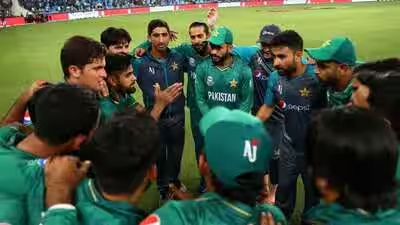
Former Pakistan cricketer Mohammad Yousuf has linked the country’s ongoing cricket crisis to its famous 10-wicket victory over India at the 2021 T20 World Cup in Dubai. According to Yousuf, the historic win brought a change in the mindset of Pakistan’s players, with some becoming overly confident instead of using the victory as a platform for further improvement.
Pakistan had never defeated India in a World Cup before that encounter. Led by Babar Azam’s unbeaten 68 and Mohammad Rizwan’s 79 not out, Pakistan chased down India’s target of 152 without losing a wicket. The result was celebrated as a landmark moment in Pakistan cricket.

However, Yousuf believes the victory ultimately had a negative impact on the team’s attitude.
‘That match damaged us a lot’
Speaking on Samaa TV, Yousuf said the win against India made some players believe they had already achieved something significant.
He argued that players should remain humble when performing well and continue working towards improvement rather than becoming complacent.
Yousuf suggested that the change in attitude contributed to several problems that later emerged within Pakistan cricket.
He also pointed to internal competition for leadership as another major concern. According to the former batter, too many players became focused on becoming Pakistan’s captain instead of taking responsibility for their individual performances.
“Everyone in the team was trying to become the captain of the Pakistan team,” Yousuf said, adding that the consequences of that mindset were still affecting Pakistan cricket.
Leadership concerns and poor performances
Yousuf criticised Pakistan’s performances across major international tournaments over the past four to five years. He said the team had struggled in ODI and T20 World Cups, Asia Cups and the Champions Trophy despite continued efforts by the Pakistan Cricket Board to improve the side.
He also highlighted the frequent changes in the coaching setup, saying several coaches had come and gone in an attempt to find solutions.
For Yousuf, however, the biggest issue was the lack of accountability among players. He said no player had consistently stepped forward and taken responsibility for the team’s performances.
He backed the PCB’s decision to intervene during the ongoing England tour, arguing that the board had to act because Pakistan’s reputation was being affected by the team’s results.
Pakistan’s England struggles
Yousuf’s comments came as Pakistan endured a difficult Test series in England. Pakistan lost the Headingley Test by an innings and 103 runs before suffering another heavy defeat at Lord’s, where England won by 194 runs.
The PCB subsequently made significant changes to the touring squad. Seven players — Mohammad Rizwan, Imam-ul-Haq, Salman Ali Agha, Ali Usman, Khurram Shahzad, Aamir Jamal and Muhammad Awais Jafar — were sent back to Pakistan with one Test still remaining in the series.
The board also removed head coach Sarfaraz Ahmed and assistant coach Umar Gul, while calling up seven replacements, including five uncapped players.
The decision to make such major changes during a Test series attracted considerable attention. Yousuf, however, said he did not believe the timing was a problem.
He pointed out that Pakistan were ninth in the World Test Championship standings, noting that the team needed to take corrective measures as its international reputation was being damaged.
Yousuf also suggested that developments inside the dressing room may have contributed to the decision to send the seven players home.
‘It’s not just this one series’
Yousuf stressed that Pakistan’s problems cannot be attributed solely to the England series.
He noted that Pakistan had reached the T20 World Cup final in 2022 and an Asia Cup final, but argued that performances had deteriorated after those appearances.
Pakistan have also struggled against Bangladesh in recent years. Their defeats across formats have added to concerns surrounding the team’s leadership, selection policies and overall direction.
For Yousuf, the central issue remains the mindset that developed after Pakistan’s historic win over India in Dubai.
The former Pakistan star believes that instead of treating the victory as the beginning of a stronger era, players allowed it to become a source of excessive confidence. In his assessment, the subsequent decline has exposed deeper problems within the team’s culture and accountability.
Pakistan’s current crisis, therefore, according to Yousuf, is not the result of one poor series or one isolated decision. It is the culmination of several years of inconsistent performances, leadership battles, coaching changes and an inability to build sustained momentum after major victories.