The Divine Shield of Goa: A Miracle in 1961
In the shadowed twilight of Portuguese dominion over Goa in 1961, as the final hours of colonial rule ticked inexorably toward their end, according to legend, a transcendent event unfolded, one that countless Goans revere as the divine hand that averted utter annihilation of their cherished homeland.

Filomeno Diogo Jacinto da Silva, a gifted violinist drawn into the Portuguese military in 1958 by his innate musical talent, offers an intimate eyewitness testament to Goa’s salvation during the 1961 liberation. Blessed with a natural aptitude for playing the violin, he journeyed to Portugal in 1959 for Sergeant Militian training, returning to Goa in 1960. From October 17, 1961, he served at Emmisora do Goa, later integrated into All India Radio (AIR), until his retirement in 1993.
The Gathering Storm and Sacred Command
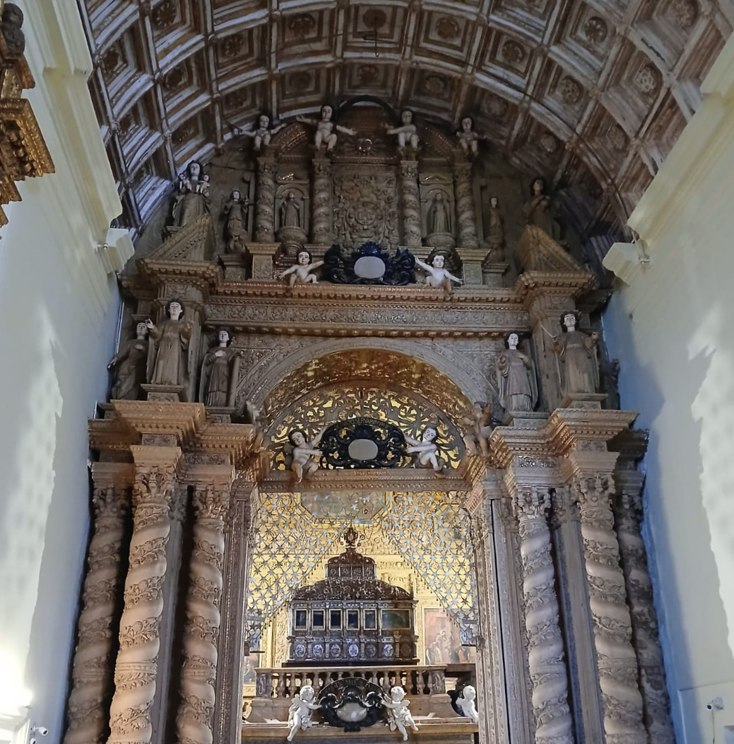
As the Indian Army breached Goa’s borders on December 18, 1961, Diogo Jacinto da Silva was mobilized as a reservist to safeguard the territory. Foreseeing the inevitability of Indian triumph, Portuguese authorities dispatched 100 soldiers to the Basilica de Bom Jesus with a solemn mission: to take away the casket enshrining the sacred relics of St. Francis Xavier and secure it aboard the last flight out of Goa, a special aircraft dispatched from Portugal, piloted by Solome de Almeida.
The grim decree from Lisbon was clear: once the relics were relocated, the city of Goa, the resplendent original Portuguese capital, would face obliteration, its magnificence and glory consigned to ashes.
The Unyielding Casket: A Celestial Standstill
Within the sealed sanctum of the Basilica, amid the grave assembly of the Bishop, the Governor, and the Secretary, the 100 soldiers strained in unison to lift the casket bearing St. Francis Xavier’s sacred relics. Yet, to profound astonishment, it remained immovable, an impenetrable force anchoring it in place, defying all human might. This inexplicable occurrence, etched in collective memory as a profound miracle, reshaped the destiny that loomed.
Salazar’s Shadow Lifted by Saintly Grace Confronted by this awe-inspiring phenomenon, the Governor, who bore explicit orders from Salazar to raze Goa, found his resolve shattered. To unleash destruction would profane the sacred relics of St. Francis Xavier, the eternal Patron Saint of Goa and Defender of the East. In this luminous intervention, many believe that the saint himself interceded, shielding the city from ruin as the Portuguese withdrew in 1961, preserving its timeless splendor for generations
The popular narrative, built largely on personal recollections such as those of Filomeno Diogo Jacinto da Silva, recounts a moment of divine intervention in which Portuguese soldiers were mysteriously unable to lift the casket containing the relics of St Francis Xavier. According to this version, the inexplicable immobility of the casket prevented the relics from being taken to Lisbon and, in doing so, safeguarded Goa from possible devastation.
The historical record, however, tells a different story. Goa’s last Portuguese Governor General, Manuel António Vassalo e Silva, in fact defied direct orders from Prime Minister António Salazar to transport the relics to Portugal. His refusal stemmed from concerns over the “adverse reaction from Goan Catholics” and his recognition of the relics as a vital “moral patrimony” for Portuguese India, an emblem around which the local population could unite in moments of crisis. His decision was rooted in political and administrative calculation, not any supernatural obstacle.
As recorded by historian Vasco Pinho, Vassalo e Silva justified his defiance by stressing that the relics were a moral treasure of the Portuguese Estado da Índia, around which the people would rally in the perilous days he believed were imminent. He insisted that St Francis Xavier, revered as the Saint of the East, rightfully belonged in Goa, and therefore he could not comply with the order.
In Snapshots of Indo-Portuguese History–II, Pinho also points out that this was just one of three directives from Salazar that Vassalo e Silva intentionally ignored. Jesuit scholar Delio de Mendonca similarly observed that the governor general rejected Salazar’s instructions because he feared a strong negative reaction from Goan Catholics.
Moreover, there are no official Portuguese military or Church documents from the period that describe a physical or unexplained failure, even by a hundred soldiers to move the casket.
Adding further context, the relics were already on display because the Portuguese authorities had hurriedly organised an exposition in mid-December 1961 (beginning December 13), seeking the saint’s intercession to preserve the existing political order. Attendance was restricted to civil and military officials. When the Indian Army entered Goa on December 18, the exposition ended abruptly, and the relics were simply restored to their usual location. They were not immobilised during any attempt to transport them.
Despite the lack of documentary evidence, the story mentioned above, remains a deeply resonant expression of faith and identity for many Goans, symbolising the fusion of religious devotion and a pivotal historical moment. Historians, however, regard it as a legend rather than a verified event.